深圳溯源
无法加载取货服务可用情况
衣服尺寸:
胸围/腰围/臀围/衣长:94/80/98/98 厘米
细节描述:
【器物考据:繁花织就的东方幻梦】
展现在我们面前的这件旗袍,绝非寻常织物,而是一场关于色彩与光影的精密叙事。
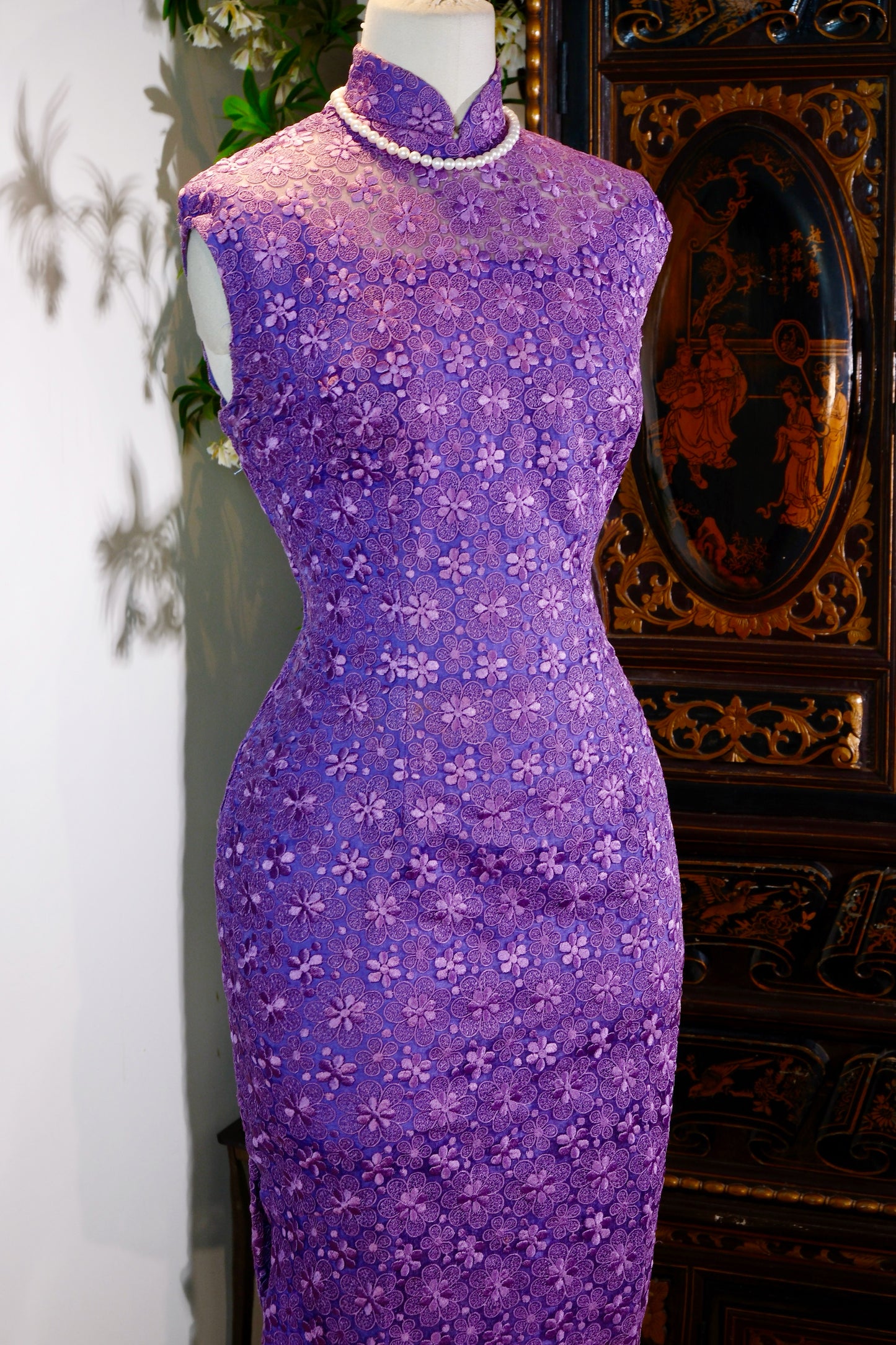
- 面料肌理: 此衣采用极为罕见的全幅立体刺绣蕾丝(All-over Embroidered Lace)作为主面料。不同于普通印花,这种工艺要求工匠在网眼底布上,以丝线层层堆叠出花卉的轮廓与脉络。
- 图案解构: 细观其纹样,并非传统中式牡丹或梅兰竹菊,而是呈现出一种高度几何化、秩序化的五瓣花阵列。这种图案带有浓郁的1960年代欧洲装饰艺术风格——花朵大小均等,排列如棋盘般严谨,却在视觉上营造出一种类似万花筒般的迷幻美感。
- 色彩美学: 紫色在中国传统色谱中地位微妙,既有“紫气东来”的尊贵,又因难以印染而显得神秘。这件旗袍的紫,是一种深邃的蓝紫底色上覆盖着浅紫丁香色的浮雕感花纹。光线穿透时,底色的冷艳与表层的温润相互交织,宛如暮色四合时的紫藤萝架,既有法式的浪漫慵懒,又不失东方的含蓄深沉。
- 剪裁细节: 经典的高领无袖(Sleeveless High-collar)设计,精准地修饰了肩颈线条。特别是领口处的挖空与珍珠项链的搭配,是六十年代上海与台北名媛圈极为推崇的“中西合璧”穿法——用西方的珠宝点缀东方的领口,打破了立领的沉闷,增添了呼吸感。
【历史钩沉:海峡对岸的西风东渐】
彼时,随着政治中心的南移,大量江浙沪的裁缝师傅随国民政府迁台,将海派旗袍的精湛技艺带到了台北。与此同时,台湾正处于轻工业起飞的前夜,纺织业开始承接欧美的订单与技术。
这件旗袍正是那个时代的缩影:它拥有最传统的东方骨架(旗袍形制),却披上了最时髦的西方皮肤(法国蕾丝)。
在那个年代,能穿上一件由法国进口面料、经由台北名师之手缝制的蕾丝旗袍,是身份与品味的极致象征。它不仅仅是一件衣服,更是当时台湾上流社会女性对于“现代性”的一种渴望与表达。她们穿着它出入于圆山大饭店的舞会,或是牯岭街的文艺沙龙,它是那个动荡年代里,女性对于美与优雅的最后坚守。
【学术视野:稀缺性与艺术价值】
在服装史的维度上,这件作品具有极高的标本价值。
张爱玲曾在《更衣记》中写道:“对于不会说话的人,衣服是一种语言,随身带着的是袖珍戏剧。”这件旗袍,就是一出无声的戏剧。
1. 材质的不可再生性: 六十年代的法国蕾丝多采用人造丝或早期尼龙混纺,那种特有的光泽感和挺括度,是现代化纤无法复刻的。加之全幅刺绣极其耗时,当时的产量本就极低,能完好保存至今且无氧化发黄者,实属凤毛麟角。
2. 风格的断代史: 它处于旗袍从“繁复装饰”向“极简线条”过渡的晚期阶段。它保留了立领的庄重,但通过大面积的透视蕾丝,大胆地引入了西方的性感观念。这种“透而不露,艳而不俗”的分寸感,正是古董衣区别于现代仿制品的灵魂所在。
结语:
这件紫色的蕾丝旗袍,不仅是一件御寒蔽体的衣物,更是一段被封存的时光。它见证了东西方审美在太平洋西岸的一次完美邂逅。收藏它,便是收藏了一段关于优雅、关于匠心、关于那个远去时代的绮丽旧梦。
Measurements / Size Guide:
Bust / Waist / Hips / Total Length: 94/80/98/98 cm
Detailed Description:
The qipao presented before us is by no means an ordinary textile, but a precise narrative composed of color, light, and shadow.
Fabric Texture: This garment implements an exceptionally rare All-over Embroidered Lace (全幅立体刺绣蕾丝) as its primary substrate. Diverging from standard flat printing, this labor-intensive process required artisans to build contours and veins of floral motifs through layers of dense silk thread stitched atop a delicate mesh base fabric.
Motif Deconstruction: A close inspection of the pattern reveals that it eschews traditional Chinese motifs like peonies or the "Four Gentlemen" (plum, orchid, bamboo, chrysanthemum) in favor of a highly geometric, ordered array of five-petaled flowers. This layout carries a strong flavor of 1960s European decorative art—the blossoms are uniform in size and arranged with the rigorous precision of a chessboard, yet visually they orchestrate a mesmerizing, kaleidoscope-like optical beauty.
Color Aesthetics: Purple occupies a highly nuanced position in traditional Chinese color charts; it commands the sovereign nobility of "the purple aura coming from the east" (ziqi donglai), yet remains fundamentally mysterious due to the historical difficulty of its extraction and dyeing. The purple of this qipao features a deep, melancholic blue-violet base cloaked in relief-like floral patterns of pale lilac. When light filters through the textile, the cold elegance of the background layer interweaves with the warm tenderness of the surface, mimicking a wisteria trellis at dusk—capturing French romantic nonchalance without sacrificing Eastern, quiet depth.
Tailoring Details: The classic Sleeveless High-collar (高领无袖) design mathematically refines the line of the neck and shoulders. In particular, the delicate cutout at the collar paired with a pearl necklace reflects the signature "East meets West" styling highly celebrated among elite socialites in mid-century Shanghai and Taipei—using Western jewelry to punctuate an Eastern neckline, breaking up the severity of the standing collar and introducing an exquisite sense of respiration.
During this unique historical window, following the southward relocation of the political center, a vast contingent of elite master tailors from Jiangsu, Zhejiang, and Shanghai migrated to Taiwan, transplanting the absolute pinnacle of Haipai (Shanghai-style) qipao craftsmanship into Taipei. Concurrently, Taiwan stood on the absolute eve of its light industry takeoff, with its textile sector actively absorbing Western export contracts and engineering techniques.
This qipao stands as a definitive epitome of that era: it possesses the most traditional Eastern skeleton (the structural qipao silhouette) yet is draped in the most fashionable Western skin (imported French lace).
In that decade, donning a custom lace qipao stitched by a Taipei master utilizing premium fabric imported from France represented the ultimate hallmark of social status and refined taste. It transcended its utilitarian identity as clothing to exist as a physical manifestation of the Taiwanese upper-class female desire for, and expression of, "modernity." They wore these garments to high society galas at the Grand Hotel (圆山大饭店) or literary salons along Guling Street; it was the final, elegant bastion of femininity amidst a highly turbulent era.
Within the rigorous timeline of dress history, this specific archival piece holds immense value as a material specimen.
Eileen Chang profoundly observed in Reflections on Clothing (Geng Yi Ji): "For those who cannot speak, clothes are a language, a pocket theater carried upon the body." This qipao operates as precisely such a silent drama.
The Irreproducible Nature of Materials: 1960s French lace was frequently woven from vintage rayon or early nylon blends. The unique, dignified luster and crisp structural hand-feel generated by these mid-century fibers are completely impossible for modern synthetic chemical fibers to replicate. Furthermore, because all-over embroidery was exceptionally time-consuming, the original production volume was naturally minuscule. That a piece has survived into the present day in pristine condition, entirely free of structural oxidation or yellowing, makes it an absolute anomaly.
A Chronological Benchmark of Style: This garment captures the late transitional phase of the qipao as it evolved from "complex surface ornamentation" toward "minimalist structural lines." While it strictly preserves the formal decorum of the standing collar, it boldly introduces Western concepts of sensuality through its expansive, semi-transparent lace overlay. This masterful control of boundaries—being "translucent without being exposed, and vibrant without being vulgar"—is the very soul that distinguishes an authentic antique garment from modern factory reproductions.
This purple lace qipao is far more than a simple garment meant to shield the body from the elements; it is a beautifully sealed capsule of time. It stands as physical evidence of a flawless aesthetic encounter between East and West on the western shores of the Pacific. To steward this piece is to preserve a tangible segment of elegance, master craftsmanship, and the splendid, distant dream of a bygone golden era.