深圳溯源
无法加载取货服务可用情况
衣服尺寸:
胸围/腰围/臀围/衣长:80/66/86/84 厘米
细节描述:
【器物之诗:繁花似锦的东方绮梦】
这件旗袍,是一首穿在身上的五十年代香江旧梦。
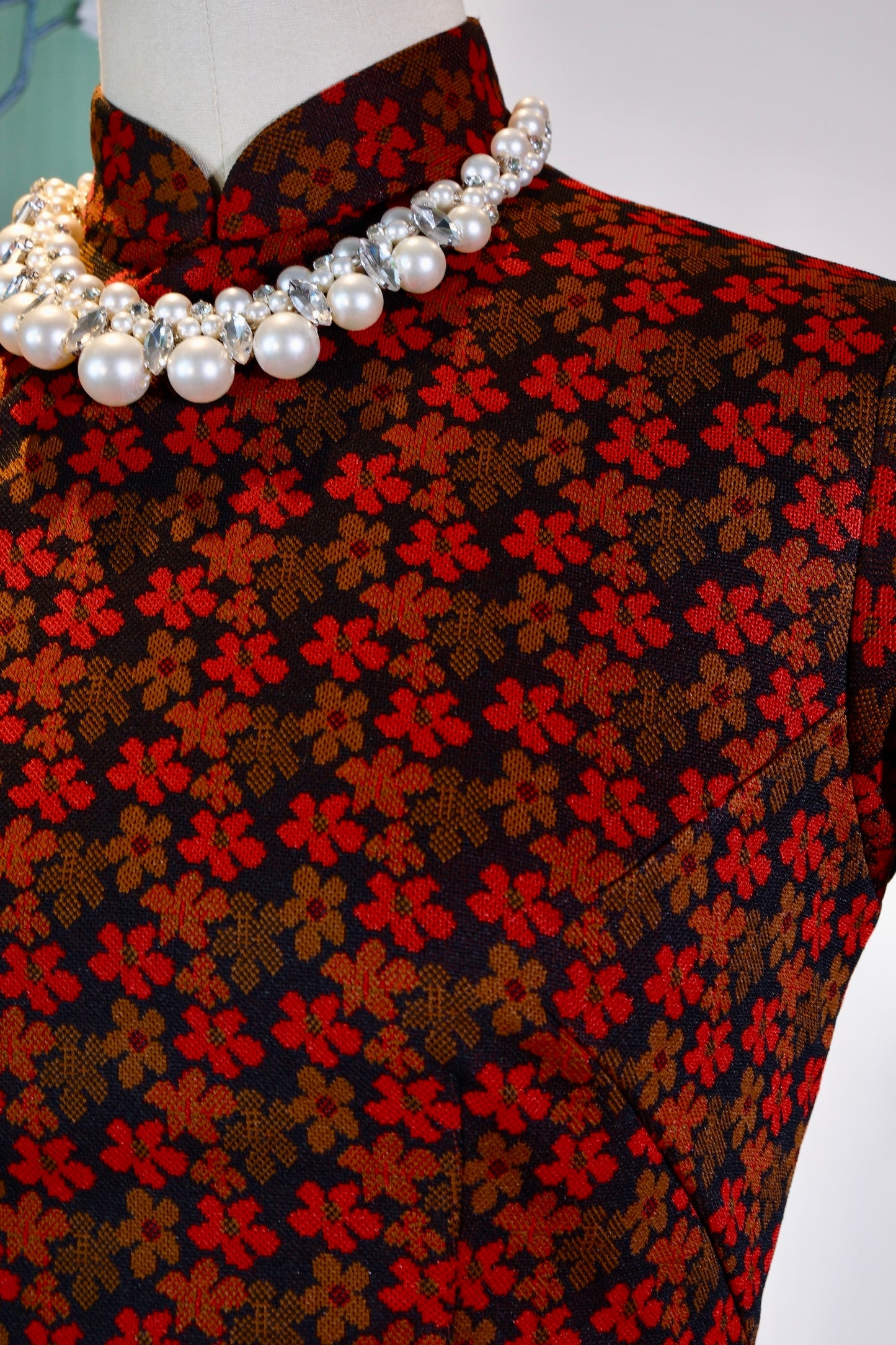
观其纹样,乃是典型的“满地碎花”织锦工艺。不同于苏绣的温婉写意,这种源自南洋与港粤交界处的织锦风格,更具一种热烈而摩登的生命力。底色选用深邃沉稳的玄黑或藏青,宛如静谧夜空,其上密布着朱砂红与古铜金交织的四瓣花卉。这些花朵并非孤立的静止,而是呈现出一种“落花流水”般的动态韵律,仿佛春风拂过,落英缤纷。
从服饰史的角度审视,这种高密度的几何化花卉排列,深受当时西方Art Deco(装饰艺术)风格的影响,却又保留了中国传统“图必有意,意必吉祥”的审美内核。红与金的配色,在暗色底布的衬托下,既有《红楼梦》中“软烟罗”般的富贵气象,又不失现代都市女性的干练与利落。面料表面泛着的微微珠光,是那个年代特有的 rayon(人造丝)与棉混纺或早期尼龙混纺的质感,它记录了纺织工业在战后复苏时期的技术印记。
【岁月之痕:香江裁缝的黄金时代】
若要追溯这件衣裳的身世,我们必须将目光投向二十世纪五十年代的香港。
那是张爱玲笔下“倾城之恋”余温尚存的时代,也是上海裁缝师傅大规模南下香江的时期。他们带来了精湛的“海派”立体剪裁技艺,与香港本地的实用主义相融合,催生了旗袍历史上最辉煌的“黄金十年”。
这件旗袍的剪裁,便是这一历史时刻的见证。请看其领口,采用了经典的“元宝领”变体,高度适中,既护住了颈项的优雅,又不至于禁锢呼吸;肩部的线条处理极其考究,运用了“归拔”工艺(即通过高温熨烫使平面布料产生立体弧度),使得衣身如第二层肌肤般贴合人体曲线。这种对女性S型曲线的极致追求,正是五十年代旗袍区别于清代直筒袍服的最大特征。
它不仅仅是一件衣服,它是那个动荡年代里,流离失所的人们对美好生活的一种顽强坚守。在那个物质尚不丰裕的岁月里,拥有一件如此花色繁复、做工精良的织锦旗袍,往往意味着穿着者非富即贵,或许是一位穿梭于中环写字楼的职场先锋,或许是一位出席晚宴的名媛淑女。
【文心雕龙:稀缺的艺术孤品】
古人云:“锦衣雪华玉颜色,回眸一笑百媚生。” 白居易在《长恨歌》中虽写的是唐时风华,但这件五十年代的织锦旗袍,却以一种更为世俗、更为鲜活的方式,延续了这份东方美学。
它的稀缺性,在于“不可复制的时间成本”。
这种老式提花织锦面料,随着当年纺织厂的更迭,早已停产。如今市面上的仿古面料,往往失之于“贼光”,唯有这种经过七十年岁月氧化后的哑光质感,才显得温润如玉,正如明人张岱所言:“人无癖不可与交,以其无深情也;人无疵不可与交,以其无真气也。”这衣服上的每一处细微的磨损,都是时间的包浆,是真气的所在。
收藏这样一件古董衣,并非为了将其束之高阁,而是为了触摸那段历史。它是连接过去与现在的纽带,让我们在抚摸那冰凉而顺滑的织锦时,能听见半个多世纪前,高跟鞋敲击在石板路上的清脆回响。
此衣,可遇而不可求。它不仅属于服装史的博物馆,更属于懂得欣赏那份“旧时光里的美人骨”的知音。
Measurements / Size Guide:
Bust / Waist / Hips / Total Length: 80/66/86/84 cm
Detailed Description:
This garment is a wearable poem, preserving a mid-century dream of Victoria Harbour.
Its visual structure features an all-over micro-floral (mandi sui hua) brocade technique. Departing from the soft, painterly strokes of Su embroidery, this brocade style—rooted along the trade corridors between the Lingnan region and Southeast Asia—radiates a vibrant, modern energy. Set against a deep, twilight background of jet black or dark navy, dense clusters of four-petaled blossoms interweave in cinnabar red and antique bronze gold. Rather than static motifs, the blooms flow across the surface with the dynamic rhythm of falling petals on running water (luohua liushui).
From an apparel history perspective, this high-density, semi-geometric floral layout reflects the clear influence of Western Art Deco abstraction, while retaining the foundational Chinese design principle that "every pattern conveys a meaning, and every meaning portends good fortune" (tu bi you yi, yi bi jijiang). The red-and-gold palette against a dark ground projects an aura of restrained affluence, balanced by the sharp, functional lines favored by mid-century urban women. The subtle iridescent sheen across the surface originates from period-specific textile blends—early rayon combined with cotton or early nylon—capturing a physical record of post-war textile manufacturing.
Tracing the lineage of this garment brings us directly into 1950s Hong Kong—an era marked by the convergence of Shanghai master tailors migrating south to Victoria Harbour. Fusing traditional Shanghai-style (Haipai) three-dimensional pattern-making with local practicality, these craftsmen birthed what is widely considered the "Golden Decade" of qipao history.
The tailoring of this piece stands as a direct witness to that historical moment:
Neckline Construction: It features a refined variation of the classic ingot collar (yuanbao ling), cut to a moderate height that frames the neck gracefully without restricting movement.
Shoulder & Waist Sculpting: The shoulder lines utilize specialized heat-shaping methods (guiba—manipulating fabric volume and curve through calibrated iron heat and moisture) to contour the textile like a second skin. This commitment to defining the body's natural curve marks the fundamental departure of the 1950s qipao from the loose, straight-cut robe silhouettes of the Qing dynasty.
During a decade of post-war recovery, owning a densely patterned, finely tailored brocade qipao signaled status and taste—worn with equal composure by corporate professionals in Central offices and socialites attending formal evening gatherings.
Classical literature frequently celebrates garments as living expressions of identity. The archival value of this 1950s brocade qipao rests on its irreversible historical context and material obsolescence.
Discontinued Textile Formulas: Vintage jacquard brocades of this blend and density went out of production as mid-century textile mills modernized their equipment. Modern reproduction textiles often exhibit a harsh synthetic glare (zeiguang), lacking the soft, jade-like luster produced by seven decades of natural silk and rayon oxidation.
Patina as Historic Evidence: The minor surface wear acquired across seventy years constitutes a natural patina (baojiang)—a physical record of authentic use that digital printing or modern weaving cannot replicate.
This 1950s brocade qipao is far more than an item of apparel; it is a tangible bridge across decades. Touching the cool, smooth surface of its brocade, one almost hears the crisp cadence of high heels echoing down mid-century stone steps—a quiet testament to the enduring grace of an irreplaceable golden era.