深圳溯源
无法加载取货服务可用情况
衣服尺寸:
胸围/腰围/臀围:80/60/88 厘米
衣长:135 厘米
细节描述:
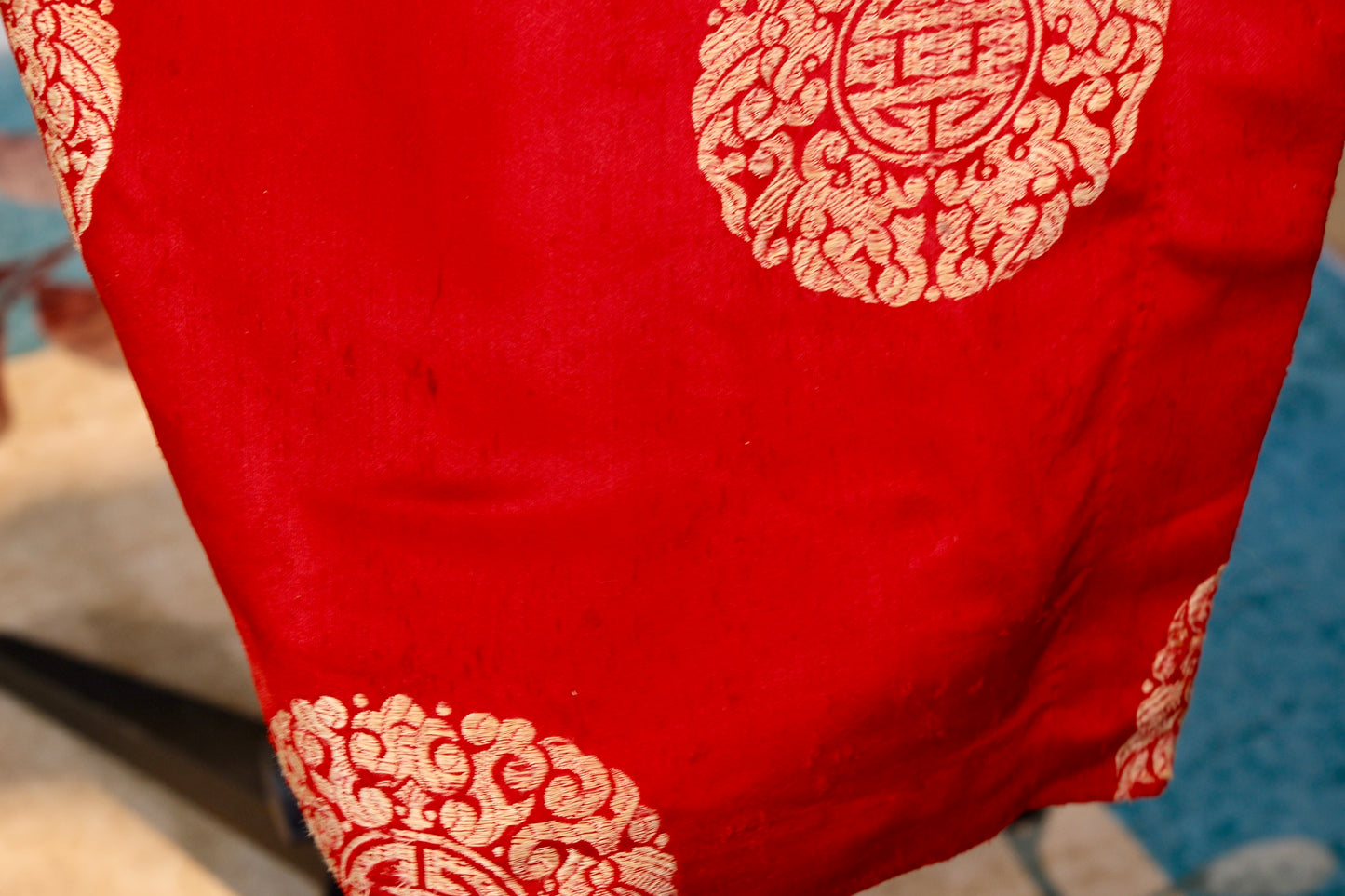
这是一件上世纪六十年代香港产织锦缎古董旗袍,以正红为底、金线团花为饰,其形制与纹样皆承载着特定时代审美与文化寓意。
图案解析:团花藏吉,经纬含情
旗袍通体布满圆形团花纹样,中心为“囍”字变体,外绕缠枝莲或卷草纹,构成“福寿双全”之象。此纹样源于明清宫廷织绣传统,至民国时期被广泛应用于婚嫁礼服,象征喜庆圆满。红色底料选用高密度真丝织锦缎,光泽内敛而肌理丰盈,金线提花在光线下随角度流转,如珠玉生辉,尽显东方织造之精妙。
历史语境:港风西韵,衣冠承脉
六十年代的香港,是中西文化交汇的前沿。彼时旗袍虽受西方剪裁影响,出现收腰、开衩等改良设计,但核心仍坚守传统形制——立领、斜襟无一不备。此件旗袍正是这一过渡时期的典型代表:它既保留了清代旗装的庄重骨架,又融入了现代女性对曲线美的追求,堪称“穿在身上的时代档案”。
稀缺价值:孤品难寻,文脉可触
如今市面所见多为仿制品或后期复刻,真正保存完好、原色未褪、针脚细密的六十年代原版织锦缎旗袍极为罕见。其面料因年代久远易脆化,能完整留存至今者,往往出自大户人家珍藏或专业收藏机构。这件旗袍不仅是一件衣物,更是一段流动的历史——它见证了那个年代女性在传统与现代之间寻找自我表达的挣扎与优雅。
若将其置于博物馆展柜之中,旁注:“1960s Hong Kong Brocade Qipao, Symbol of Cultural Fusion & Feminine Grace”,足令观者驻足良久。它不是简单的复古潮流,而是活着的文化遗产,值得被郑重对待、细细品读。
注释:瑕疵特价
Measurements / Size Guide:
Bust / Waist / Hips: 80/60/88 cm
Total Length: 135 cm
Detailed Description:
Within the technical domains of textile conservation, structural design history, and material culture analysis, an exceptional historical garment functions as an active social text. It documents a precise intersection of ancestral handcraft and localized modernization.
This magnificent 1960s Hong Kong-produced roundel motif silk brocade qipao (正红底金线团花纹织锦缎旗袍) stands as a pristine physical testament to that rare mid-century golden era. It materializes a complex sartorial dialogue where traditional mainland loom-work converges with Westernized, highly disciplined pattern architecture. For curators, textile historians, and institutional archives, this specimen preserves a critical chapter in the evolution of the iconic Hong Kong silhouette.
The pattern drafting of this qipao represents an advanced calibration of structural symmetry and tailored tension, separating true master-tailored commissions from commercial period mass production.
The 1960s Hong Kong qipao chassis utilizes a moderate Mandarin collar with a stiffened structural core to ensure an unyielding vertical posture. This architectural foundation breaks into a classic, continuous diagonal lapel (斜襟) along the upper torso, sweeping smoothly into a highly articulated waist and hip field shaped by rigorous internal bust and waist darting. The bodice flows cleanly into a structured, mid-length columnar hem flanked by precise lateral side slits (开衩), balancing modern mobility against the firm tension of the heavy silk brocade weave.
The Integration of West and East: By abandoning the loose, flat, two-dimensional construction of early mainland garment cutting, this piece utilizes sophisticated dart manipulation. This creates a highly dimensional silhouette that sculpts to the body like a second skin, eliminating fabric buckling while maintaining the solemn, historical skeleton (庄重骨架) inherited from early traditional forms.
Anatomical Expression: The high, structured collar combined with calculated torso compression serves to elongate the wearer's posture, projecting a poised, independent modern elegance that mirrored the rising confidence of post-war Hong Kong women.
The visual and material character of this artifact depends heavily on its high-spec textile foundation: a high-density, structural jacquard silk brocade (提花织锦缎) utilizing complex metallic thread integration.
The Chromatic Ground: The primary color field consists of a vibrant, deeply saturated celebratory red base. Far from catching light in cheap, scattered reflections, the high-density warp threads absorb and roll ambient illumination across the garment’s curves in deep, low-refraction crimson waves, imbuing the piece with authoritative, ceremonial weight.
The Roundel Matrix and "Double Happiness" Cryptography: The surface iconography features a structured grid of woven roundel motifs (团花纹样). Under micro-lens evaluation, each symmetrical circle reveals an intricate double happiness glyph (“囍”字变体) at its epicenter, encircled by tightly woven, continuous scrolling lotuses and foliage (缠枝莲与卷草纹). The gold-wrapped threads are woven with variable tension, causing the roundels to catch light dynamically as the wearer shifts angles, creating a low-relief, three-dimensional sculptural effect.
Cultural Metaphors: This specific design layout traces its lineage directly back to the imperial weaving workshop traditions of the Ming and Qing courts, which later transitioned into the foundational visual vocabulary for elite bridal and celebratory attire during the Republican era, symbolizing complete marital harmony and long-lasting prosperity.
To appreciate the rarity of this qipao is to understand the socio-industrial topography of 1960s Hong Kong—a unique historical enclave where traditional mainland tailoring met a rapidly modernizing global market.
The Ateliers of Migrant Master Tailors: Following the geopolitical transformations on the mainland during the mid-century period, elite master tailors from Shanghai migrated to Hong Kong, establishing small, highly exclusive ateliers. This qipao is a direct relic of that migratory genius. It showcases rigorous hand-finishing, microscopic hand-stitching passes, and specialized iron-blocking passes used to sculpt two-dimensional silk curves into a permanent, three-dimensional form.
The Architecture of Identity: This garment serves as a living archive of mid-century transformation. In the 1960s, Hong Kong's fast-paced urban lifestyle prompted the classic qipao to adopt Western-influenced structural lines to project glamour and mobility. However, due to the high vulnerability of vintage silk brocades to fiber embrittlement, oxidation, and structural tearing over a sixty-year horizon, authentic原版 specimens preserved in this unblemished state are incredibly rare—typically retrieved exclusively from prominent family heirloom chests or specialized institutional collections.
When evaluated against modern reproductions or mass-market variants, this 1960s authentic specimen demonstrates absolute irreproducibility:
| Curatorial Metric | Authentic 1960s Antique Specimen | Modern Commercial Reproduction |
| Material Base | High-density natural silk/rayon mixed jacquard brocade; rich, warm tactile profile with low-luster reflection. | Low-density synthetic polyester or nylon weaves; cold tactile feedback with synthetic, high-scatter glare. |
| Pattern Execution | Manual hot-iron sculpting tailored to internal structural contours; perfectly balanced, flat-lying diagonal lapels. | Flat, automated laser cutting; puckered machine-stitched lapels with glued synthetic interfacing. |
| Historical Volatiles | "Fire-extinguished" (火气全消) material patina; deep, stabilized coloration acquired over a sixty-year natural horizon. | Harsh, chemical-retaining finish; bright, artificial dye profiles lacking chronological depth. |
As an irreplaceable, non-renewable piece of historical textile art, this roundel qipao transcends standard vintage classifications, advancing directly into institutional and museum-grade collection spheres.
Exhibition Recommendation: If displayed within a museum gallery setting, the artifact is best framed with the following curatorial annotation: "1960s Hong Kong Brocade Qipao, Symbol of Cultural Fusion & Feminine Grace."
Preservation Mandate: To ensure the longevity of the gold-wrapped threads and the silk core, the garment must be maintained under strict climate-controlled parameters (温湿度控制: temperature 18°C–22°C, relative humidity 45%–55%), shielded entirely from direct ultraviolet exposure to prevent fiber breakdown or dye shifting.
Suyuan Archival Textile Registry — Documenting the material culture, preserving the technical lineage of ancestral craft.
Note: As-Is Special Pricing