溯源
无法加载取货服务可用情况
衣服尺寸:
胸围/腰围/臀围/衣长:90/76/96/96 厘米
细节描述:
“衣裳是文化的表征,是思想的容器。” —— 沈从文《中国古代服饰研究》
在古董衣的浩瀚星河中,若要寻找一件能完美诠释上世纪五十年代香港“中西合璧”黄金时代的标本,眼前这一件无疑是其中的佼佼者。它不仅仅是一件衣物,更是一首穿在身上的现代主义诗歌。
一、 图案解码:当抽象表现主义遇见东方剪裁
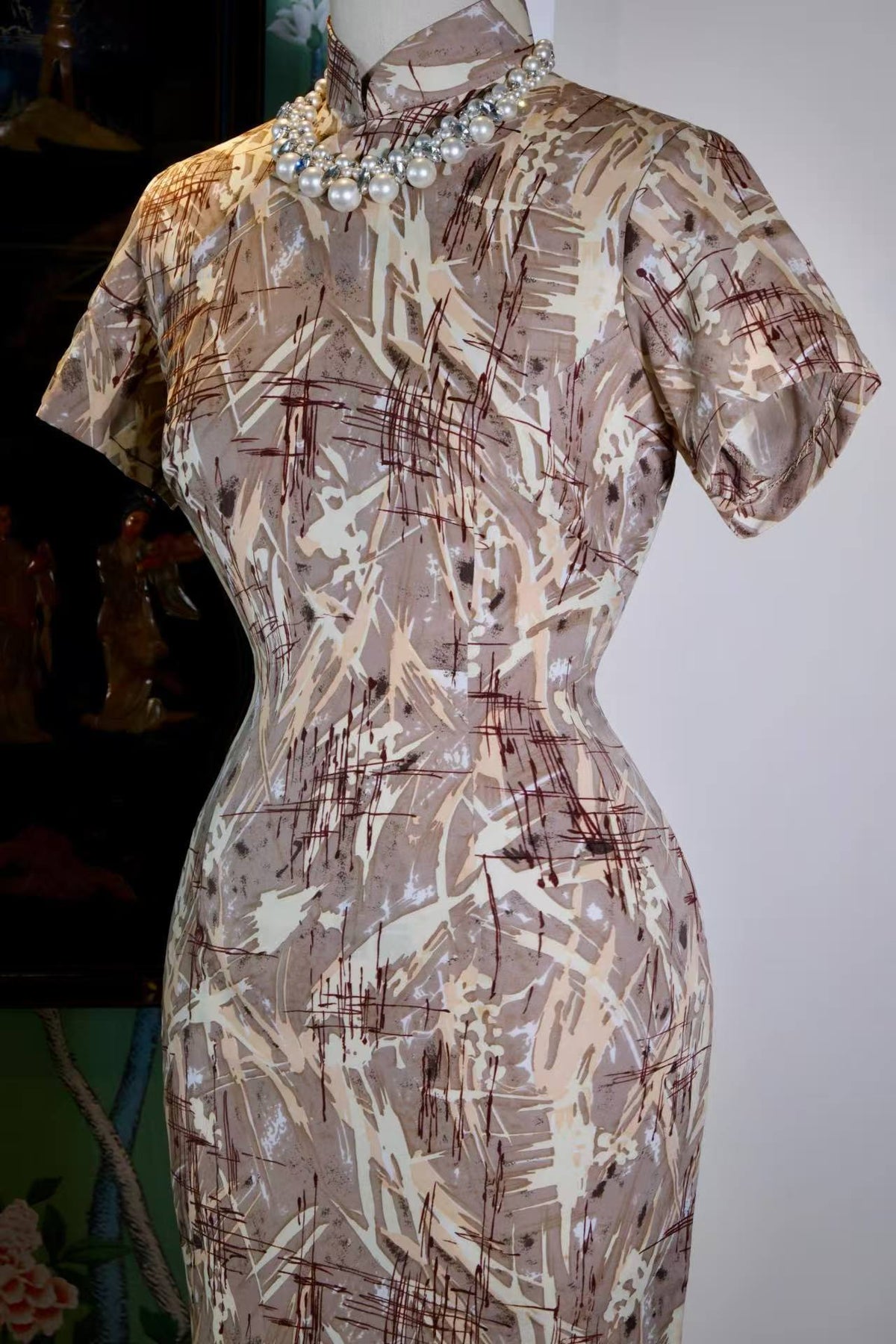
这件旗袍最引人入胜之处,在于其面料纹样的前卫性。
不同于传统旗袍惯用的牡丹、凤凰或具象山水,这件衣服采用了极为罕见的抽象表现主义(Abstract Expressionism)风格印花。
- 视觉语言: 画面中充斥着类似书法飞白般的深褐色线条,它们如疾风骤雨般交错、穿插,打破了画面的宁静。这种笔触让人联想到弗朗兹·克莱恩(Franz Kline)的黑白抽象画,充满了力量感与速度感。
- 色彩美学: 底色采用了温润的米灰与浅褐交织,如同陈年的宣纸或斑驳的旧墙,营造出一种岁月的朦胧感。而深褐色的线条则如枯藤老树,又似狂草入画。
- 艺术隐喻: 这种非具象的图案,在当时是一种极大的审美突破。它不再试图描绘自然界的具体事物,而是直接表达情绪与张力。这种“乱中有序”的视觉效果,恰好隐喻了五十年代香港那个充满活力、混乱却又生机勃勃的社会面貌。
二、 历史溯源:欧洲面料与香港工艺的联姻
这件旗袍的身世,本身就是一部微缩的全球化贸易史。
据考证,其面料源自上世纪五十年代的欧洲进口印花棉布或人造丝。彼时,战后欧洲纺织业正在经历一场现代艺术的复兴,大量具有艺术感的印花布料被出口至远东。而香港,作为当时的自由港与时尚枢纽,拥有全亚洲最顶尖的裁缝工艺。
- 海派与港派的融合: 请注意其剪裁。虽然使用了西式的面料,但工匠依然坚守了中式旗袍的精髓——归拔工艺。通过高温熨烫使平面布料产生立体弧度,完美贴合女性身体曲线。
- 细节考究: 经典的立领高度适中,既修饰颈部线条又不显拘谨;短袖设计利落大方,符合五十年代女性逐渐走向职场、追求行动便利的时代特征。这种“西料中做”的模式,正是当时上流社会名媛们趋之若鹜的时尚标杆。
三、 稀缺性与艺术价值:不可复制的孤品
张爱玲曾言:“对于不会说话的人,衣服是一种语言,随身带着的袖珍戏剧。”
这件旗袍的稀缺性体现在三个维度:
1. 面料的不可再生: 这种具有极高艺术水准的欧洲进口抽象印花布,存世量极少。随着时间流逝,大部分此类衣物因保存不当而损毁,能完好留存至今且色泽如初者,凤毛麟角。
2. 审美的独特性: 它跳脱了大众对旗袍“温婉、传统”的刻板印象,展现了一种知性、独立甚至带有几分冷峻的现代女性气质。它是那个时代“新女性”精神的物质载体。
3. 工艺的绝唱: 如今机器量产的旗袍,再也无法复刻当年老裁缝手工“推、归、拔”赋予衣物的灵魂与温度。
结语:
身着此衣,仿佛能听到半个世纪前留声机里周璇的歌声,能看到维多利亚港初上的华灯。它不仅是一件用来收藏的古董,更是一段关于美、关于时代、关于东西方文化碰撞的永恒记忆。
愿得有心人,以此衣为媒,续写那段流金岁月的风华绝代。
Measurements / Size Guide:
Bust / Waist / Hips / Total Length: 90/76/96/96 cm
Detailed Description:
"Clothes are the emblem of culture, the receptacle of thought." — Shen Congwen, Researches on Ancient Chinese Costumes
In the vast galaxy of vintage garments, if one were to seek a specimen that perfectly interprets the "East-meets-West" golden era of 1950s Hong Kong, the piece before us stands undoubtedly among the absolute finest. It is far more than a mere item of attire—it is a modernist poem worn upon the body.
I. Pattern Decoding: When Abstract Expressionism Meets Eastern Tailoring
The most captivating aspect of this cheongsam lies in the avant-garde nature of its fabric motif.
Differing from the traditional motifs commonly found on cheongsam such as peonies, phoenixes, or figurative landscapes, this dress adopts an extraordinarily rare Abstract Expressionism-style print.
Visual Language: The composition is filled with deep brown lines resembling brushwork strokes in Fei Bai (flying white) calligraphy. Intersecting and interweaving like a sudden wind and torrential rain, they break the serenity of the image. This brushwork evokes the black-and-white abstract paintings of Franz Kline, overflowing with a sense of power and speed.
Color Aesthetics: The base color utilizes a warm, interweaving tone of rice-grey and light brown, akin to aged Xuan paper or a mottled old wall, creating a hazy sense of time. Meanwhile, the deep brown lines resemble withered vines and ancient trees, or cursive calligraphy rendered into art.
Artistic Metaphor: This non-figurative motif represented a monumental aesthetic breakthrough at the time. It no longer attempted to depict concrete things in nature, but directly expressed emotion and tension. This visual effect of "order within chaos" serves as a precise metaphor for Hong Kong's vibrant, chaotic, yet dynamic social landscape during the 1950s.
II. Historical Provenance: A Marriage of European Fabric and Hong Kong Craftsmanship
The provenance of this cheongsam is, in itself, a miniature history of global trade.
According to research, its fabric originates from printed cotton or rayon imported from Europe in the 1950s. At that time, post-war European textiles were undergoing a renaissance of modern art, exporting large quantities of artistic printed fabrics to the Far East. Meanwhile, Hong Kong, serving as a free port and fashion hub of the era, possessed the premier tailoring craftsmanship in all of Asia.
Fusion of Shanghai and Hong Kong Styles: Observe its tailoring closely. Although Western fabrics were utilized, the artisan firmly maintained the core essence of traditional Chinese cheongsam—the shaping and ironing technique (Gui Ba). By applying high-temperature ironing, flat fabric was transformed into three-dimensional curves, contouring seamlessly to the female body.
Refined Details: The classic mandarin collar sits at a moderate height, refining the necklines without feeling rigid; the short-sleeve design appears crisp and dignified, reflecting the era's characteristics as 1950s women increasingly entered workplaces in pursuit of practical mobility. This model of "Western material with Eastern tailoring" was precisely the fashion benchmark eagerly pursued by high-society socialites back then.
III. Rarity and Artistic Value: An Irreplicable One-of-a-Kind Piece
Eileen Chang once wrote: "To those who cannot speak, clothes are a language, carrying with them a pocket-sized drama wherever they go."
The rarity of this cheongsam is embodied across three dimensions:
Non-Renewable Fabric: European imported abstract print fabrics with such high artistic standards are surviving in extremely low numbers. As time passed, most garments of this type were destroyed due to improper preservation; those surviving intact to this day with their original colors preserved are true rarities.
Aesthetic Uniqueness: Breaking away from the popular stereotype of cheongsams as merely "subdued and traditional," it displays an intellectual, independent, and even slightly austere modern feminine temperament. It serves as a material carrier of the "New Woman" spirit of that era.
Swan Song of Craftsmanship: Today's mass-produced cheongsams by machines can never replicate the soul and warmth imparted by the manual shaping, pulling, and ironing techniques of old master tailors.
Epilogue
Wearing this garment, one seems to hear the songs of Zhou Xuan spinning off a gramophone from half a century ago, and glimpse the evening lights just coming on across Victoria Harbour. It is not merely an antique intended for collection, but an eternal memory of beauty, of an era, and of the collision between Eastern and Western cultures.
May a true connoisseur take this garment as a bridge to continue writing the peerless elegance of those golden years.