溯源
无法加载取货服务可用情况
衣服尺寸:
胸围/腰围/臀围/衣长:86/76/92/95 厘米
细节描述:
这件诞生于20世纪60年代台湾的纯棉古董旗袍,是一份极为难得的、关于那个“西风渐进与乡愁并存”时代的物质样本。
壹 · 图案之美:密而不喧,温润如诗
这套旗袍选用的是极具时代印记的深咖啡色纯棉印花面料。
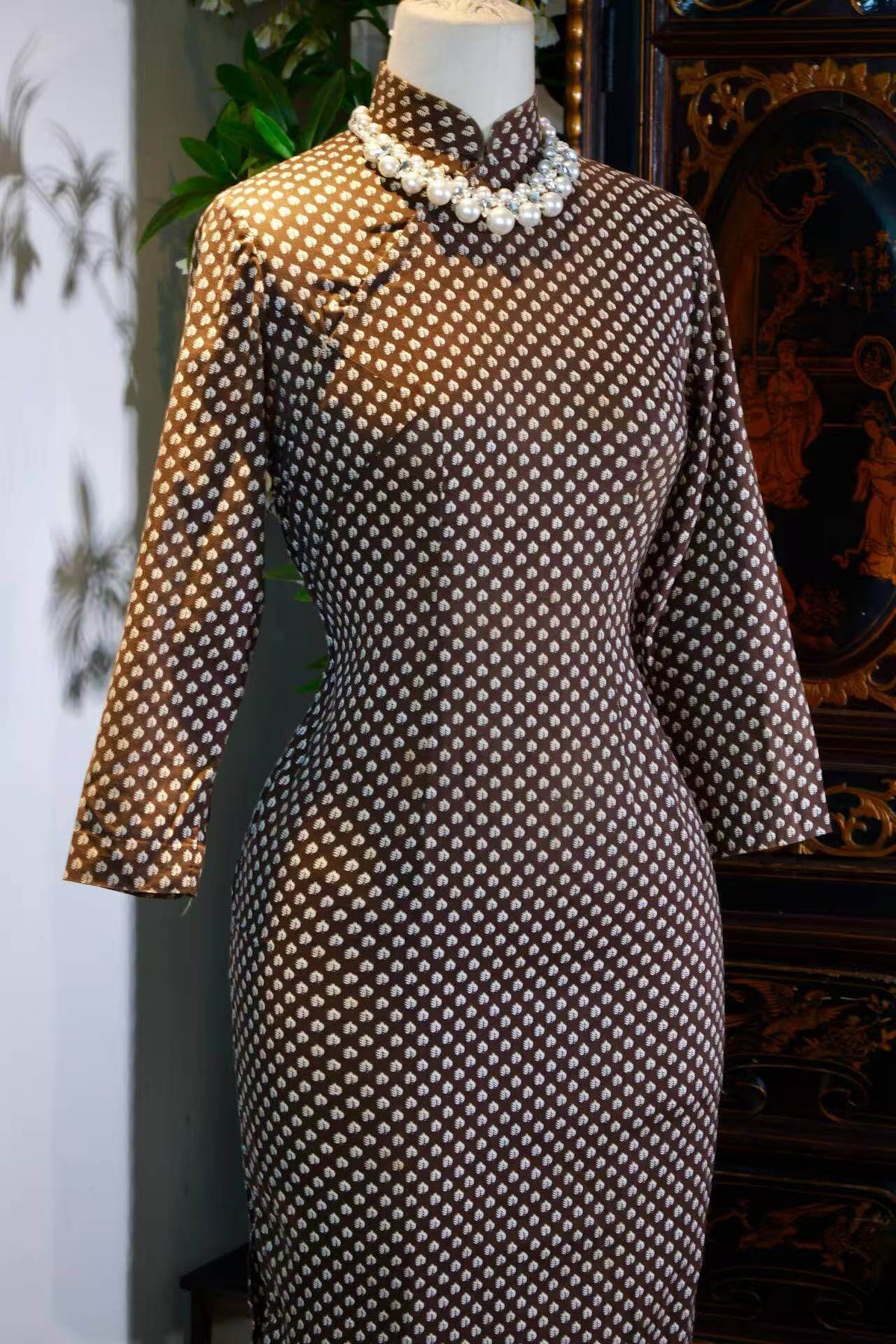
衣身遍布的并非大红大绿的具象花卉,而是呈几何矩阵般规律排布的白色抽象花叶纹样。这种细密而克制的“满地印花”(All-over print),在深色调的底色上,宛如雨夜窗棂上落下的细碎光影,又似宣纸上洇开的工笔小品。
纯棉材质特有的哑光质感,消解了丝绸可能带来的张扬与轻浮,赋予整件衣服一种沉静、内敛的书卷气。搭配颈间的双层大颗粒珍珠项链,冷暖相济,既压得住深色的庄重,又提得起肌肤的明亮。
贰 · 岁月之痕:一袭旗袍,半部乡愁
1949年后,大量江浙、上海移民随历史洪流迁徙至台湾。旗袍,对于这批渡海而来的女性而言,不仅是一种时尚,更是一种“回望家乡的视觉寄托”。
20世纪60年代的台湾,正处于旗袍流行史的“黄金末期”与“西风东渐”的交汇点。正如刘瑜在《中国旗袍文化史》中所指出的,这一时期的港台旗袍,既保留了中式风骨的温婉,又在剪裁上大胆吸收了西方的立体省道(Darts)工艺。
这件旗袍便完美体现了这一过渡期的特征:
* 立领与襟袖:保留了恰到好处的传统立领与七分袖,温婉守礼;
* 立体剪裁:腰身与臀部的弧度经过了精准的西式立体收省,既贴合女性自然的生理曲线,又毫无紧绷之感。
* 它没有刻意追求50年代那种极致夸张的S型宝瓶轮廓,而是呈现出一种“宽严相济、合度而不失礼”的中式优雅,极有可能是当年台北某位知识女性、教师或大家闺秀在秋日正式场合的体面穿着。
叁 · 艺术风格与稀缺价值:不可复制的“日常传奇”
张爱玲曾写道:“对于不会说话的人,衣服是一种语言,随身带着的袖珍戏剧。”
在古董旗袍的收藏市场中,真丝、丝绒、织锦缎固然名贵,但“品相完好、剪裁考究的六十年代纯棉印花旗袍”却有着另一种不可替代的稀缺性:
1. 材质的脆弱性与存世量:纯棉材质极易因岁月氧化、穿着磨损、多次洗涤而褪色或破损。这件旗袍历经六十余年,其图案依然清晰,版型没有严重变形,其保存之完好,在私人收藏中已属凤毛麟角。
2. 雅俗共赏的学术价值:它摒弃了晚清旗袍繁冗的“十八镶滚”,也不同于30年代海派旗袍的浓艳,它代表着1960年代台湾知识分子女性审美的最高水平——简约、实用、雅致,是研究两岸服饰文化交流与战后女性社会角色转变的绝佳实物史料。
穿上一件这样的古董旗袍,你穿的不仅是一件衣服,更是一个时代的体温、一段跨海而来的家族记忆,以及一份在时间洪流中静默绽放的东方风骨。
Measurements / Size Guide:
Bust / Waist / Hips / Total Length: 86/76/92/95 cm
Detailed Description:
This 100% cotton vintage cheongsam, born in 1960s Taiwan, is an extremely rare material specimen of an era where "Western influences were gradually taking root while nostalgia persisted."
I. The Beauty of the Pattern: Dense Yet Unobtrusive, Gentle as Poetry
This cheongsam is crafted from a deep coffee-brown cotton printed fabric that carries a distinct mark of its era.
The body of the garment is covered not in garish, concrete flowers of loud reds and greens, but rather in white abstract floral and leaf motifs arranged in a regular geometric matrix. This dense yet restrained "all-over print," set against the dark base tone, resembles delicate light and shadow falling on windowpanes during a rainy night, or fine brushwork sketches bleeding softly onto Xuan paper.
The matte texture unique to pure cotton dissolves any ostentatious or frivolous quality silk might carry, endowing the entire garment with a quiet, introspective scholarly elegance. Paired with a double-strand large-pearl necklace at the neck, warm and cool tones balance each other; it grounds the solemnity of the dark color while brightening the complexion of the skin.
II. Traces of Time: One Cheongsam, Half a Book of Nostalgia
After 1949, a massive wave of immigrants from Jiangsu, Zhejiang, and Shanghai migrated to Taiwan along with the tides of history. For these women who crossed the strait, the cheongsam was not merely a fashion statement, but a "visual anchor for looking back at their homeland."
Taiwan in the 1960s sat right at the intersection of the "final golden era" in cheongsam history and the "spread of Western influence to the East." As Liu Yu points out in The History of Chinese Cheongsam Culture, Hong Kong and Taiwan cheongsams of this period retained the gentle grace of traditional Chinese spirit while boldly absorbing Western three-dimensional darting techniques in their tailoring.
This cheongsam perfectly embodies the characteristics of this transitional period:
Mandarin Collar, Placket & Sleeves: Retains a perfectly proportioned traditional standing collar and three-quarter sleeves, expressing gentle modesty and propriety;
Three-Dimensional Tailoring: The curves of the waist and hips have been precisely contoured through Western 3D darts, tracing a woman's natural silhouette without feeling constricting in the slightest.
Instead of deliberately chasing the extremely exaggerated 1950s vase-like S-curve silhouette, it exhibits a Chinese elegance that is "balanced, properly fitted, and decorous." It was, in all likelihood, the respectable attire of an intellectual woman, teacher, or lady from a prominent family in Taipei for a formal autumn occasion back in those days.
III. Artistic Style & Rarity: An Irreplaceable "Everyday Legend"
Eileen Chang once wrote: "To those who cannot speak, clothes are a language, carrying with them a pocket-sized drama wherever they go."
In the vintage cheongsam collection market, while real silk, velvet, and brocade satins are indeed precious, a "well-preserved, meticulously tailored 1960s cotton printed cheongsam" possesses an entirely different, irreplaceable rarity:
Material Fragility & Surviving Quantity: Pure cotton fabric is extremely prone to fading or damage over time due to oxidation, wear, and repeated washing. After more than sixty years, the pattern of this cheongsam remains crisp and its silhouette shows no severe warping; such pristine preservation is a true rarity in private collections.
Academic Value with Universal Appeal: It rejects the overly elaborate "eighteen trims and pipings" of late Qing cheongsams and differs from the rich, flamboyant colors of 1930s Shanghai-style cheongsams. It represents the pinnacle of aesthetic standards among Taiwanese intellectual women in the 1960s—minimalist, practical, and refined. It serves as an exceptional physical historical source for studying cross-strait garment culture exchanges and the post-war transformation of women's social roles.
Putting on a vintage cheongsam like this, you are wearing far more than a garment; you are wearing the warmth of an era, a piece of family memory that crossed the sea, and an Eastern grace that quietly blooms against the torrent of time.