深圳溯源
蓝调狂想:六十年代港式抽象印花旗袍鉴赏 | "Blue Rhapsody: An Appreciation of a 1960s Hong Kong-Style Abstract Printed Qipao"
蓝调狂想:六十年代港式抽象印花旗袍鉴赏 | "Blue Rhapsody: An Appreciation of a 1960s Hong Kong-Style Abstract Printed Qipao"
无法加载取货服务可用情况
蓝调狂想:六十年代港式抽象印花旗袍鉴赏
衣服尺寸:
胸围/腰围/臀围:102/94/112 厘米
衣长:112 厘米
细节描述:
【图案赏析:笔触间的东方印象派】
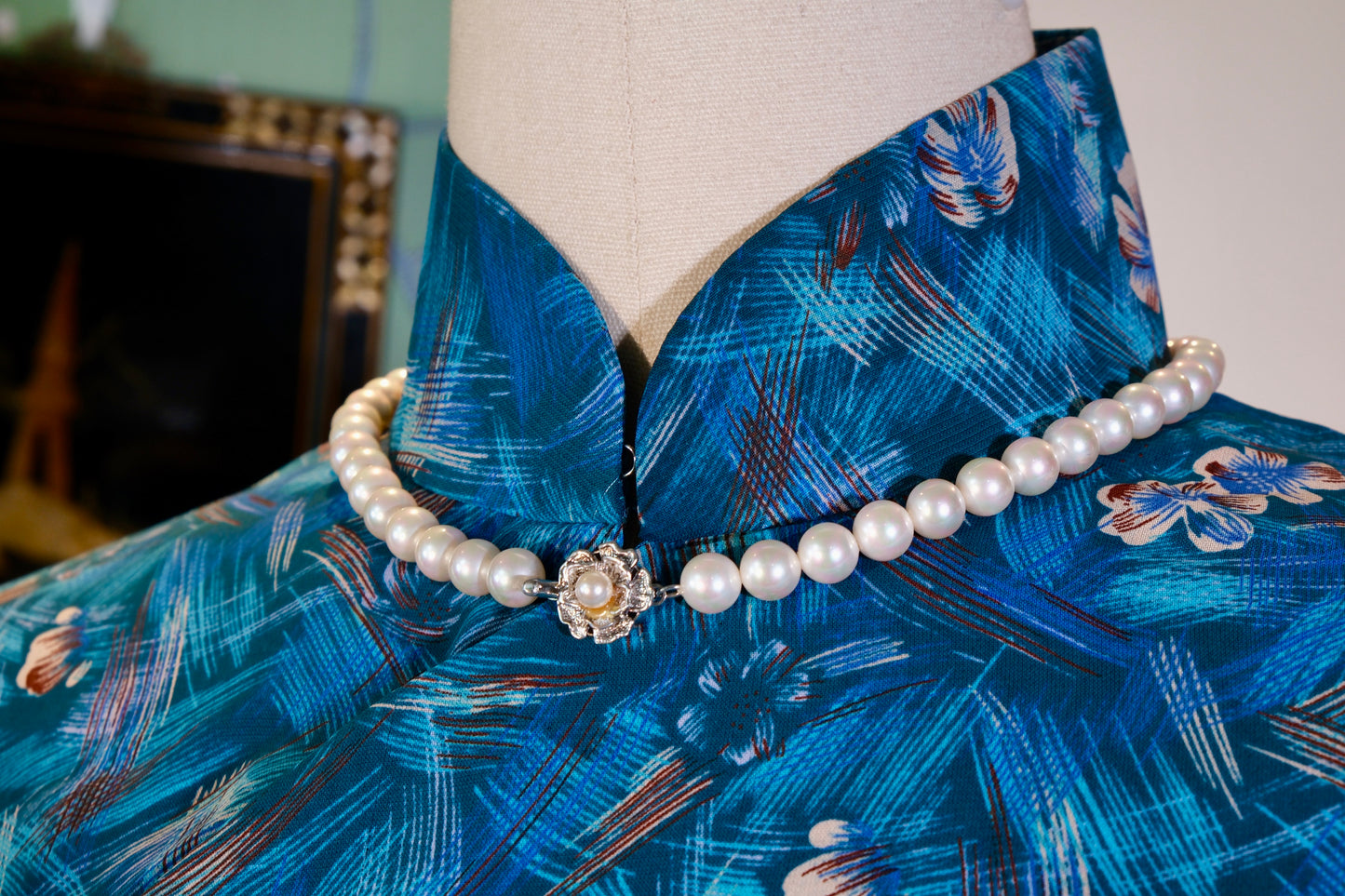
这件旗袍最引人入胜之处,在于其面料上极具艺术张力的印花设计。它摒弃了传统旗袍常见的具象牡丹或龙凤纹样,转而采用了一种类似西方“表现主义”或“印象派”的笔刷抽象风格。
- 色彩基调: 整体以深邃而静谧的孔雀蓝与湖蓝为底色,宛如雨后初霁的天空,又似深不见底的潭水,给人一种沉稳、知性且略带忧郁的高级感。
- 纹理细节: 画面上交织着无数道深浅不一的蓝色笔触,它们如同疾风扫过的竹叶,又似波涛汹涌的海浪,充满了动感与力量。在这些粗犷的线条之间,点缀着淡粉与米白相间的小碎花。这些花朵并非工笔细描,而是写意点染,仿佛是暴风雨中顽强绽放的生命,在冷色调的背景中透出一丝温婉与柔情。这种“刚柔并济”的视觉语言,正是六十年代现代主义美学介入传统服饰的典型特征。
【历史溯源:香江岁月的摩登回响】
这件旗袍诞生于上世纪六十年代的香港,那是一个东西方文化激烈碰撞与交融的黄金年代。
彼时的香港,深受西方战后现代主义思潮的影响,同时也保留着深厚的中华文化底蕴。张爱玲曾言:“对于不会说话的人,衣服是一种语言,随身带着的是袖珍戏剧。”六十年代的香港名媛与知识女性,不再满足于传统的繁复,她们追求更加利落、修身且富有现代感的剪裁。
这件旗袍采用了典型的“海派”改良工艺在香港落地生根后的样式:
- 立领: 依然保留了传统的高立领,象征着东方的含蓄与端庄,紧扣颈部线条,显得脖颈修长。
- 袖型: 短袖设计干练清爽,适应了南方湿热的气候,也符合当时女性走出家庭、步入职场的社会趋势。
- 剪裁: 极其强调腰臀比的西式立体剪裁(Darting),完美勾勒出女性的S型曲线,这是那个时代“性感与优雅并存”的最佳注脚。
【艺术价值与稀缺性:穿在身上的孤本】
从学术角度来看,这件旗袍具有极高的研究价值与收藏意义。
《诗经·郑风》有云:“青青子衿,悠悠我心。”虽原指学子衣领,但后世常以此形容那份令人难忘的青色雅致。这件旗袍的蓝,正是那种能穿越时光、抚慰人心的颜色。
其稀缺性体现在三个方面:
1. 面料的不可复制性: 这种特殊的抽象笔刷印花面料,极有可能是当年香港纺织厂为了迎合出口或高端定制市场而特别印染的孤品花型。随着时代的变迁,这种特定的染料配方和印染工艺早已失传,如今即便想复刻,也难以重现那种经过岁月沉淀后的色泽韵味。
2. 保存状况: 丝绸或人造丝混纺面料极难保存,易脆化褪色。而这件旗袍历经六十载风雨,依然色泽饱满,版型挺括,实属凤毛麟角。
3. 审美断代: 它是连接传统中式平面剪裁与现代西式立体造型的活化石。它见证了中国女性服饰从“遮蔽身体”向“展示个性”转变的关键历史瞬间。
【结语】
这不仅是一件衣裳,更是一段被封存的香江往事。穿上它,仿佛能听到老式唱片机里周璇的低吟浅唱,看到维多利亚港边那抹最独特的蓝色倩影。对于真正的藏家而言,拥有的不仅是一件古董衣,更是一份对那个风华绝代年代的深情致敬。
"Blue Rhapsody: An Appreciation of a 1960s Hong Kong-Style Abstract Printed Qipao"
Measurements / Size Guide:
Bust / Waist / Hips: 102/94/112 cm
Total Length: 112 cm
Detailed Description:
【Motif Appreciation: An Eastern Impressionism Between Brushstrokes】
The most captivating aspect of this qipao lies in the intense artistic tension of its textile print design. It completely throws off the representational peony or dragon-and-phoenix motifs common to conventional qipaos, opting instead for an abstract brushstroke aesthetic reminiscent of Western expressionism or impressionism.
-
Chromatic Base: The overall palette relies on deep, serene peacock blue and lake blue as its grounding base—evoking a clear sky just after a rainfall, or a bottomless, quiet pool of water. It delivers a high-end visual presence that is stable, intellectual, and tinged with a subtle melancholy.
-
Texture Details: The composition is interwoven with countless blue brushstrokes of varying depth and weight. They rush across the frame like bamboo leaves swept by a gale or tumultuous ocean waves, bursting with dynamic movement and raw power. Between these bold, rugged lines, delicate micro-florals in alternating pale pink and cream white are interspersed. These blossoms are not rendered via meticulous line work (Gongbi); they are applied via expressive freehand dotting (Xieyi), appearing like resilient life blooming stubbornly amidst a tempest—injecting a trace of gentleness and tenderness into the cool-toned background field. This visual language of "negotiating rigidity with softness" stands as a textbook hallmark of 1960s modernist aesthetics intervening in traditional apparel.
【Historical Origins: The Modern Echoes of Golden Hong Kong Years】
This qipao was materialized during the 1960s in Hong Kong—a golden era where Eastern and Western cultures collided and fused with absolute intensity.
Hong Kong during that timeline was deeply influenced by the sweeping tide of post-war Western modernism, while simultaneously retaining a profound core of Chinese cultural heritage. The celebrated author Eileen Chang once noted: "To those who cannot speak, clothes are a language; what one carries with them is a pocket drama." The elite socialites and intellectual women of 1960s Hong Kong were no longer satisfied with traditional, complex ornamentation; they aggressively pursued a pattern draft that was crisper, more form-fitting, and intensely contemporary.
This specific piece implements the classic styling of Shanghai-style modified craftsmanship after it took root and flourished in Hong Kong:
-
The Standing Collar: It beautifully preserves the traditional high standing collar, symbolizing Eastern containment and dignity. It contours tightly to the neck field, creating a visually elongated, graceful line.
-
The Sleeve Silhouette: The short-sleeve configuration is exceptionally crisp and efficient, engineered perfectly for the hot, humid climate of the South, while aligning seamlessly with the societal trend of contemporary women stepping out of the household and into the professional workplace.
-
The Pattern Draft: It relies on a thoroughly Western three-dimensional tailoring method (Darting) that places extreme emphasis on the bust-to-hip ratio, flawlessly contouring the female S-curve silhouette—the absolute definition of the era's signature "coexistence of sensuality and high elegance."
【Artistic Value and Scarcity: A Wearable Unique Specimen】
Appraised under academic metrics, this qipao holds immense research weight and profound collecting significance.
The ancient text The Book of Songs (Shijing) contains the line: "Green, green is your collar; deep, deep is my longing." While originally referencing the formal collars of scholars, later generations frequently deployed this phrase to describe a hauntingly unforgettable, elegant green-blue aesthetic. The specific blue anchored within this qipao is precisely that type of hue—capable of traveling across timelines to soothe the human heart.
Its absolute physical scarcity is driven by three distinct parameters:
-
The Irreproducibility of the Textile Matrix: This highly specialized abstract brushstroke print fabric was very likely an exclusive pattern custom-dyed by a Hong Kong textile mill of the era, specifically tailored to appeal to high-end bespoke clients or export markets. Following generational transitions, these specific dye formulations and printing techniques have long been lost to history. Today, even with modern reconstruction efforts, replicating that precise tonal resonance settled through decades of timeline remains impossible.
-
The Defiance of Conservation: Silk or rayon-blend matrices possess a notorious vulnerability to natural timeline, making them highly prone to embrittlement and color fading. For this qipao to cross over sixty years of history while retaining such rich color saturation and a crisp, structured silhouette is exceptionally rare—a true phenomenon.
-
An Aesthetic Transition Fossil: It serves as a genuine living fossil connecting traditional Chinese flat, planar pattern cuts with modern Western three-dimensional structure. It stands as a direct material witness to the critical historical moment when Chinese women's apparel evolved from "concealing the body" to "manifesting personal individuality."
【Conclusion】
This transcends its definition as an article of clothing to operate as a sealed archive of old Hong Kong memories. Stepping into its frame, one can almost hear the low, gentle crooning of Zhou Xuan spinning off an antique record player, catching a glimpse of that highly singular blue silhouette moving past Victoria Harbour. For a true connoisseur of curation, owning this piece means possessing far more than an antique garment; it stands as a deep, passionate tribute to a peerless and brilliant generation.
分享