深圳溯源
无法加载取货服务可用情况
衣服尺寸:
胸围/腰围/臀围/衣长:104/90/106/116 厘米
细节描述:
在服装史的浩瀚星河中,上世纪六十年代的香港旗袍犹如一颗独特而璀璨的星辰。它既承袭了海派旗袍的精致余韵,又在东西方文化剧烈碰撞的香江之畔,孕育出一种前所未有的摩登与张力。眼前这件古董旗袍,便是一枚凝固了时光的琥珀,以其抽象油画般的印花语言,向我们低声诉说着那个黄金时代的审美密码。
一、图案考释:从具象到抽象的色彩交响
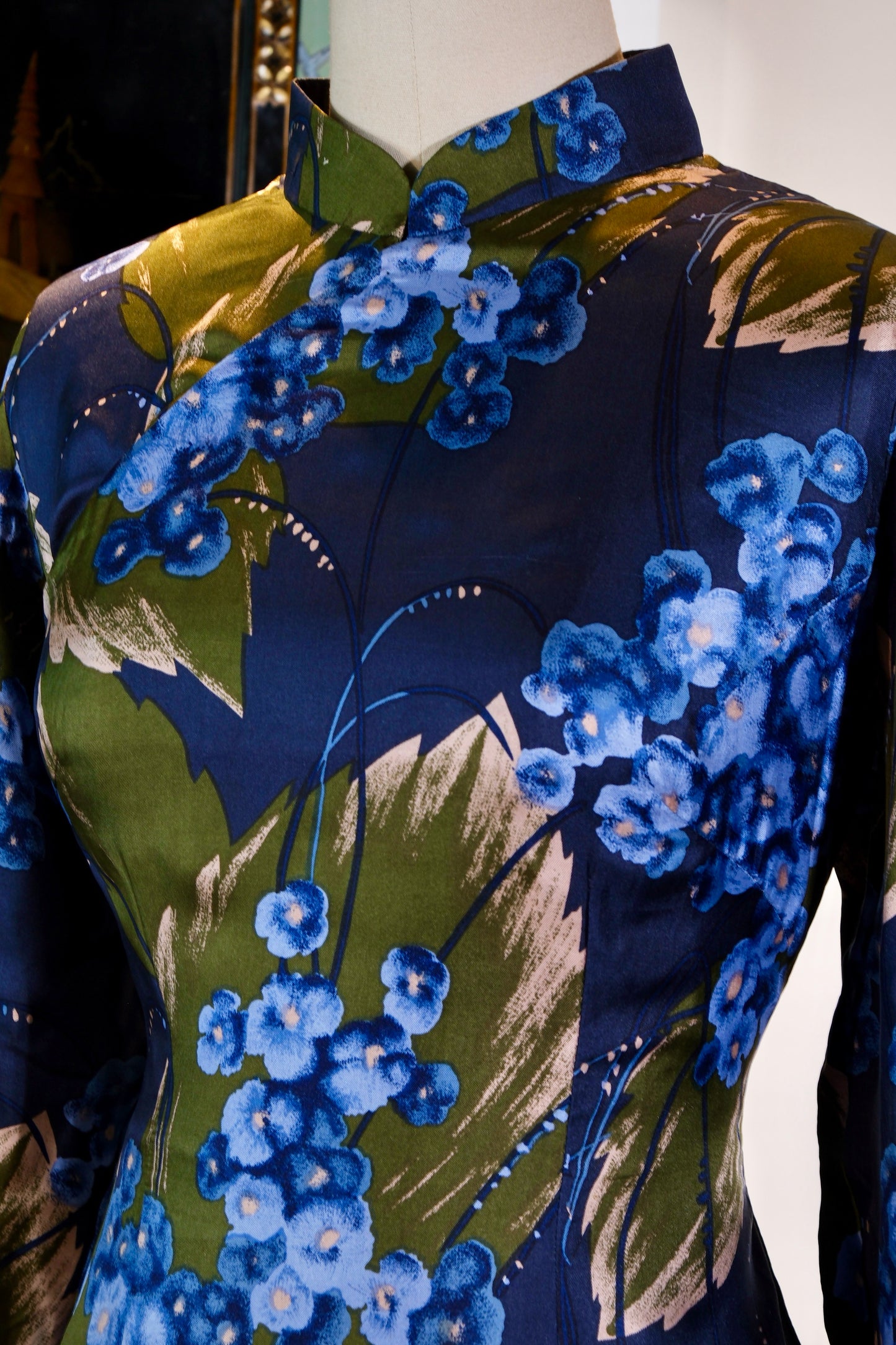
细观此衣,最摄人心魄者莫过于其面料上的印花图案。这绝非传统旗袍中常见的具象牡丹或梅兰竹菊,而是一场极具现代主义精神的视觉实验。
- 色彩的二元对立与融合:底色选用了深邃幽静的普鲁士蓝(Prussian Blue),宛如深夜的苍穹或静谧的海洋,奠定了沉稳高贵的基调。而在其上跳跃的,是高明度的群青与天蓝交织而成的花簇,辅以橄榄绿与赭石色晕染出的叶片。这种冷暖色调的强烈对比,打破了传统丝绸配色的温婉,赋予了衣物一种戏剧性的张力。
- 笔触的绘画性表达:图案并非工整的工笔描摹,而是充满了写意与狂放。设计师显然深受当时西方抽象表现主义(Abstract Expressionism)的影响,将油画的笔触移植到了织物之上。你看那叶片的边缘,并非清晰的轮廓线,而是如同画笔在画布上急促扫过留下的痕迹,带着一种“未完成”的动态美;那蓝色的花朵,似雾非雾,似花非花,更像是光影在视网膜上留下的残像。这种“似与不似之间”的意境,恰恰暗合了中国传统美学中“气韵生动”的最高追求,却又披上了一层现代艺术的外衣。
二、形制与剪裁:西风东渐下的身体解放
我们必须注意到这件旗袍在剪裁上的微妙变革。六十年代的香港,受西方时尚浪潮冲击,旗袍开始了一场关于“身体”的革命。
- 立体剪裁的介入:不同于早期平面剪裁的宽松,这件旗袍明显采用了西式立体剪裁中的“省道”(Darts)技术。请注意观察胸部与腰部的线条,它们严丝合缝地贴合人体曲线,勾勒出女性曼妙的身姿。这种对曲线的极致追求,是战后女性意识觉醒与审美自信的体现。
- 改良的细节:领口依然保留了传统的立领,但高度适中,既修饰颈部线条又不显拘谨。袖口微微外扩,呈现出一种优雅的喇叭状,这不仅增加了穿着的舒适度,更在举手投足间增添了几分流动的风情。这种设计在当时被称为“海派”风格的延续与变异,是香港裁缝师傅精湛技艺的见证。
三、历史回响:张爱玲笔下的“衣服哲学”
张爱玲曾在《更衣记》中写道:“对于不会说话的人,衣服是一种语言,随身带着的是袖珍戏剧。”这件旗袍,正是这样一出无声的戏剧。
想象一下,在1960年代的香港,一位受过良好教育、思想独立的新女性,身着此衣穿梭于中环的写字楼或半岛酒店的下午茶会。她不再是被深闺禁锢的传统仕女,而是活跃于社交场与职场的现代女性。这件衣服上的抽象花纹,正如她内心世界的投射——既有东方女性的内敛深沉(深蓝底色),又有拥抱世界的热烈与奔放(绚烂花簇)。
在那个年代,拥有一件如此设计大胆、印花独特的定制旗袍,不仅是财富的象征,更是品味与身份的宣示。它代表了穿着者不愿随波逐流、追求独特个性的精神诉求。正如古人云:“衣以载道”,这件衣裳承载的,是那个时代女性在传统与现代夹缝中绽放出的独特生命力。
四、稀缺性与收藏价值:不可复制的时光孤品
从文物收藏的角度审视,这件旗袍具有极高的稀缺性:
1. 面料的不可再生:六十年代的印花印染工艺复杂,且多为小批量生产。随着化工染料的迭代和纺织技术的变迁,这种具有独特手绘质感、色彩饱和度极高且历经六十载依然鲜亮如初的面料,已难觅踪迹。
2. 保存状况的奇迹:丝绸娇贵,极易氧化脆化。但这件旗袍色泽依旧饱满,版型挺括,说明其前任主人们对其爱护有加,且保存环境极佳。这种“全品”状态的古董衣,在拍卖市场上往往是可遇不可求的。
3. 审美价值的回归:时尚是一个轮回。近年来,Vintage风潮席卷全球,六十年代的Mod风格与东方元素的结合更是备受追捧。这件旗袍完美契合了当代对于“复古未来主义”的审美需求,它不仅仅是一件衣服,更是一件可以穿在身上的艺术品。
综上所述,这件六十年代香港产抽象印花油画风格旗袍,以其独特的艺术语言、精湛的剪裁工艺和深厚的历史文化内涵,成为了那个辉煌时代的最佳注脚。它不仅属于过去,更以其超越时间的魅力,等待着下一位懂它、惜它的知音,续写这段未完的绮梦。
Measurements / Size Guide:
Bust / Waist / Hips / Total Length: 104/90/106/116 cm
Detailed Description:
A close examination of this garment reveals that its most captivating element is the printed motif adorning the fabric. Completely discarding the realistic peonies or traditional flora commonly found in heritage qipaos, this textile presents a visual experiment charged with modernist spirit.
The Binary Opposition and Fusion of Color: The background substrate implements a deep, tranquil Prussian Blue, evocative of a midnight sky or a silent ocean, establishing a composed and noble foundation. Dancing across this canvas are brilliant clusters of ultramarine and celestial blue, anchored by leaves washed in olive green and ochre tones. This intense juxtaposition of warm and cool tones breaks away from the gentle, subdued color harmonies of traditional silk, endowing the garment with dramatic visual tension.
The Painterly Expression of Brushstrokes: The pattern completely eschews neat, meticulous outlines, opting instead for a style rich with spontaneous, wild expression. The textile designer was clearly influenced by the Western Abstract Expressionism movement of the era, transplanting the raw energy of oil painting brushstrokes directly onto the woven fabric. Observe the edges of the foliage: rather than clean, closed contours, they present rapid strokes sweeping across the surface, leaving behind a dynamic sense of the "unfinished." The blue blossoms resemble a hazy mist, capturing a fleeting image left upon the retina. This "interstitial space between likeness and unlikeness" beautifully mirrors the ultimate pursuit of "spiritual resonance" (qiyun shendong) in traditional Chinese aesthetics, yet frames it entirely within a modern artistic vocabulary.
One must note the subtle structural evolutions this qipao showcases in its drafting. Impacted by the waves of Western fashion sweeping through 1960s Hong Kong, the qipao underwent a true revolution regarding the female form.
The Intervention of Three-Dimensional Tailoring: Diverging from the loose, forgiving drape of early flat-pattern drafting, this qipao clearly implements Western three-dimensional tailoring techniques, specifically darts (收省). A careful look at the bust and waist contours reveals how seamlessly they align with the anatomical curves of the human form, sculpting a graceful and defined silhouette. This rigorous pursuit of form stands as a physical manifestation of post-war female consciousness and aesthetic self-confidence.
Modified Architectural Details: The neckline strictly preserves the formal decorum of the traditional standing collar, yet its height is meticulously moderated to elongate the neck without causing restriction. The cuffs flare out subtly, presenting an elegant bell shape that not only enhances comfort but also introduces a flowing, rhythmic grace to every gesture. This specific detail represents a continuation and regional variation of the classic Haipai (Shanghai-style) heritage, serving as a monument to the extraordinary skill of mid-century Hong Kong master tailors.
Eileen Chang profoundly observed in Reflections on Clothing: "For those who cannot speak, clothes are a language, a pocket theater carried upon the body." This qipao operates as precisely such a silent drama.
Imagine 1960s Hong Kong: an educated, independent modern woman wearing this garment while navigating the offices of Central or attending afternoon tea at The Peninsula. She was no longer a traditional lady cloistered in a secluded courtyard, but an active, modern individual engaging with the social and professional spheres. The abstract patterns on her dress served as a projection of her internal landscape—combining the deep restraint of an Eastern woman (the dark blue background) with an enthusiastic embrace of the cosmopolitan world (the brilliant floral clusters).
In that decade, commissioning a custom qipao with such a bold and unique print was a manifesto of personal taste and identity. It declared that the wearer refused to merely drift with the crowd, asserting instead her pursuit of individual character. As the ancient phrase notes, "clothing carries the Dao" (yi yi zai dao); what this garment carries is the vibrant vitality of mid-century women blooming elegantly between the spaces of tradition and modernity.
Viewed through the rigorous lens of textile curation and collecting, this archival piece holds immense structural scarcity:
The Irreproducible Nature of the Textile: The multi-color overprinting and dye processes of the 1960s were technically complex and typically restricted to small-batch productions. With the evolution of chemical colorants and the rapid automation of textile printing, fabrics carrying this specific hand-painted texture and deep color saturation—retaining their brilliance after more than sixty years—have virtually vanished from modern manufacturing.
A Miracle of Preservation: Silk fibers are organic and notoriously vulnerable to structural oxidation, brittleness, and fading. That this qipao retains its deep color saturation and crisp, original tailoring proves it was stewarded with immaculate care across generations in an optimal archival environment. Encountering a vintage garment in such pristine condition on the contemporary collecting market is an absolute anomaly.
The Convergence of Aesthetic Movements: Fashion operates in cycles. The contemporary global surge in vintage appreciation has placed a premium on the intersection of 1960s Mod style with Eastern silhouettes. This qipao flawlessly satisfies the modern pursuit of "retro-futurism." It transcends its utilitarian identity to exist as a wearable work of art.
This 1960s Hong Kong-manufactured abstract oil painting style qipao, with its singular artistic language, master structural tailoring, and deep historical resonance, serves as a definitive footnote to a brilliant era. It does not belong solely to the past; rather, with its time-transcending allure, it waits for a true connoisseur who understands and cherishes its narrative, ready to write the next chapter of this unfinished blue reverie.