深圳溯源
无法加载取货服务可用情况
衣服尺寸:
胸围/腰围/臀围:100/84/100 厘米
衣长:110 厘米
细节描述:
一、图案与工艺:经纬间的东方几何美学
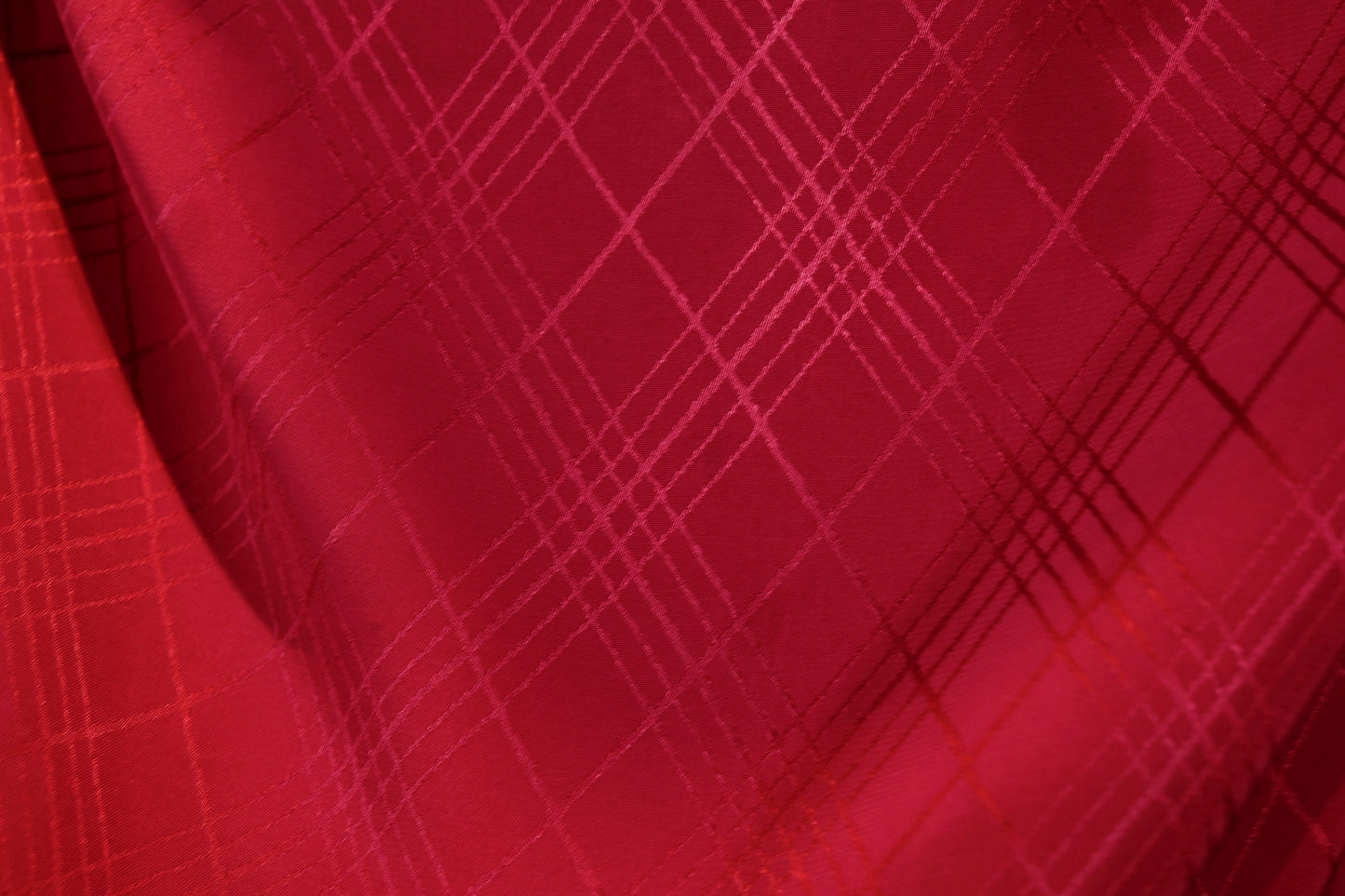
这件旗袍的面料,是上世纪六十年代台湾纺织工业黄金时期的缩影。其核心在于“同色系菱格纹提花”工艺。不同于普通的平面印花,这种纹理是通过织机在织造过程中直接形成的立体肌理。
- 视觉解析:深酒红(或称勃艮第红)的底色上,交织着略浅于底色的丝光菱形网格。这种几何纹样打破了传统旗袍花鸟龙凤的具象叙事,转向了更为现代、理性的抽象表达。
- 光影质感:由于提花工艺的特性,光线照射下,菱格的凸起部分会呈现出丝绸般的漫反射光泽,而凹陷处则保持哑光深邃。这种“隐纹”设计,远看如纯色般端庄沉稳,近观则见万千经纬交错,尽显低调奢华。
二、形制与剪裁:极简主义的胜利
作为一件典型的六十年代台湾产古董旗袍,它在形制上体现了那个时代特有的“去装饰化”趋势。
- 无绲边(No Piping):这是极为高级的处理方式。传统旗袍讲究“三镶三滚”,但这件作品摒弃了所有领口、袖口及开叉处的滚边装饰。这种“素身”做法对裁剪和缝纫的精准度要求极高,因为没有滚边的遮掩,任何线条的歪斜都将无所遁形。它追求的是一种纯粹的轮廓美,如同宋代瓷器般,以简驭繁。
- 无花扣(No Frog Buttons):领口处未见传统的盘扣,采用了隐形暗扣和侧拉链设计。这种设计进一步净化了视觉中心,让视线完全集中在面料本身的质感和穿着者的颈项线条上。
- 短袖立领:保留了中式立领的含蓄,配合利落的短袖,既适应了台湾亚热带的气候,又展现了六十年代女性干练、独立的新形象。
三、历史与故事:海峡彼岸的流金岁月
这件旗袍不仅是一件衣物,更是一段被封存的时光标本。
- 时代背景:上世纪五六十年代的台湾,正处于从农业社会向轻工业社会转型的关键期。当时的台湾纺织业蓬勃发展,尤其是人造丝和混纺技术的进步,使得旗袍不再仅仅是达官贵人的专属,开始进入中产阶级女性的衣橱。
- 文化隐喻:张爱玲曾言:“对于不会说话的人,衣服是一种语言。”这件旗袍诞生于一个新旧交替、中西碰撞的年代。它没有旧上海十里洋场的奢靡繁复,却多了一份海岛特有的清新与务实。它可能曾属于一位在那段岁月里努力生活、受过良好教育的女性,或许是一位教师,或许是一位公务员的妻子。她穿着它出席学校的庆典、家庭的聚会,或是仅仅是在一个阳光明媚的午后,独自品味一杯清茶。
- 稀缺性:随着七十年代后成衣工业的兴起和西式服装的全面普及,这种精工细作的定制或半定制旗袍逐渐退出日常舞台。能保存至今且品相如此完好的六十年代台湾产提花旗袍,已是凤毛麟角。它见证了那个时代女性对美的执着追求,也承载了一段不可复制的历史记忆。
四、引经据典:艺术风格的注脚
《礼记·深衣》有云:“古者深衣,盖有制度,以应规、矩、绳、权、衡。”这件旗袍虽为近代产物,但其对线条的极致追求,恰恰暗合了古人对于服饰“制度”与“法度”的理解。它不靠繁复的装饰取胜,而是以精准的剪裁和优质的面料,展现出一种内敛而高贵的气质。
正如沈从文先生在《中国古代服饰研究》中所言,服饰的演变往往与社会变迁紧密相连。这件旗袍,正是六十年代台湾社会风貌的一个缩影——既有对传统的坚守,又有对现代的拥抱;既有东方的韵味,又有西方的影响。它是一件艺术品,更是一段历史的见证。
注释:微瑕特价
Measurements / Size Guide:
Bust / Waist / Hips: 100/84/100 cm
Total Length: 110 cm
Detailed Description:
The fabric of this qipao is a miniature reflection of the golden era of the Taiwanese textile industry during the 1960s. Its core lies in the "tone-on-tone rhombus matrix jacquard" process. Unlike ordinary flat prints, this structural texture was formed directly through the loom during the weaving process to create a three-dimensional tactile surface.
Visual Analysis: Interwoven across the deep wine-red (or Burgundy) ground color is a mercerized rhombus grid slightly lighter than the base tone. This geometric motif breaks away from the concrete narratives of traditional dragons, phoenixes, flowers, and birds found on conventional qipaos, pivoting instead toward a more modern, rational, and abstract expression.
Light and Shadows: Due to the inherent characteristics of the jacquard weaving technique, the raised portions of the rhombus lattice reflect light with a soft, silk-like diffusion, while the recessed areas retain a deep, matte intensity. This "hidden pattern" design appears as a stately, solid color from a distance, yet reveals a universe of interwoven warp and weft lines upon closer inspection, fully embodying understated luxury.
As a definitive specimen of a 1960s Taiwan-produced antique qipao, its structural framework reflects the distinct de-ornamentation trend of that specific era.
No Piping (无绲边): This is an exceptionally high-tier design execution. While traditional qipao design strictly follows complex multi-layered edge finishes (“三镶三滚”), this piece completely discards all piping decoration along the collar, sleeve openings, and side slits. This clean-edged execution demands absolute precision in cutting and stitching; without piping to conceal the raw edges, any slight deviation in the seam line becomes immediately visible. It pursues a pure beauty of silhouette, managing complexity with ultimate simplicity much like classical Song dynasty ceramics.
No Frog Closures (无花扣): The collar line completely omits traditional decorative fabric frog closures, utilizing concealed snap fasteners and a hidden side zipper instead. This choice further purifies the visual center, drawing the viewer's eye entirely to the texture of the fabric itself and the linear grace of the wearer’s neck.
Short Sleeves and Standing Collar: The design preserves the modest restraint of the traditional Chinese standing collar, pairing it with clean short sleeves. This adaptation not only suited the subtropical climate of Taiwan but also projected the efficient, independent new image of 1960s women.
This qipao transcends standard garments, acting as a perfectly preserved chronological specimen of a bygone era.
Socio-Industrial Background: During the 1950s and 1960s, Taiwan was in a critical transition phase from an agricultural society to a light-industrial economy. The local textile industry grew rapidly during this period; in particular, advancements in rayon and mixed-fiber technologies meant that the qipao was no longer the exclusive luxury of high-ranking elites and began entering the wardrobes of middle-class women.
Cultural Metaphor: As Eileen Chang famously observed, "To those who cannot speak, clothes are a language." This qipao was born in an era of cultural transition, where the old met the new and East met West. It lacks the decadent, heavy complexity of old Shanghai’s high-society boutiques, presenting instead a fresh clarity and pragmatism unique to the island. It may have belonged to an educated woman navigating that historical period—perhaps a schoolteacher or the wife of a civil servant. She would have worn it to attend school celebrations, family holiday gatherings, or simply to enjoy a cup of tea on a bright afternoon.
Scarcity: Following the rise of the mass garment industry and the total adoption of Western dress styles in the 1970s, these meticulously crafted custom or semi-custom qipaos gradually exited the everyday stage. An authentic 1960s Taiwanese-produced jacquard qipao preserved in such unblemished condition today is an absolute rarity. It stands as a physical witness to that generation’s pursuit of elegance and carries an irreproducible historical memory.
The classical text The Book of Rites • Deep Robe (《礼记·深衣》) states: "In ancient times, the deep robe conformed exactly to structural rules, matching the square, the compass, the line, and the balance." Although this qipao is a modern artifact, its absolute pursuit of clean lines secretly aligns with the ancient understanding of structural discipline (“制度”) and aesthetic rules (“法度”). It does not rely on heavy ornamentation to command attention, using precise tailoring and premium fabric instead to project an inherently reserved, noble character.
Just as Shen Congwen noted in Studies of Ancient Chinese Clothing (《中国古代服饰研究》), the evolution of dress is always deeply intertwined with social transformation. This qipao serves as a perfect miniature of 1960s Taiwanese social life—firmly holding onto tradition while openly embracing modernity, balancing Eastern poetic grace with Western functional design. It is a work of art, and more importantly, a living witness to history.
Suyuan Archival Textile Registry — Documenting the material culture, preserving the technical lineage of ancestral craft.
Note: As-Is Special Price