深圳溯源
无法加载取货服务可用情况
衣服尺寸:
胸围/腰围/臀围:84/68/86 厘米
衣长:132 厘米
细节描述:
这件旗袍,是上世纪六十年代东西方纺织工艺与东方美学交融的结晶,其艺术价值与历史稀缺性,足以令任何收藏家或服饰研究者为之屏息。它并非寻常衣饰,而是一件承载着时代记忆、工艺巅峰与文化对话的“可穿戴文物”。
图案解析:金线勾勒的东方花语
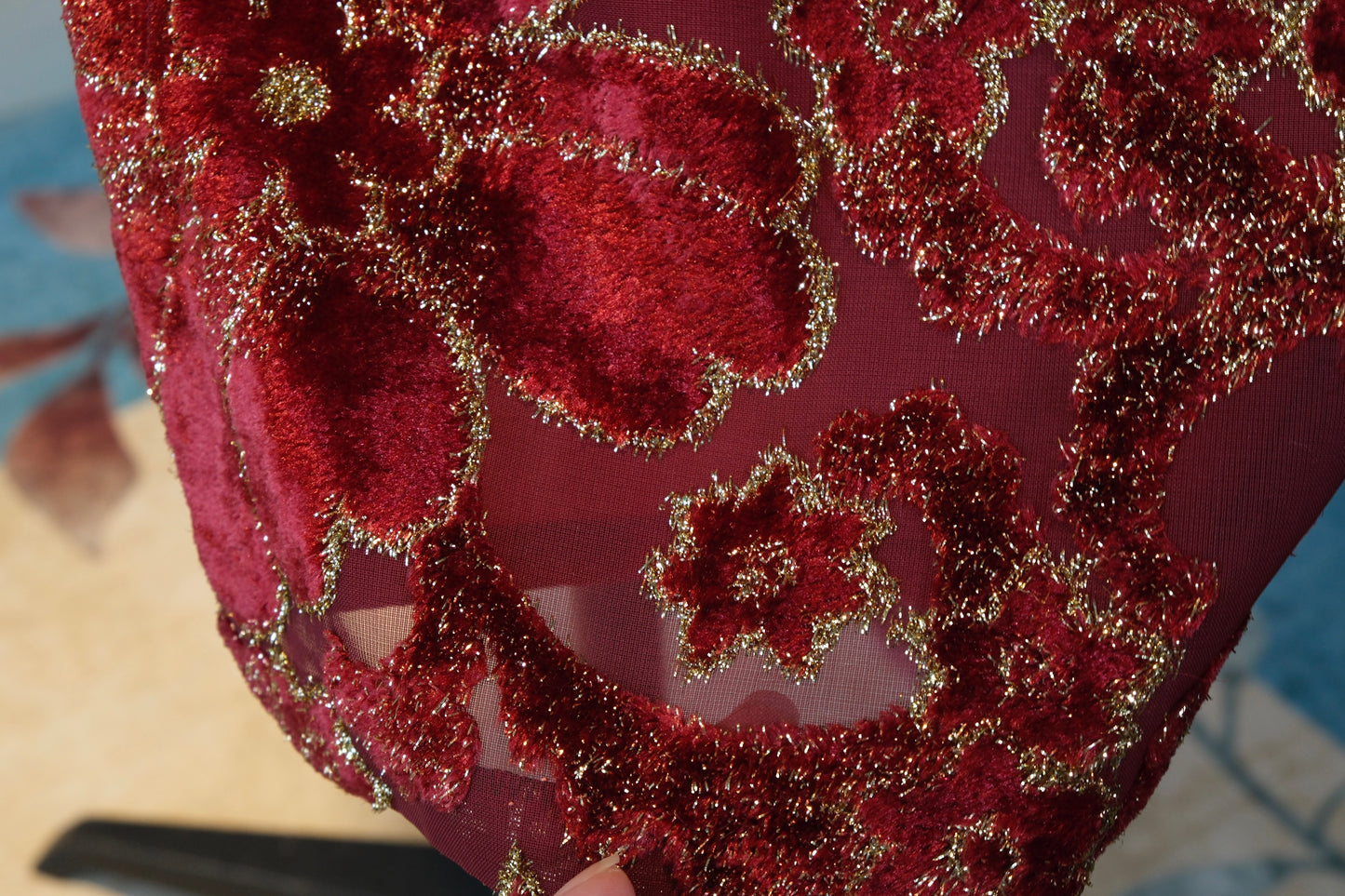
旗袍通体以深酒红丝绒为底,其上以烧花(Burn-out)工艺蚀刻出繁复的花卉纹样,再以金葱丝线(Lurex)沿花脉勾边,形成“浮凸”的立体视觉效果。花朵形态饱满,似牡丹又似菊,花瓣层叠舒展,枝叶缠绕其间,构成一幅流动的“富贵满堂”图景。这种“烧花+织金”的组合,在六十年代的台湾旗袍中极为罕见——烧花工艺源自意大利,需将特定化学药剂涂于织物表面,再经高温处理使部分纤维溶解,从而形成镂空或半透明的肌理;而金葱丝的加入,则赋予图案在光线下流转的金属光泽,宛如月光洒落花海。整件衣服的图案布局疏密有致,既非满铺的繁冗,亦非留白的孤寂,而是暗合中国画“计白当黑”的构图哲学,每一朵花、每一片叶都如工笔重彩般精雕细琢,却又在整体上保持呼吸感。
故事溯源:一场跨越海洋的工艺联姻
这件旗袍的诞生,本身就是一段传奇。它的“血统”可追溯至1960年代的台北裁缝铺——彼时台湾正值经济起飞初期,上流社会对“洋气”与“传统”的双重追求催生了大量高端定制旗袍。而面料,则来自遥远的意大利。当时意大利北部(如科莫地区)的丝绒织造厂已掌握成熟的烧花技术,其产品以“奢华、精致、富有戏剧性”著称,常被用于高级时装与舞台服装。这些面料经由贸易渠道输入台湾,再由本地匠人根据顾客身形量身剪裁,最终成就了这件“意式面料+中式剪裁”的混血杰作。
更值得玩味的是,它可能曾属于一位“新派名媛”——或许是外交官夫人、商界女强人,或是文化界人士。她穿着它出席晚宴、茶会或重要社交场合,在灯光下,金线闪烁,丝绒垂坠,每一步都带着无声的宣言:我既尊重传统,也拥抱世界。这种“中西合璧”的审美,正是六十年代台湾社会转型期的缩影——旧秩序尚未完全褪去,新风尚已悄然渗透,而旗袍,恰是这场文化碰撞中最优雅的载体。
引经据典:从《考工记》到张爱玲的衣橱
若论其艺术风格,可追溯至中国古代“锦绣”传统。《周礼·考工记》有云:“画缋之事,杂五色……青与赤谓之文,赤与白谓之章。”此旗袍之“文”,正在于红与金的强烈对比,以及烧花工艺所营造的“虚实相生”之境。而金线的运用,则令人联想到唐代“蹙金绣”——以金线盘绕成纹,极尽华贵。明代《天工开物》亦载:“凡织帛,罗纱用金线者,谓之‘金缕’。”可见金线与丝织品的结合,自古便是身份与审美的象征。
至于其稀缺性,不妨引用张爱玲在《更衣记》中的感叹:“衣服是一种言语,随身带着一种袖珍戏剧。”这件旗袍,正是那个年代“袖珍戏剧”的绝佳道具。它不仅是一件衣服,更是一种“姿态”——穿着它的人,必是懂得如何在传统与现代之间游走、如何在东方韵味与西方工艺之间取得平衡的女性。而如今,能保存如此完好、工艺如此精湛、且带有明确地域与时代印记的古董旗袍,已是凤毛麟角。市场上流通的所谓“老旗袍”,多为仿品或后期修复之作,真正原装原料、未经改动的六十年代精品,往往藏于私人收藏馆或博物馆,鲜少现身市面。
结语:一件衣服,一段历史,一种永恒的美
这件旗袍,是时间的琥珀,封存了六十年代的繁华与野心、匠心与巧思。它不只是“好看”,更是“有故事”;不只是“珍贵”,更是“不可替代”。当你凝视它时,你看到的不仅是一袭红衣,而是一个时代的呼吸、一群人的梦想、两种文明的对话。它提醒我们:真正的时尚,从不追逐潮流,而是创造经典;真正的奢侈,不在于价格标签,而在于它所承载的历史重量与人文温度。
若你有幸拥有它,请善待它——因为它不仅属于你的衣橱,更属于这个世界的文化遗产。
Measurements / Size Guide:
Bust / Waist / Hips: 84/68/86 cm
Total Length: 132 cm
Detailed Description:
This qipao is the crystallization of the convergence between 1960s Western textile technology and Eastern aesthetics. Its artistic value and historical scarcity are enough to make any collector or fashion historian catch their breath. It is no ordinary garment, but a piece of "wearable cultural relic" carrying the memories of an era, the peak of craftsmanship, and a cross-cultural dialogue.
The entire body of the qipao uses a deep wine-red velvet as its ground, upon which intricate floral motifs are etched via the devoré (burnout) process, with metallic lurex threads outlining the veins of the flowers to create a raised, three-dimensional visual effect. The blossoms are full in form—resembling both peony and chrysanthemum—with layered petals spreading wide and branches twisting between them, composing a fluid picture of "wealth and honor filling the hall." This combination of "devoré + loomed gold" is exceptionally rare among 1960s Taiwanese qipaos. The devoré technique originated in Italy, requiring a specific chemical paste to be applied to the textile surface, which is then treated with high temperatures to dissolve portions of the fibers, creating a hollowed-out or translucent texture. Concurrently, the addition of lurex filaments endows the motifs with a metallic luster that shifts dynamically under light, as if moonlight is scattering across a sea of flowers. The layout of the entire garment pattern is densely yet orderly arranged; it avoids both the heavy clutter of full coverage and the isolated loneliness of total blankness, secretly aligning with the compositional philosophy of "treating white space as ink" (ji bai dang hei) in traditional Chinese painting. Every single flower and leaf is as meticulously sculpted as heavy-color Gongbi artwork, yet retains a sense of breathability overall.
The birth of this qipao is itself a legend. Its lineage can be traced back to the custom ateliers of Taipei in the 1960s—a time when Taiwan was in the early stages of its economic takeoff, and high society's dual pursuit of "Western sophistication" and "local tradition" sparked a large wave of high-end custom qipao commissions. The fabric, however, came from faraway Italy. At that time, velvet weaving mills in northern Italy (such as the Como region) had already mastered mature devoré technology, and their products were celebrated for being luxurious, exquisite, and dramatic, frequently utilized in haute couture and theatrical costuming. These fabrics entered Taiwan through international trade channels and were tailored by local master artisans to fit the customer's exact body measurements, ultimately achieving this cross-bred masterpiece of "Italian fabric + Chinese tailoring."
Even more interesting to ponder is that it may have once belonged to a "modern madam"—perhaps a diplomat's wife, a prominent businesswoman, or a cultural figure. She would have worn it to attend evening banquets, tea parties, or major social occasions. Under the lights, the gold threads flashed and the velvet draped gracefully, with every single step carrying a silent declaration: I both respect tradition and embrace the world. This "East-meets-West" aesthetic serves as a distinct miniature of 1960s Taiwanese society during its transition phase—the old order had not fully faded away, while new trends had already quietly penetrated, and the qipao was precisely the most elegant carrier for this cultural collision.
If one is to trace its artistic style, it can be linked back to the ancient Chinese tradition of Jin-Xiu (fine embroidery and brocades). The Rituals of Zhou • The Book of Diverse Crafts (《周礼·考工记》) states: "The work of painting and embroidering consists of mixing the five colors... The combination of green and red is called wen, and the combination of red and white is called zhang." The wen (patterned beauty) of this qipao lies precisely in the strong contrast between red and gold, as well as the realm of "mutual generation of virtual and real space" created by the devoré process. Concurrently, the utilization of gold threads brings to mind the "couching gold embroidery" (cui jin xiu) of the Tang dynasty, where gold filaments were coiled into patterns to achieve ultimate luxury. The Ming dynasty text The Exploitation of the Works of Nature (《天工开物》) also records: "Whenever weaving silk, those that use gold threads for loomed fabrics are called jin lu (gold-threaded filaments)." It is evident that the combination of gold threads and silk textiles has been a symbol of status and refined aesthetics since ancient times.
As for its scarcity, one might reference Eileen Chang's famous observation in Chronicle of Changing Clothes (《更衣记》): "Clothes are a language, a pocket theater carried around with oneself." This qipao functions as the absolute perfect prop for that generation's "pocket theater." It is far more than a functional garment; it represents a specific posture—the wearer must be a woman who understands how to navigate between tradition and modernity, and how to strike a flawless balance between Eastern poetic grace and Western manufacturing technology. Today, authentic antique qipaos preserved in such unblemished condition, featuring such masterful craftsmanship, and carrying clear regional and chronological marks are an absolute rarity. The vast majority of so-called "old qipaos" circulating in modern markets are reproductions or late-stage restorations; genuine original-material, unaltered 1960s masterpieces are mostly shielded within private conservation vaults or institutional museums, rarely appearing on the open market.
This qipao acts as a piece of chronological amber, encapsulating the prosperity, ambition, handcraft, and ingenuity of the 1960s. It is not merely beautiful, it is "full of stories"; it is not merely precious, it is completely irreplaceable. When you gaze upon it, you see far more than a crimson dress; you feel the breath of an era, the dreams of a generation, and a dialogue between two distinct civilizations. It reminds us that true fashion never chases trends, but creates classics; true luxury does not reside in the price tag, but in the historical weight and human warmth it carries.
If you are fortunate enough to possess it, please treat it with absolute care—because it belongs not only to your private wardrobe, but to the cultural heritage of this world.
Suyuan Archival Textile Registry — Documenting the material culture, preserving the technical lineage of ancestral craft.