深圳溯源
无法加载取货服务可用情况
衣服尺寸:
胸围/腰围/臀围:80/68/90 厘米
衣长:132 厘米
细节描述:
“锦衣旗袍诗,曼玉花样时。”
在时尚轮回的洪流中,唯有真正的经典能穿越半个世纪的风尘,依旧熠熠生辉。今日所呈之珍品,乃是一件产自上世纪六十年代香港的无袖织锦缎旗袍。彼时的香港,正处于东西方文化交汇的黄金时代,海派旗袍的余韵与西式剪裁的利落在此完美融合,造就了这件不可复制的时代孤品。
一、 纹样考据:菊傲霜枝,金红交辉
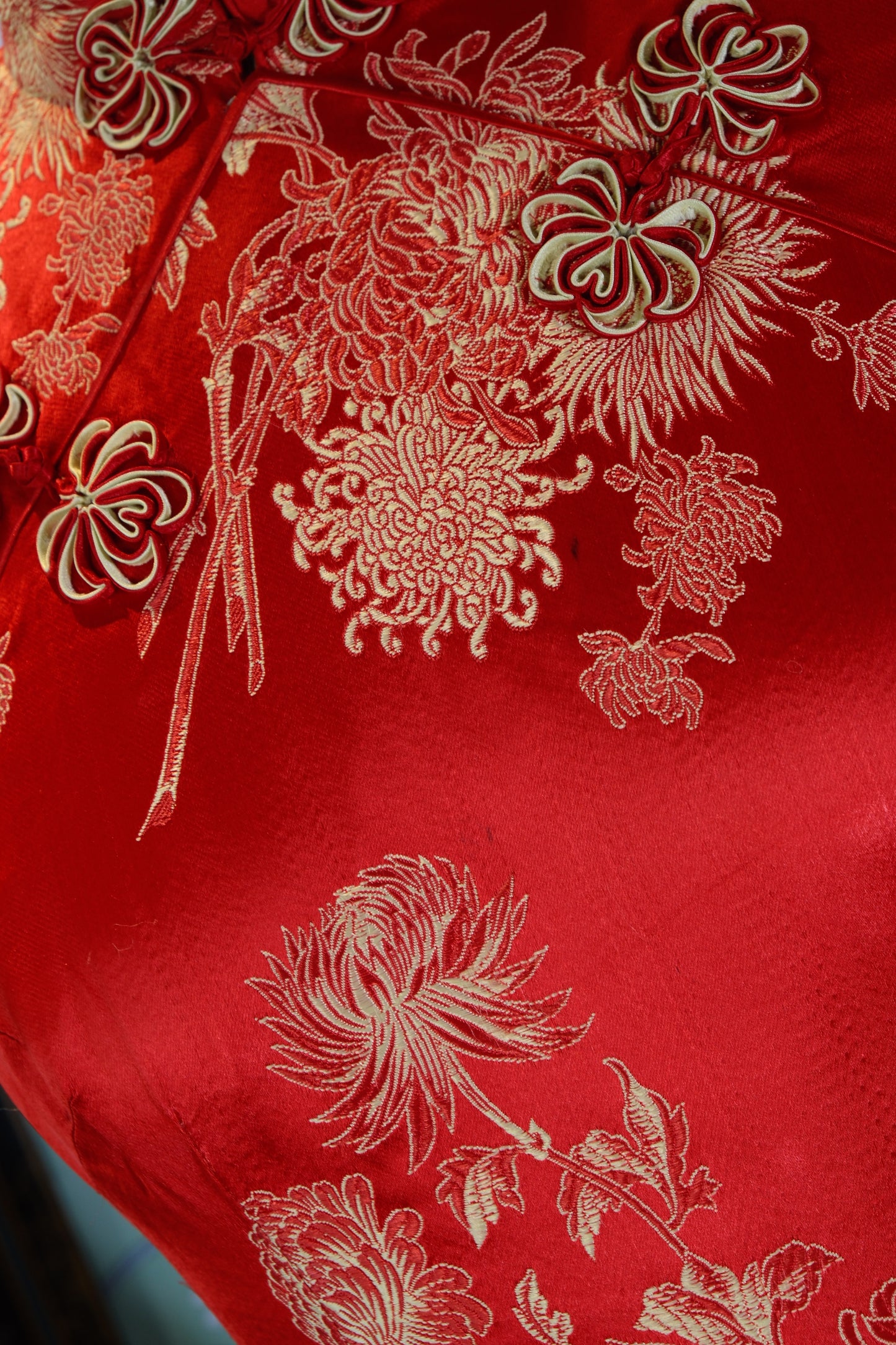
观其面料,乃是典型的传统提花织锦缎。这种面料质地紧密,光泽感极强,触手生温,是旧时达官贵人方能享用的奢华之物。
- 主色调: 采用了极具东方神韵的正红底色,寓意吉祥、热烈与尊贵。红色在中国文化中不仅是色彩的表达,更是情感的图腾。
- 图案解析: 衣身遍布金色的菊花纹样。古人云:“采菊东篱下,悠然见南山。”菊花,位列“梅兰竹菊”四君子之一,象征着高洁、隐逸与长寿。
- 细看这织锦中的菊花,并非呆板的重复,而是枝叶舒展,花朵饱满。花瓣层层叠叠,如金丝编织而成,在红色的底衬下,呈现出一种富丽堂皇而不失清雅的艺术效果。
- 这种“满地花”的布局,在视觉上极具冲击力,既保留了传统织造的繁复美,又通过金色的运用避免了俗艳,反而透出一种皇家般的威仪与端庄。
二、 工艺细节:双襟盘扣,匠心独运
此衣最精妙之处,在于其领口与前襟的设计。
- 双襟设计: 不同于常见的单开襟,这件旗袍采用了更为考究的双襟(或称如意襟变体)结构。这种设计对裁剪师的要求极高,必须保证左右对称,线条流畅,稍有不慎便会显得臃肿。它巧妙地修饰了胸部线条,将女性的柔美与含蓄展现得淋漓尽致。
- 精工盘扣: 请注意领口处的盘扣,这是整件衣服的“眼”。采用了与面料同色系的织锦缎制作,造型宛如盛开的微型花朵(类似梅花或菊花扣),与衣身的菊花纹样遥相呼应。这种“扣即是花,花亦是扣”的设计巧思,体现了当时香港裁缝极高的审美水准和手工技艺。
三、 历史回响:香江旧梦,绝版风华
张爱玲曾言:“对于不会说话的人,衣服是一种语言,随身带着的是袖珍戏剧。”
这件旗袍诞生于1960年代的香港。那是一个特殊的年代,旗袍开始进行最后的华丽转身。为了适应现代都市生活的快节奏,袖型逐渐变短甚至取消(如本件的无袖设计),裙长适度缩短,更加强调腰臀比的曲线美,融入了西方的立体剪裁理念。
然而,随着七十年代后成衣工业的兴起和西方迷你裙的冲击,这种需要耗费大量工时、依赖老裁缝手工量体裁衣的传统织锦缎旗袍,逐渐退出了日常穿着的舞台,成为了博物馆里的陈列或收藏家柜中的秘宝。
稀缺性综述:
如今市面上所见旗袍,多为现代机器量产,面料多为化纤,图案多为数码印花,虽有其形,却无其神。而这件六十年代的古董旗袍:
1. 面料绝版: 老式真丝或人造丝混纺的提花织锦缎,其色泽的温润度是现代化学纤维无法模拟的。
2. 工艺失传: 那种纯手工归拔(熨烫塑形)出来的立体胸腰曲线,以及手工盘制的精致花扣,已是凤毛麟角。
3. 岁月包浆: 六十年的时光赋予了它独特的“火气全消”的沉稳感,这是一种新衣永远无法具备的历史厚度。
结语:
这不仅是一件衣服,更是一首穿在身上的唐诗宋词,一段关于东方女性优雅与坚韧的无声叙事。拥有它,便是拥有了一段触手可及的流金岁月。
微瑕特价
Measurements / Size Guide:
Bust / Waist / Hips: 80/68/90 cm
Total Length: 132 cm
Detailed Description:
Within the technical domains of textile conservation, structural design history, and material culture analysis, an exceptional historical garment functions as an active social text. It documents a precise intersection of ancestral handcraft and localized modernization.
This magnificent 1960s Hong Kong-produced, sleeveless double-breast chrysanthemum silk brocade qipao (无袖双襟织锦缎旗袍) stands as a pristine physical testament to that rare mid-century golden era. It materializes a complex sartorial dialogue where traditional mainland loom-work converges with Westernized, highly disciplined pattern architecture. For curators, textile historians, and institutional archives, this specimen preserves a critical chapter in the evolution of the iconic Hong Kong silhouette.
The pattern drafting of this qipao represents an advanced calibration of structural symmetry and tailored tension, separating true master-tailored commissions from commercial period mass production.
The 1960s Hong Kong qipao chassis utilizes a moderate Mandarin collar with a stiffened structural core to ensure an unyielding vertical posture. This architectural foundation breaks into a rare, perfectly symmetrical double-breast layout (双襟结构) along the upper torso, sweeping smoothly into a modern, sleeveless armhole scye. The bodice is shaped into a highly articulated waist and hip field through rigorous traditional damp-iron manipulation (归拔工艺) and subtle internal darting, flowing cleanly into a structured, mid-length columnar hem that retains the firm tension of the heavy silk brocade weave.
The Mechanics of Symmetrical Double-Breast Drafting: Unlike standard asymmetrical single-opening variants, the double-breast layout requires rigorous dimensional precision. The master tailor must manipulate the pattern pieces to achieve absolute horizontal alignment across the front torso panel. This structural choice distributing the textile's weight evenly across the chest, eliminates bias wrinkling and yields a clean, armor-like upper bodice that accentuates the wearer's poise without sacrificing historical restraint.
The "Eye" of the Garment — Artisanal Frog Closures: Serving as both structural anchors and miniature sculptures, the meticulous hand-rolled frog closures (精工盘扣) at the neckline and lapels are formed directly from matching silk brocade. Configured into micro-floral motifs that mirror the greater textile motif, these closures reflect a high-tier design logic where closure and ornamentation merge seamlessly—each button serving as a flower, and each flower functioning as a button.
The visual and material character of this artifact depends heavily on its high-spec textile foundation: a high-density, structural jacquard silk brocade (提花织锦缎) utilizing complex metallic thread integration.
The Chromatic Ground: The primary color field consists of a vibrant, deeply saturated celebratory red. Far from catching light in cheap, scattered reflections, the high-density warp threads absorb and roll ambient illumination across the garment’s curves in deep, low-refraction crimson waves, imbuing the piece with authoritative, ceremonial weight.
The Metallurgical Weft and Chrysanthemum Layout: The surface iconography features fine gold-wrapped threads tightly woven into the weft architecture to form dense, layered chrysanthemum patterns (满地花). The layout rejects mechanical repetition; branches bend and extend across seams with deliberate calligraphic posture, while the blossoms are rendered in tiered, overlapping low-relief gold work.
Cultural Metaphors: This presentation directly evokes the classical scholar-gentry ideal popularized by Tao Yuanming's poetry ("采菊东篱下,悠然见南山"). The chrysanthemum, as one of the traditional Four Gentlemen (四君子), carries a heavy semiotic charge—signifying unyielding dignity under frost (菊傲霜枝), reclusive elegance, and longevity, beautifully balanced by the imperial prosperity suggested by the gold-on-red presentation.
To appreciate the rarity of this qipao is to understand the socio-industrial topography of 1960s Hong Kong—a unique historical enclave where traditional mainland tailoring met a rapidly modernizing global market.
The Ateliers of Migrant Master Tailors: Following the geopolitical transformations on the mainland during the mid-century period, elite master tailors from Shanghai migrated to Hong Kong, establishing small, highly exclusive ateliers. This qipao is a direct relic of that migratory genius. It showcases rigorous hand-finishing, completely enclosed hand-rolled piping (滚边), and specialized iron-blocking passes (归拔) used to sculpt two-dimensional silk curves into a permanent, three-dimensional form.
The Shift to Modern Mobility: As noted by Eileen Chang (张爱玲), clothing operates as a silent, portable theater of human transition. In the 1960s, Hong Kong's fast-paced urban lifestyle prompted the classic qipao to shed its sleeves and shorten its hemline to adopt Western-influenced structural lines. However, by the 1970s, the rise of industrial ready-to-wear lines and the global explosion of Western mini-skirts permanently dismantled this specialized bespoke industry. Consequently, garments requiring weeks of intensive manual craftsmanship vanished from daily life, elevating surviving examples to archival status.
When evaluated alongside modern reproductions, this 1960s artifact demonstrates strict irreproducibility across three core sectors:
| Curatorial Metric | Authentic 1960s Antique Specimen | Modern Commercial Reproduction |
| Material Base | High-spec natural silk/rayon mixed jacquard brocade; rich, warm tactile profile with low-luster reflection. | Low-density synthetic polyester or nylon weaves; cold tactile feedback with synthetic, high-scatter glare. |
| Pattern Execution | Manual hot-iron sculpting (归拔) tailored to internal structural contours; hand-turned floral frog closures. | Flat, automated laser cutting; standard machine-sewn closures with glued synthetic reinforcement. |
| Historical Volatiles | "Fire-extinguished" (火气全消) material patina; deep, stabilized coloration acquired over a sixty-year natural horizon. | Harsh, chemical-retaining finish; bright, artificial dye profiles lacking chronological depth. |
As a non-renewable specimen of mid-century textile history, this double-breast qipao stands as a museum-grade piece suitable for institutional acquisition, fine art auctions, or elite private conservation portfolios.
Environmental Mandate: To arrest the degradation of the delicate gold-wrapped threads and protect the organic silk fibers from embrittlement or oxidation, the artifact must be conserved under strict environmental controls. It must be maintained at a stable temperature of 18°C–22°C and a relative humidity of 45%–55%, completely isolated from ultraviolet exposure to prevent structural fiber breakdown or dye shifting.
Suyuan Archival Textile Registry — Documenting the material culture, preserving the technical lineage of ancestral craft.
Note: As-Is Special Price