深圳溯源
无法加载取货服务可用情况
衣服尺寸:
胸围/腰围/臀围:88/74/96 厘米
衣长:109 厘米
细节描述:
【引言:织物里的光阴】
张爱玲曾言:“对于不会说话的人,衣服是一种语言,随身带着的是袖珍戏剧。”当我们凝视这件上世纪六十年代的台湾产古董旗袍时,仿佛听到了一段被封存在经纬之间的低语。它不仅仅是一件衣物,更是一枚时间的琥珀,凝固了那个时代特有的温婉与坚韧,以及东方美学在现代化转型期的微妙呼吸。
【纹样赏析:繁花似锦的秩序】
此衣最摄人心魄之处,在于其面料——极为罕见的羊毛织锦。不同于丝绸的流光溢彩,羊毛赋予了织物一种哑光的、如油画般厚重的质感。
细观其纹样,并非寻常的平面印花,而是通过提花工艺织就的立体浮雕。图案以经典的“缠枝莲”为骨架,藤蔓蜿蜒流转,生生不息;其间错落点缀着抽象化的“宝相花”与“云雷纹”。这种布局深得中国传统构图之精髓——“密不透风,疏可走马”。朱砂红作为底色,沉稳而不艳俗,如同陈年的普洱;灰白与淡褐色的花纹交织其中,宛如岁月留下的斑驳光影。这种色彩的克制与纹样的繁复形成了极佳的张力,既有宫廷织造的富贵气,又兼具文人审美的雅致感,正如《长物志》所推崇的“宁古无时,宁朴无巧”的高级境界。
【形制考证:西风东渐下的东方剪裁】
从服装史的维度审视,这件旗袍是1960年代台湾服饰工艺巅峰的缩影。彼时的台湾,正处于传统与现代剧烈碰撞的熔炉之中。
看其剪裁,已完全脱离了清末民初的宽袍大袖,转而追求极致的合体与曲线美。高耸的立领依然恪守着东方的含蓄礼教,护住颈项间的端庄;但腰身的收省处理却明显受到了西方立体剪裁的影响,精准地勾勒出女性的柔美身姿。七分袖的设计,既保留了传统“上衣下裳”的遗韵,又适应了当时日益频繁的社交活动,展现出一种干练而优雅的新女性形象。这种“中西合璧”并非生硬的拼接,而是如盐溶于水般自然,体现了当时台湾裁缝师高超的技艺与审美自觉。
【稀缺性与价值:不可复制的孤品】
在古董衣收藏界,羊毛织锦旗袍因其保存难度大、存世量极少而被视为“金字塔尖”的藏品。羊毛纤维虽保暖挺括,却极易虫蛀脆化,能历经六十载岁月而色泽如初、版型不塌者,实属凤毛麟角。
据史料记载,六十年代台湾虽有“纺织王国”之美誉,但高端织锦多依赖进口或极少数老派工坊手工定制。这件旗袍所用的羊毛提花面料,极有可能是当年专为外销或高级定制而研发的特种面料,随着时代的变迁,这种工艺早已失传。因此,它不仅是一件衣裳,更是一段不可再生的纺织历史,是研究战后台湾社会风貌与女性意识觉醒的珍贵实物标本。
【结语:穿在身上的诗史】
《诗经》有云:“岂曰无衣?与子同袍。”衣裳,从来都是情感的载体。这件旗袍,或许曾陪伴某位名媛出席过重要的晚宴,或许曾在某个午后的茶会中惊艳四座。如今,它静默于模特架上,珍珠项链与之相映成辉,仿佛在诉说着一段关于美丽、关于传承、关于时光的不朽故事。
拥有它,便是拥有了一段可以触摸的历史,一份穿越时空的东方雅韵。
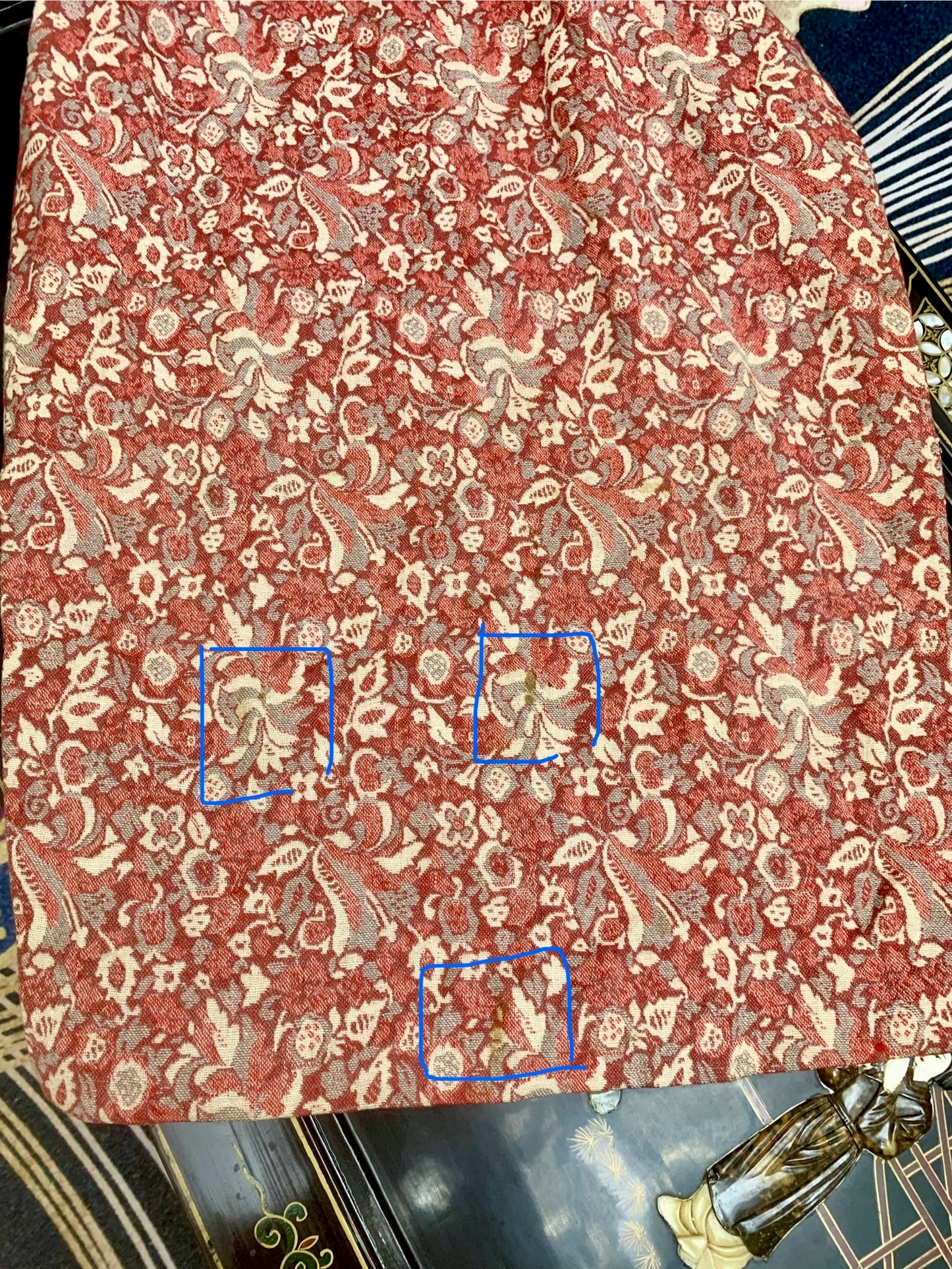
注:瑕疵特价
Measurements / Size Guide:
Bust / Waist / Hips: 88/74/96 cm
Total Length: 109 cm
Detailed Description:
Eileen Chang famously observed in The Record of Changing Clothes: "To those who cannot speak, clothes are a language; what one carries with them is a pocket drama." Gazing upon this authenticated antique qipao birthed in 1960s Taiwan, one can almost discern a low, interiorized whisper frozen within the warp and weft. This artifact transcends its utility as a luxury garment to function as a pristine piece of temporal amber—permanently archiving the gentle grace, unyielding fortitude, and subtle structural transitions defining Eastern aesthetics during its mid-century modernization.
The most arresting attribute of this garment resides in its structural composition: a highly rare Wool Brocade (Yangmao Zhijin). Shifting decisively away from the high-clarity, reflective luster characteristic of premium silk, the wool fiber endows the textile plane with a matte, low-visibility texture possessing the weighted density of a classical oil painting.
A close appraisal of the surface ornamentation reveals that it completely rejects flat surface printing, utilizing instead a highly complex jacquard weaving engineering to create high-relief, three-dimensional structural motifs. The pattern employs a classical interlinking lotus vine design (Chanzhilian) as its foundational skeleton, where trailing vines undulate across the canvas to signify perpetual lifeforce. Interspersed between these lines are abstracted rosette blossoms (Baoxianghua) and ancient cloud-and-thunder fret designs (Yunleiwen). This structural layout masterfully channels the core composition doctrine of classical Chinese fine art: "dense enough to block the wind, yet spacious enough to gallop a horse." Cinnabar red serves as the primary grounding chassis—subdued, deep, and absolutely resistant to vulgarity, reminiscent of fine aged Pu-erh tea. Argent-gray and pale taupe filaments are interwoven across this red field, mimicking the fractured interplay of light and shadow left by the passage of time. This calculated equilibrium between chromatic restraint and extreme structural complexity generates magnificent visual tension. It simultaneously projects the sovereign opulence of court-commissioned imperial textiles and the minimalist discipline of literati aesthetics, flawlessly materializing the supreme design ethos advocated in the Ming Dynasty treatise Treatise on Superfluous Things (Changwuzhi): "Prefer the antique to the contemporary; prefer simplicity to superficial skill."
Appraised through the analytical lens of costume history, this qipao operates as a flawless physical crystallization of the absolute peak capabilities achieved by Taiwan's tailoring apparatus during the 1960s—an epoch characterized by the intense, furnace-like collision and reconciliation of heritage and modernity.
Evaluating the pattern-drafting blueprint, the garment has completely unburdened itself from the loose, expansive, wide-sleeve volumes characteristic of the late Qing Dynasty and early Republican eras, pivoting aggressively toward advanced ergonomic contours and supreme fit. The towering standing collar (Liling) strictly defends traditional Confucian decorum, disciplining and framing the neck with absolute dignity. Concurrently, the calculated pattern darting (收省) localized at the waist parameters draws heavily upon Western three-dimensional tailoring logic, mapping the biological S-curve of the female form with immense mathematical precision. The choice of three-quarter sleeves (Qifenxiu) simultaneously safeguards the traditional aesthetic memory of the "separate upper and lower vestments" system (Shangyi Xiachang) while accommodating the accelerated mobility required by the mid-century woman's escalating social engagement. This cross-cultural synthesis avoids crude structural juxtaposition, dissolving Eastern grace into Western form as naturally as salt dissolves into water—a direct testament to the sublime technical mastery and acute aesthetic autonomy of the period's master tailors.
Within the elite networks of antique apparel conservation, a wool broquard qipao occupies the absolute apex of the curatorial pyramid due to its severe vulnerability to environmental duress and its exceptionally low global survival yield. While wool fibers provide excellent insulation and high structural rigidity, they are notoriously susceptible to insect predation, chemical embrittlement, and localized fiber fracturing over long timelines. For a textile matrix of this composition to survive across six decades while maintaining its original chromatographic saturation and pristine architectural volume is an extreme statistical anomaly.
Historical records indicate that while Taiwan was celebrated globally as a "Textile Kingdom" during the 1960s, the production of elite, high-specification brocades remained heavily reliant on specialized luxury imports or custom-executed commissions from a select few old-school heritage ateliers. The wool jacquard yardage deployed for this chassis was almost certainly a proprietary, high-tier textile engineered specifically for elite export or haute-couture private commissions; following the total reorganization of global industrial textile lines, this specific weaving algorithm has entered absolute depletion. Consequently, this chassis performs as an irreplaceable, non-reproducible primary physical document—a material monument charting post-war societal evolution, industrial history, and the mid-century awakening of East Asian female autonomy.
The ancient Classic of Poetry (Shijing) records: "How can you say you have no clothes? I shall share my robes with you." Clothing has never functioned merely as a passive instrument for shielding the anatomy; it operates as the ultimate living epidermis of history, the primary material vessel of human emotion. This specific qipao may have accompanied an elite socialite to a historic state banquet, or commanded absolute visual resonance during a high-society afternoon salon. Today, it stands in monumental composure upon the curatorial bust, its presence beautifully elevated by a contrasting strand of pearls—silently uttering an undying narrative centered on human craftsmanship, discipline, and absolute beauty. To curate this specimen is to permanently archive a touchable fragment of history; to step into its structure is to engage in a profound, cross-temporal dialogue with the sovereign elegance of an unrepeatable golden youth.
Note: As-Is Special Offer