深圳溯源
无法加载取货服务可用情况
衣服尺寸:
胸围/腰围/臀围/衣长:100/84/100/100 厘米
细节描述:
【形制与面料:流金岁月的触感】
这件旗袍诞生于上世纪六十年代的香港,彼时正值“海派”旗袍向“港式”旗袍转型的黄金时期。它摒弃了四十年代过于繁复的装饰,转而追求线条的极致流畅与面料本身的奢华质感。
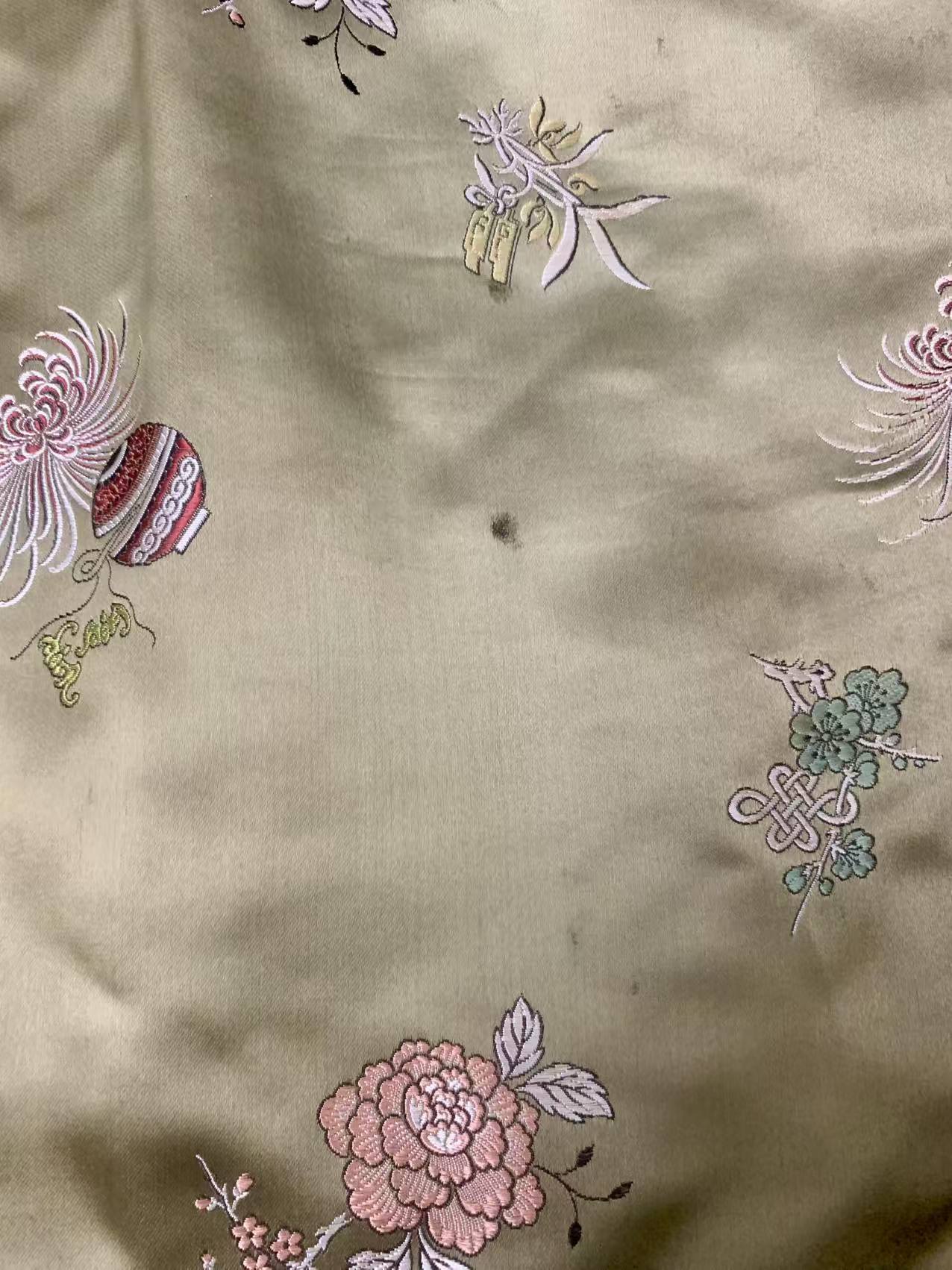
整衣采用高定级别的提花织锦缎为面料。这种面料在光线下呈现出如液态黄金般流动的色泽,是一种极具视觉冲击力的橄榄绿(或称苔藓绿),既沉稳内敛,又暗藏生机。织锦缎特有的厚重感与挺括度,完美支撑起了六十年代旗袍标志性的立体剪裁——那是一种强调女性自然曲线、腰身收紧、臀胯圆润的S型轮廓,尽显东方女性的婉约与风骨。
【纹样解码:穿在身上的吉祥诗篇】
最令我着迷的是其面料上精妙绝伦的提花纹样。这并非随意的印花,而是通过复杂的提花工艺织造而成的“暗花”与“明花”交织的艺术。
1. 缠枝牡丹(富贵连绵): 画面中最为显眼的是那一朵朵盛开的粉色牡丹。在中国传统文化语境中,“唯有牡丹真国色,花开时节动京城”。这里的牡丹并非孤立存在,而是采用了“缠枝”的构图方式,枝蔓卷草蜿蜒相连,寓意“生生不息、富贵连绵”。粉嫩的色调在深绿底色上显得格外娇艳,打破了沉闷,增添了少女般的灵动。
2. 菊花与绣球(延年益寿): 穿插于牡丹之间的,是形态各异的菊花与绣球花。菊花傲霜斗雪,象征高洁与长寿;绣球花团锦簇,寓意圆满与希望。这些花卉纹样大小错落,疏密有致,仿佛一阵风吹过,花园中的花朵正在轻轻摇曳。
3. 盘长结与杂宝(福寿双全): 仔细观察,花叶之间还点缀着传统的“盘长结”(佛教八宝之一,象征回环贯彻、永恒不灭)以及类似灯笼或绣球的几何纹饰。这些符号化的纹样将文人的雅趣与世俗的祈愿完美融合,体现了六十年代香港社会在传统与现代夹缝中对美好生活的向往。
【历史回响:张爱玲笔下的“乱世繁华”】
张爱玲曾在《更衣记》中写道:“回忆这东西若是有气味的话,那就是樟脑的香,甜而稳妥,像记得分明的快乐,甜而怅惘,像忘却了的忧愁。”
这件旗袍,正是那段历史的见证者。六十年代的香港,是东西方文化剧烈碰撞的熔炉。此时的旗袍,不再仅仅是民国旗袍的遗存,它吸收了西方的立体剪裁(如装袖、收省),变得更加修身、现代。
想象一下,在那个年代,一位穿着此衣的女子,或许正走在中环的石板路上,或是坐在湾仔的茶楼里。她颈间佩戴的那串长款珍珠项链(图片中搭配展示),是当时名媛淑女的标配,拉长了颈部线条,增添了优雅的层次感。这件衣服不仅是一件遮蔽身体的织物,它是那个时代女性独立意识觉醒的宣言——她们开始大胆地展示身体曲线,追求精致与体面。
【稀缺性与艺术价值:不可复制的孤品】
从学术角度来看,这件旗袍具有极高的收藏价值:
- 工艺的断代: 真正的老式提花织锦缎,其经纬密度极高,色彩过渡自然,这是现代化纤印染技术难以模仿的“古朴感”。随着老一辈织造工匠的离去,这种带有独特“手工温度”的面料已近乎绝迹。
- 保存的奇迹: 丝绸娇贵,历经六十载岁月,能保持如此完整的色泽,无明显褪色、脆化,实属罕见。这不仅得益于当年的染色工艺精湛,更得益于历任收藏者的悉心呵护。
- 审美的标本: 它完美定格了六十年代“港式旗袍”的审美巅峰——既有中国传统纹样的庄重,又有现代时装的利落。
结语:
这不仅是一件衣服,这是一段被封存的时光。当你穿上它,你穿上的不仅是锦绣华服,更是那个流金岁月的优雅与从容。正如古诗所云:“锦衣雪华玉颜色,回眸一笑百媚生。”愿这件稀世珍宝,能遇上一位懂它、惜它的有缘人,续写下一段风华绝代的故事。
注释:瑕疵特价
Measurements / Size Guide:
Bust / Waist / Hips / Total Length: 100/84/100/100 cm
Detailed Description:
Originating in 1960s Hong Kong, this specimen captures the precise historical zenith when the classic Shanghai style (Haipai) integrated completely into the distinctively professionalized "Hong Kong Style" (Gangshi). Stripping away the heavy, literal ornamentations of the late 1940s, the design philosophy of this era pivoted toward radical fluidity of line and the raw premiumization of structural textiles.
The primary matrix of the garment is a couture-grade jacquard brocade (zhijindan). Under dynamic lighting, the surface exhibits a liquid-gold, shifting luminosity across a deep, visually compelling Olive or Moss Green ground—a palette that is simultaneously grounded, aristocratic, and structurally alive. The characteristic density and intrinsic stiffness of traditional brocade provide the exact mechanical support required for the 1960s qipao’s signature three-dimensional contour: a highly sculpted, ergonomic S-silhouette that compresses the waist and rounds the high hip, forcefully articulating the poise and modern agency of the mid-century Eastern woman.
The core visual power of this artifact lies in the technical mastery of its woven iconography. Rather than surface-level printing, the motifs are engineered directly into the structure through complex jacquard configurations, creating an exquisite dialogue between matte grounds and lustrous silk floats.
The Interlocking Peony (Continuous Opulence / Chanzhi Mudan): The primary graphic weights are the fully bloomed pink peonies, capturing the classical ideal that "Only the peony reigns supreme as the true national color." Crucially, the composition avoids isolated clusters; instead, it utilizes the ancient interlocking vine arrangement (chanzhi), where scrolling tendrils weave continuously across the field to signify eternal renewal and unbroken lineage. The delicate pink hue flashes vividly against the moss-green backdrop, shattering any structural monotony with a youthful, dynamic kineticism.
Chrysanthemum and Hydrangea (Longevity and Completeness): Interspersed among the peony clusters are multi-form chrysanthemums and tightly grouped hydrangeas. The chrysanthemum, resilient against winter frosts, serves as an established archetype of moral purity and long life, while the dense spherical form of the hydrangea signifies familial harmony and complete realization. The flowers alternate in scale, density, and spatial distribution, mimicking the organic cadence of a garden stirred by a gentle breeze.
The Mystic Knot and Auspicious Emblems (Omnipresent Fortune / Panchang): A macro-inspection of the foliate ground reveals hidden graphic inserts of the traditional Mystic Knot (panchang—one of the Eight Auspicious Buddhist Symbols, denoting infinite continuity and cyclic eternity) alongside geometric variations resembling festive lanterns and silk balls. These signifiers seamlessly synthesize high-literati intellectualism with vernacular prayers for prosperity, mirroring the collective psychology of 1960s Hong Kong society as it navigated the ideological threshold between classical tradition and Western modernity.
As Eileen Chang famously observed in Reflections on Clothing: "If memory could be bottled, it would smell of camphor—sweet and reassuring, like a joy remembered clearly; sweet and melancholy, like a sorrow forgotten."
This garment functions as a physical witness to that precise cultural transition. The Hong Kong of the 1960s was a volatile forge of Eastern and Western cross-pollination. The qipao was no longer just an antique remnant of the Republican era; it aggressively adopted European haute-couture pattern drafting—such as set-in sleeves and deep structural waist and bust darts—becoming leaner, sharper, and distinctly urbanized.
To reconstruct its historical life-world: a woman wearing this specimen would have navigated the stone-paved declines of Central or presided over elite salons within the Mid-Levels. The long, multi-layered pearl strand styled with the garment was the mandatory uniform of the era’s upper-class intelligentsia and socialites, elongating the cervical spine and providing an architectural counterpoint to the high Mandarin collar. This vestment was not a passive text; it was a loud declaration of emerging female autonomy—a deliberate exhibition of the anatomical curve, executed with absolute decorum and refinement.
From an academic and market perspective, this qipao presents several critical markers of elite collection value:
Chronological Authenticity of Craft: The genuine mid-century jacquard brocade exhibits a remarkably high warp-and-weft density and a soft, organic tonal gradation across the silk floats that modern synthetic chemical dyes and high-speed digital looms cannot replicate. With the passing of that foundational generation of master weavers, textiles with this specific "hand-made temperature" are permanently extinct.
Exceptional Preservation State: Natural silk is a highly volatile protein fiber. For a garment to endure sixty years while preserving absolute chromatic intensity, free from structural embrittlement, UV-fading, or localized fracturing, is an extraordinary anomaly. It confirms both the supreme chemical stabilization of the original dye-baths and decades of impeccable, climate-controlled archival stewardship.
The Aesthetic Paradigm: It captures the definitive design equilibrium of the "Hong Kong Style" qipao at its historical peak—retaining the formidable cultural dignity of Chinese iconography while matching the streamlined, structural precision of Western mid-century modernism.
This artifact is more than couture; it is a fragment of time preserved in fiber. To engage with it is to step into the grace and unflappable composure of a bygone era. True to the classical verse, "Woven in gold and snow-white silk, her radiance commands the room; with a single backward glance, a thousand charms awaken." This rare treasure awaits a custodian capable of decoding its structural poetry and preserving its unmatched lineage for the next generation.
Note:As-Is Special Offer