深圳溯源
无法加载取货服务可用情况
衣服尺寸:
胸围/腰围/臀围:102/90/100 厘米
衣长: 112 厘米
细节描述:
【器物综述】
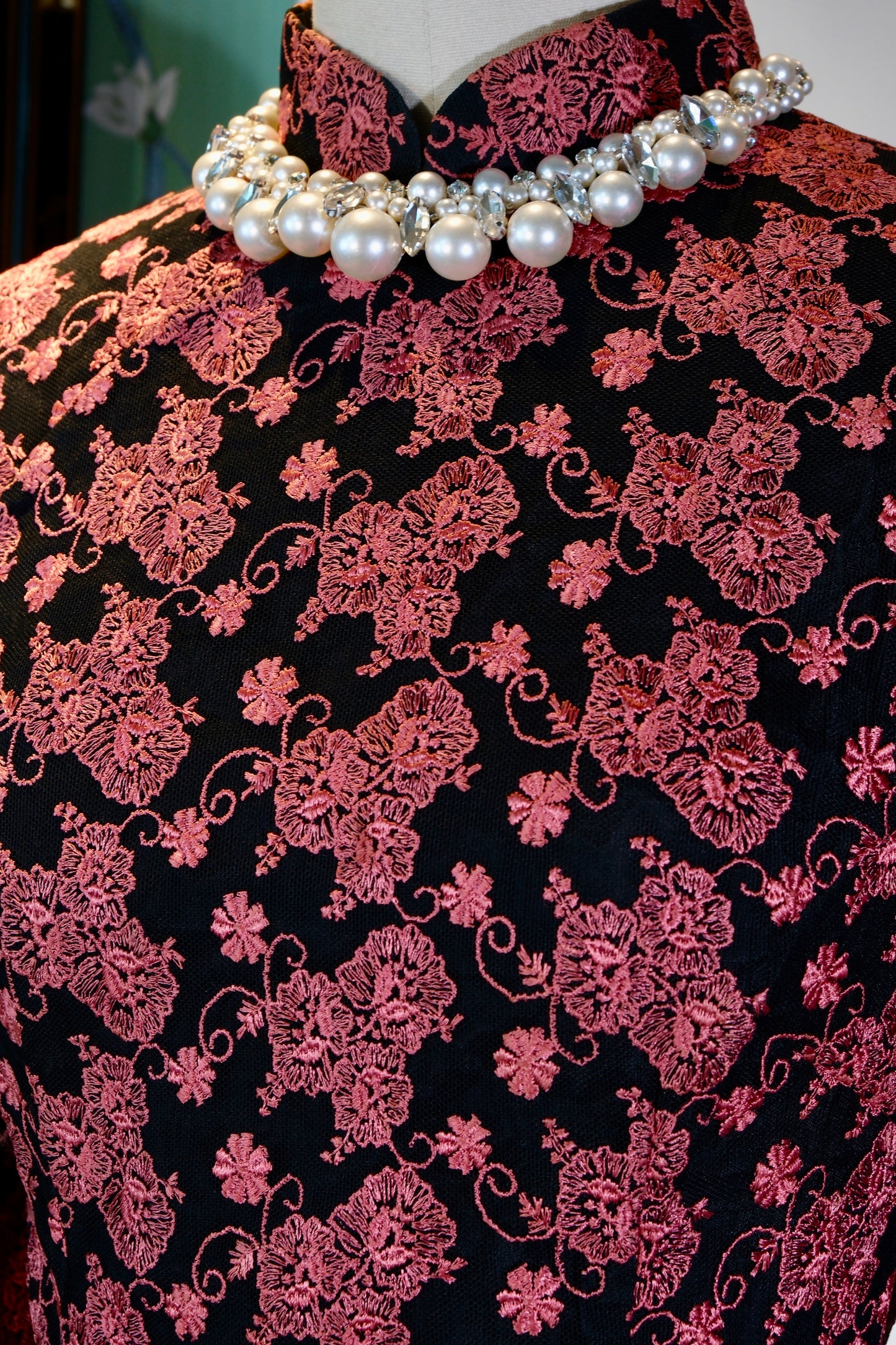
此件藏品,乃上世纪六十年代台湾裁缝工艺与日本进口面料完美结合之典范。彼时正值台湾纺织业腾飞前夜,高端成衣多依赖进口面料与本地精湛手工的结合。这件旗袍选用了当时极为昂贵的日本进口机绣蕾丝(Japanese Machine Embroidered Lace),底料为挺括的黑色网纱,上覆重工粉色花卉刺绣。其形制保留了传统海派旗袍的严谨结构——高领、收腰、开衩,但在面料选择上却大胆引入了西洋蕾丝工艺,是典型的“中西合璧”时代产物,见证了那个年代东方女性对摩登与古典的双重追求。
【纹样赏析:繁花似锦,暗香浮动】
观其衣身,图案布局疏密有致,极具章法。
1. 主花: 并非传统的牡丹或龙凤,而是采用了更具现代装饰艺术风格的蔷薇科花卉(似玫瑰或月季)。花朵呈盛放状,花瓣层叠,利用粉色丝线的粗细变化表现出极强的立体浮雕感。这种花卉形态在六十年代的波普艺术与时尚插画中颇为常见,象征着女性的热烈与生命力。
2. 辅纹: 大花之间穿插着细碎的五瓣小花与卷草纹。这些藤蔓线条流畅婉转,如同书法中的“游丝描”,将孤立的花朵串联成一片连绵不断的锦簇。
3. 色彩美学: 黑色底色如夜空般深邃,衬托出粉色刺绣的娇艳欲滴。这种“黑粉”配色在当时属于极具前瞻性的审美,既有成熟女性的稳重,又不失少女的浪漫情怀。正如《诗经·郑风》所云:“有美一人,清扬婉兮。”这满身的繁花,恰似女子心中那份欲说还休的情愫,在暗夜中独自芬芳。
【历史回响:流金岁月的剪裁记忆】
这件旗袍的故事,要从六十年代的台北说起。那是一个张爱玲笔下“倾城之恋”余韵尚存,却又开始拥抱西方工业文明的年代。
据考证,当时的台湾名媛或家境殷实的女性,在定制旗袍时,往往会特意指定使用“日本蕾丝”或“法国蕾丝”。日本进口的机绣蕾丝以其针脚细密、光泽度好且价格相对法式蕾丝更为亲民而风靡一时。然而,蕾丝面料极难伺候,它没有弹性,且容易脱丝。
这就要求裁缝必须具备极高的技艺。请看这件旗袍的归拔工艺:为了让柔软的蕾丝贴合人体曲线,裁缝师必须通过高温熨烫和手工拉伸(即“归拔”),使平面的布料产生立体的弧度,以容纳胸腰臀的起伏。尤其是袖口的设计,采用了微喇的七分袖,既露出了手腕最纤细的部分,又呼应了蕾丝的通透感,这是六十年代区别于五十年代长袖保守风格的显著特征。
它不仅仅是一件衣服,它是那个时代一位女性在参加晚宴、或是拍摄全家福时,最郑重其事的战袍。它可能曾伴随着留声机里的周璇歌声,在舞池中旋转;也可能静静地挂在樟木箱里,等待着下一个重要时刻的到来。
【学术价值与稀缺性:针尖上的绝唱】
从服装史的角度审视,此件藏品的稀缺性体现在以下三点:
1. 面料的不可再生性: 六十年代的日本机绣蕾丝多采用人造丝或早期尼龙混纺,随着化工技术的迭代,那种特有的哑光质感和丝线的光泽已难以复刻。现代蕾丝往往过于光亮或过于廉价,唯有老料才能沉淀出这种温润的岁月感。
2. 工艺的断层: 这种全蕾丝旗袍对拼接技术要求极高。为了保持花纹的完整性,裁缝需要在侧缝、肩缝处进行极其复杂的“对花”操作。如今,愿意花费数十小时去对齐一朵花的匠人已是凤毛麟角。
3. 保存的难度: 蕾丝面料娇贵,极易勾丝脆化。能像图中这样,历经半个多世纪依然色泽鲜亮、网底完整、无大面积破损,实属“传世级”品相。
古人云:“锦衣雪华玉颜色,回眸一笑百媚生。”这件旗袍,以黑为纸,以粉为墨,绣尽了六十年代的繁华旧梦。它不仅是一件御寒蔽体之物,更是一段可以被触摸的历史,一首穿在身上的无声诗。
Measurements / Size Guide:
Bust / Waist / Hips: 102/90/100 cm
Total Length: 112 cm
Detailed Description:
This archival specimen stands as a magnificent manifestation of 1960s Taiwanese bespoke tailoring seamlessly integrated with premium imported Japanese textiles. Positioned on the eve of the post-war Taiwanese light-industrial boom, high-end custom apparel portfolios relied heavily on a sophisticated marriage of foreign luxury raw materials and elite local handcraft. This specific qipao features an exceptionally expensive imported Japanese machine-embroidered lace (Japanese Machine Embroidered Lace), constructed over a crisp, structural black mesh chassis overlaid with heavy-gauge pink botanical embroidery. While its silhouette strictly preserves the disciplined structural logic of the traditional Shanghai style (海派)—marked by a stiffened standing collar, precise waist reduction, and balanced lateral side slits—its material chassis boldly incorporates Western lace technology. It functions as a classic text of the "East-meets-West" design era, chronicling mid-century Eastern women's balanced pursuit of modern lifestyle and classical restraint.
The composition of the embroidery features a highly disciplined distribution of dense and open fields, executing a rigorous visual rhythm across the textile layout:
The Primary Botanical Focus: Departing from traditional concrete imperial iconography like the peony, dragon, or phoenix, the fabric utilizes Rosaceae family flora (resembling the rose or Chinese monthly rose) aligned with modern Art Deco decorative frameworks. The blossoms are caught in full bloom with multi-layered, cascading petals. By varying the structural thickness of the pink silk filaments, the machine embroidery achieves a powerful, low-relief tactile depth. This floral morphology was deeply prevalent in 1960s Pop Art layouts and fashion illustration spheres, operating as a visual symbol of independent vital force.
The Secondary Filigree Matrix: Dispersed between the primary roundels are micro-calibrated, five-petaled miniature flowers interwoven with scrolling foliage. These winding vines extend across the garment seams with a fluid calligraphic elegance akin to the "continuous thread" line-drawing technique (“游丝描”), stitching the isolated botanical clusters into an unbroken, infinite garden matrix.
The Chromatic Palette: The deep black base functions as a nocturnal void, absorbing ambient light to throw the vibrant pink embroidery into high visual relief. This black-and-pink contrast represented a highly progressive, forward-looking aesthetic during the mid-century horizon, balancing mature dignity with romantic undertones. As the classical text The Book of Songs • Zheng Wind notes: "There is a beautiful maiden, refined and clear of countenance." This total saturation of blossoms mimics a woman's interior reticence, broadcasting a quiet fragrance within the dark.
The provenance of this qipao belongs to the distinct urban context of 1960s Taipei—an era where the nostalgic elegance of old Shanghai still lingered, even as the urban landscape actively embraced Western industrialized modernism.
Archival documentation shows that when prominent Taiwanese madams or women from affluent merchant families commissioned custom qipaos, they routinely specified the inclusion of "Japanese imported lace" or "French custom lace." Japanese machine-embroidered lace became highly popular because its stitch passes were incredibly dense, its thread luster was stabilized, and its valuation was far more practical than fragile French alternatives. However, executing a garment from raw lace operates as an immense challenge for a custom tailor; the material possesses no natural mechanical elasticity and is highly vulnerable to structural thread pulling.
This material constraint demanded ultimate mastery over the traditional tailoring art of Gui-Ba (归拔工艺). To force the non-stretch lace to contour fluidly around the three-dimensional geometry of the female form, the master craftsman had to apply precise hot-iron blocking, localized dampness, and manual tension manipulation. This physical sculpting stretched and shrank the flat textile matrix directly over custom dress forms, building an internal structural skeleton to accommodate the natural curves of the bust, waist, and hips. Crucially, the sleeve design adopts a modified, slightly flared three-quarter sleeve (七分袖), exposing the narrowest part of the wrist while referencing the translucent quality of the lace weave. This architectural choice serves as a primary marker distinguishing the expressive 1960s design language from the conservative long-sleeved profiles of the 1950s.
This piece transcends everyday dress; it operated as a ceremonial "battle dress" (战袍) commissioned specifically for elite evening galas or formal family heirloom portrait sessions. It may have moved across mid-century ballrooms to the low hum of old gramophones, or rested quietly wrapped inside protective camphor wood chests, awaiting its next milestone.
From the standpoint of textile conservation and design history, the absolute rarity of this specimen is verified across three key technical metrics:
The Non-Renewable Material Base: 1960s Japanese machine-embroidered lace utilized specific early formulations of rayon or early nylon blends. Following decades of chemical and manufacturing iterations, that highly specific, muted matte depth and soft filament luster can no longer be replicated by modern commercial textile mills. Modern lace yields an over-processed, high-scatter artificial shine, whereas this vintage material displays a settled, honest chronological depth acquired over a sixty-year natural horizon.
The Structural Fragmentation of Craft: Executing a complete qipao out of continuous lace requires extreme precision during the assembly phase. To maintain total continuity of the pattern across the garment's anatomy, the tailor had to calculate a highly complex pattern-matching protocol (“对花”) along the lateral side seams, shoulder seams, and diagonal lapel closures. In contemporary apparel spheres, master tailors willing to invest dozens of manual hand-hours to align a single floral motif have almost completely vanished.
The Horizon of Preservation: Lace is inherently fragile, prone to fiber embrittlement, atmospheric oxidation, and structural tearing. For a specimen to survive over half a century while maintaining vivid coloration, a completely unblemished structural mesh chassis, and total freedom from insect or mechanical breakdown qualifies it directly for museum-grade, "传世级" (transmitted-through-generations) classification.
As the ancients wrote: "Clad in fine embroidered silks like flawless snow, a single backward glance awakens a hundred charms." This qipao uses black as its paper and pink as its ink, writing a complete silent poem of the forgotten dreams of the 1960s. It transcends its primary function as a physical shield against the elements, standing as a piece of tangible, living history you can touch and hold.
Suyuan Archival Textile Registry — Documenting the material culture, preserving the technical lineage of ancestral craft.