深圳溯源
无法加载取货服务可用情况
衣服尺寸:
胸围/腰围/臀围/衣长:92/80/104/106 厘米
细节描述:
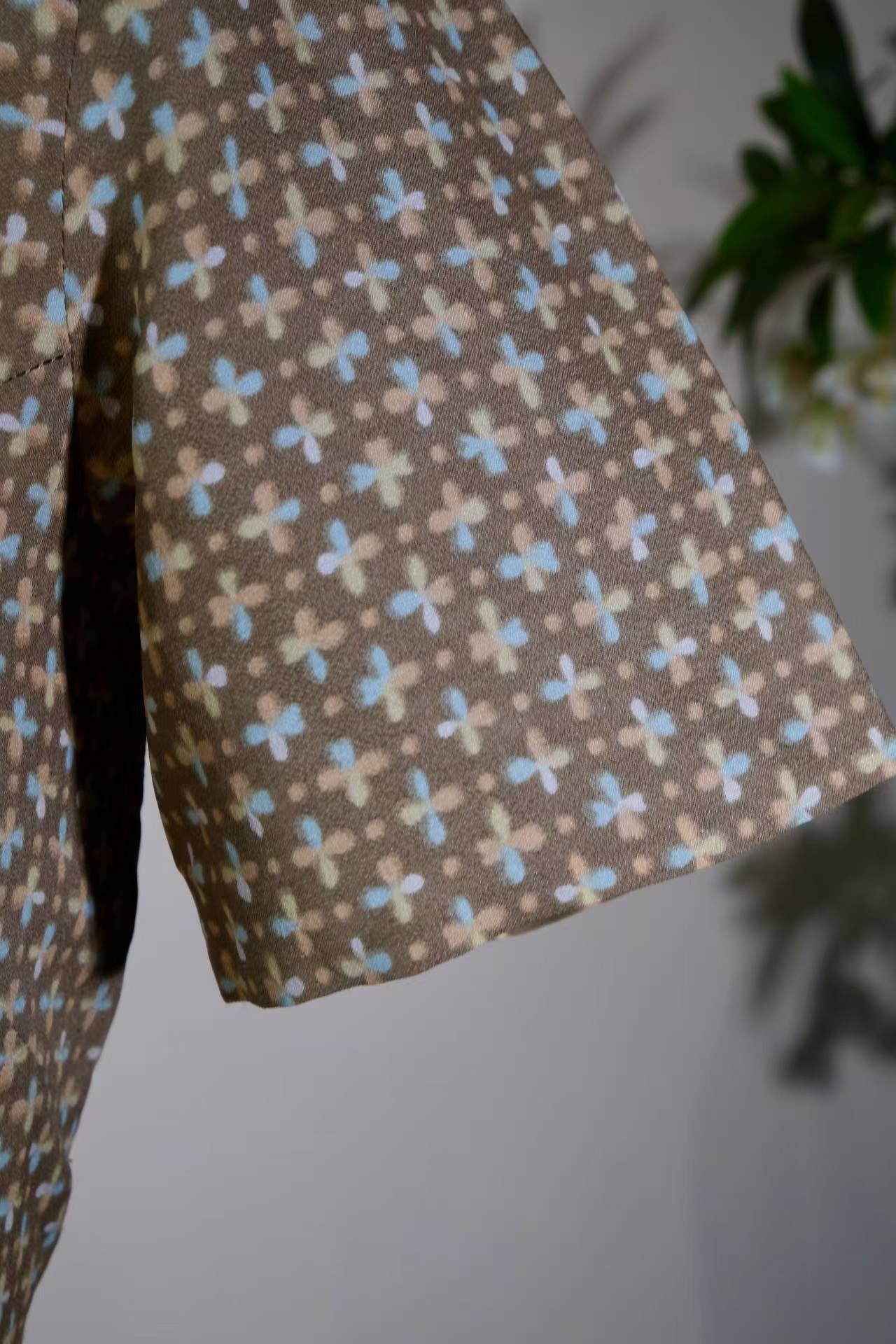
一、 纹样赏析:几何秩序下的波普前奏
这件旗袍最引人入胜之处,在于其面料纹样的独特性。它并非传统苏绣或织锦缎那般具象的牡丹凤凰,而是一种极具现代主义色彩的抽象几何纹样。
细观其表,底色呈现出一种经过岁月沉淀的暖灰褐调(Taupe),宛如旧时光里的咖啡渍。其上密布着规则的十字星芒与圆点阵列。这些图案并非简单的印染,而是采用了上世纪中叶极为流行但如今已近乎失传的“喷绘”工艺。工匠利用喷枪将染料雾化,使得蓝、白、米黄三色在织物纤维间自然晕染,边缘带着一种类似水彩画的朦胧感与颗粒感。
这种排列整齐的“十字花”与“波点”,在视觉上构成了一种严谨的数学韵律。它让人联想到同时期西方正在兴起的欧普艺术(Op Art)与波普文化,却又被东方特有的含蓄色调所收敛。这是一种“克制的摩登”,既有工业时代的秩序美,又保留了手工温度的随机性。
二、 剪裁与工艺:黄金时代的身体叙事
从服装史的角度审视,这件旗袍是20世纪60年代香港旗袍制作技艺巅峰的实物佐证。
1. 极致的“归拔”功夫:
请注意腰臀部位的线条。在没有弹力面料的年代,裁缝完全依靠熨斗的高温与手势,通过“归”(收缩)与“拔”(拉伸)的物理手段,改变羊毛或棉麻混纺面料的经纬密度,从而塑造出贴合人体曲线的立体造型。这件旗袍腰部收紧而臀部圆润,侧缝线条如流水般顺滑,这是机器量产无法复制的“软雕塑”技艺。
2. 时代特征的领型与袖口:
不同于30年代的高耸硬领,60年代的旗袍领口趋于低矮、柔软,更加强调颈部的修长与活动的自由度。袖口采用连肩短袖,微微外撇,这种设计不仅修饰了手臂线条,更透出一种干练、独立的职业女性气息——那是属于那个时代香港女性的特有风貌。
三、 历史回响:张爱玲笔下的“衣饰政治”
张爱玲在《更衣记》中曾写道:“对于不会说话的人,衣服是一种语言,随身带着的是袖珍戏剧。”
这件诞生于1960年代香港的旗袍,正是那出“袖珍戏剧”的最佳道具。那是一个新旧交替、中西交融的激荡年代。彼时的香港,作为“东方之珠”,正处于经济腾飞的前夜。穿着这件旗袍的女性,或许是在中环写字楼里敲击英文打字机的秘书,或许是穿梭于尖沙咀百货公司的摩登主妇。
她们不再满足于传统丝绸的华丽,转而追求更具功能性、更符合快节奏都市生活的棉麻质地与几何印花。这种审美转向,实际上是女性社会角色转变的隐喻——从深闺走向职场,从附庸走向独立。
四、 稀缺性与收藏价值:不可复制的绝唱
在古董衣收藏界,“喷绘”工艺的存世量远低于刺绣与提花。
原因在于其工艺的特殊性与不稳定性。喷绘极其依赖工匠个人的手感与经验,且色牢度难以控制,随着时间推移极易褪色或斑驳。能像这件一样,历经六十载光阴,色泽依然保持如此完整、晕染层次依然清晰的,实属凤毛麟角。
此外,60年代的香港成衣业虽已起步,但这种高档定制(Bespoke)级别的喷绘旗袍,往往只服务于少数精英阶层。它不仅是一件衣物,更是一段被封存的“香江旧梦”。
结语:
当你抚摸这件旗袍,指尖触碰到的不仅是略带粗糙感的棉麻肌理,更是半个多世纪前那个风华绝代年代的体温。它以静默的姿态,诉说着关于美、关于时间、关于女性觉醒的永恒故事。这不仅是一次收藏,更是一场与历史的深情对话。
Measurements / Size Guide:
Bust / Waist / Hips / Total Length: 92/80/104/106 cm
Detailed Description:
The most mesmerizing aspect of this qipao resides in the absolute uniqueness of its pattern layout. It completely steers away from the representational peonies or phoenixes characteristic of traditional Suzhou embroidery or rich jacquard brocade, choosing instead a highly modernist, abstract geometric layout.
Gazing closely at its surface reveals a background substrate settled into a beautifully aged, warm warm-grey brown tone (Taupe), reminiscent of fine coffee patinas left within the folds of yesterday. Atop this base rests a densely packed, disciplined array of cruciform stars and pointillist dot matrices. Rather than basic industrial stamping, these motifs were generated through "airbrush printing" (penhui)—a technique that reached a fever pitch during the mid-twentieth century but has since become a lost art. Artisans deployed specialized atomizing air-guns to mist the pigments directly into the textile matrix, allowing the blue, white, and cream-yellow hues to naturally bleed and bleed within the fabric fibers. This execution produces an ethereal, vaporous boundary and fine-grained texture reminiscent of a brilliant watercolor painting.
This flawlessly arranged layout of cruciform florets and polka dots constructs a rigorous mathematical rhythm. Visually, it instantly channels the Op Art and Pop Art movements rising concurrently across the Western hemisphere, yet its intensity is beautifully disciplined by an inherently Eastern, understated color palette. It functions as a masterclass in "restrained modernism," capturing the structural order of the industrial age while fiercely retaining the beautiful spontaneity of manual handcraft.
Examined through the rigorous lens of dress history, this garment serves as primary physical evidence documenting the absolute pinnacle of Hong Kong qipao pattern-drafting and tailoring technique during the 1960s.
The Supreme Supreme Manifestation of Gui-Ba Craftsmanship: Observe the flawless contour transitions tracing the waist and hips. In a mid-century window completely devoid of modern stretch-elastane textiles, bespoke tailors relied exclusively on heavy irons, high-temperature steam, and intuitive muscle memory. Through the physical mechanics of Gui (shrinking/compressing) and Ba (stretching/extending), they permanently altered the warp and weft alignment of the wool or cotton-linen blend matrix to sculpt flat cloth into three-dimensional anatomical forms. This qipao nips sharply at the waist before curving out over the hips with fluid, seamless side-seams—creating a piece of "soft sculpture" that modern mass factory assembly lines can never replicate.
Chronological Hallmarks of Collar and Cuff Engineering: Completely charting a course away from the towering, rigidly stiffened necklines of the 1930s, qipao collars of the 1960s trended significantly lower and softer, accentuating a elongated neck line while maximizing physical mobility. The cap sleeves are drafted as a continuous extension of the shoulder line, flaring out with a subtle, clean flare. This design choice beautifully refines the arm lines while projecting the sharp, self-directed ethos of the independent career woman—the definitive watermark of mid-century Hong Kong femininity.
Eileen Chang profoundly noted in Reflections on Clothing (Geng Yi Ji): "For those who cannot speak, clothes are a language, a pocket theater carried upon the body."
This specific qipao, crafted in 1960s Hong Kong, stands as the ultimate material prop for exactly that species of "pocket theater." It was a highly dynamic historical window characterized by the intense passing of the old guard and the vibrant collision of East and West. At this time, Hong Kong, operating as the "Pearl of the Orient," stood on the absolute eve of a massive economic takeoff. The woman who originally stepped into this form might have been a bilingual secretary tapping away on an English typewriter within a Central corporate high-rise, or a chic cosmopolitan housewife moving through the luxury departments of Tsim Sha Tsui.
They were no longer content with the delicate, impractical luxury of traditional silk, turning instead toward functional, high-utility cotton-linen textures and avant-garde geometric prints that harmonized with a fast-paced urban lifestyle. This aesthetic pivot was, in reality, a profound structural metaphor for the shifting socio-economic roles of women—stepping boldly out from inner family chambers into the corporate workforce, transforming from societal dependents into self-directed agents.
Within the elite circles of antique costume connoisseurship, archival pieces utilizing authentic "airbrush-printing" (penhui) techniques survive in significantly lower absolute volumes than traditional embroidery or heavy jacquard textiles.
This extreme curation premium is driven entirely by the instability and manual complexity of the historic process. Airbrush printing was hyper-dependent on the individual artisan's hand-feel, stroke speed, and decades of experiential knowledge. Furthermore, controlling the colorfastness of these atomized pigments was notoriously difficult, leaving the textiles highly vulnerable to severe fading, blotching, or deterioration over time. That this piece has journeyed across more than six decades while retaining its saturated coloration, structural integrity, and crisp, multi-layered gradient transitions is an extraordinary anomaly.
Moreover, while Hong Kong's mass-market ready-to-wear export apparel industry was rapidly scaling during the 1960s, a specialized, bespoke airbrush-printed piece of this caliber was executed exclusively to cater to a highly select, elite stratum of society. It transcends its utilitarian identity as clothing to exist as a sealed time capsule archiving a bygone dream of old Hong Kong.
When you touch this qipao, your fingertips meet far more than the lightly textured, crisp hand-feel of its vintage cotton-linen blend; you are brushing against the physical temperature of an extraordinarily refined, elegant era from half a century ago. It stands in magnificent silence, effortlessly narrating an eternal chronicle of material beauty, temporal grace, and female awakening. To steward this piece is far more than a simple acquisition; it is a profound, soulful dialogue across history.