溯源
无法加载取货服务可用情况
【引言:雾里的巴黎与霓虹下的上海】
在民国服装史的长卷中,上世纪三十年代是一抹无法复刻的、最为浓烈又最为迷幻的色彩。彼时的上海,被冠以“东方巴黎”之名,它不仅是一座城市,更是一个巨大的时尚磁场。
如果说二十年代是张爱玲笔下那种“蓝布长衫、倒大袖”的文明新装时代,那么三十年代的服饰美学,则是一次彻底的、由内而外的华丽蜕变。随着西方经济大萧条带来的审美转向(大萧条时期的优雅),以及好莱坞电影工业的黄金时代,中国都市女性的衣橱被彻底打开了。她们不再满足于简单的“中西杂陈”,而是开始追求一种更为摩登、更为精致的“高级定制”感。
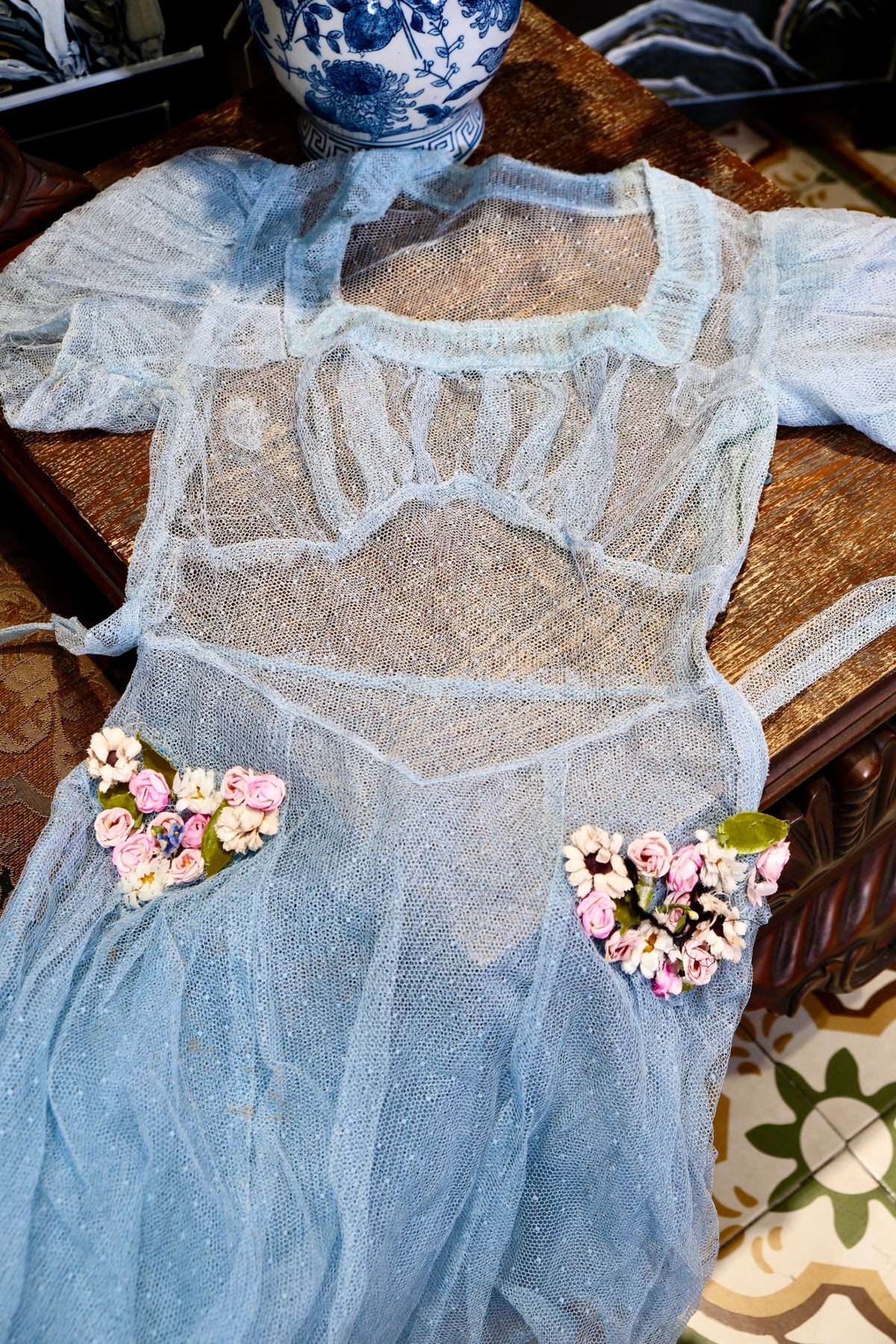
眼前这件天青幻纱立体编花晚礼服,正是那个时代美学巅峰的缩影。它不仅是服装,更是一段被时光封存的摩登往事。
【版型考据:大萧条时期的“垂坠与解放”】
这件礼服的版型设计,精准地对应了1930年代全球女装廓形的演变。
* 方领与泡泡袖的复古致敬: 领口采用了极具30年代特征的方领设计,并辅以蓬松的泡泡袖。这一设计并非凭空而来,它是对18世纪新古典主义(Neoclassicism)和帝国腰线(Empire Waist)的现代改良。在三十年代的时尚语境中,这种袖子既是对旧时代宫廷优雅的致敬,又通过缩短袖长、放宽袖型,解放了女性的手臂,赋予其行动的便利。
* 自然的垂坠与曲线重塑: 与20年代直筒型(Flapper style)的扁平美学截然不同,30年代的服装开始强调女性自然的身体曲线。这件礼服摒弃了紧身胸衣的强制性束缚,通过剪裁与面料的悬垂性(Draping),在腰部形成自然收束,裙摆顺势而下,呈现出一种如水波般流动的韵律感。
* 露背设计的摩登宣言: 视线的尽头是这件礼服最精妙之处——大面积的露背设计与系带结构。在30年代的时尚界,露背装(Backless Dress)是极其大胆且摩登的标志。当时流行语云:“腿部线条已不再新鲜,背部曲线才是新的展示空间。”这种设计将女性的性感从传统的含蓄转为一种健康、自信的现代表达。
【面料与工艺:指尖上的“镂空温柔”】
这件礼服最为人称道的,是其极为考究的面料与繁复的手工细节。
* 天青色网纱(Aether Blue Tulle): 这种浅蓝色,在传统色谱中接近“天青”或“月白”。在三十年代的语境里,浅色网纱是名媛淑女的专属,它轻盈、通透,在舞厅的霓虹灯下会泛起如梦似幻的光泽。
* 手工立体编花(Handmade Florid Appliqué): 请注意腰胯两侧的立体花簇。这绝非机器压制的平面印花,而是典型的手工立体编花工艺。工匠利用丝绸或棉布,通过缠绕、捏褶、定型,手工缝制出层层叠叠的玫瑰花与叶片。这种工艺耗时极长,每一朵花的朝向、每一片叶的卷曲都藏着匠人的温度。在那个没有流水线的年代,这种“奢侈的时间成本”本身就是最高贵的象征。
* 隐约的肌理: 网纱上点缀着微小的肌理点(Swiss Dot),这种细节增加了面料的层次感,使其在视觉上不至于单调,展现出一种低调的奢华。
【文学与意境:一袭蓝纱里的“海上旧梦”】
若要用文字来描绘这件礼服的气质,或许可以借用那个时代的文学意象。
它不像旧时大户人家闺秀那般沉静如水,也不似新式女学生那般清冷素净。它更像是一位刚刚从百乐门舞厅走出的摩登女郎,或是《玲珑》杂志画报上那位自信、独立的“新女性”。
* “玲珑”时代的注脚: 三十年代发行的《玲珑》杂志曾无数次描绘过这样的女性:她们烫着波浪卷发,涂着胭脂,穿着收腰的连衣裙,出入于电影院、咖啡馆。这件礼服,正是她们身体的语言。它诉说着一种挣脱束缚的渴望,一种对自我身体认知的觉醒。
* 繁华与苍凉的交织: 张爱玲曾说,衣服是一种暗语。这件衣服的天青色,带着一种“雾里看花”的朦胧感。在旧上海那个纸醉金迷又危机四伏的年代,穿上这样一件如梦似幻的裙子,本身就是一种对抗平庸、对抗动荡的姿态。它既有着西方浪漫主义的轻盈,又隐隐透着东方美学中“隔帘看月”的含蓄。
【结语:穿在身上的历史博物馆】
今天,当我们站在博物馆的展柜前,隔着玻璃凝视这件天青幻纱立体编花晚礼服时,我们看到的不仅仅是一块布料、几根丝线。
我们看到的是一个时代的呼吸。它见证了那个年代中国女性如何小心翼翼地、却又无比坚定地拥抱现代性;它记录了中西文化在远东这片土地上最绚烂的一次碰撞与交融。
它静静地挂在模特身上,仿佛在低声吟唱一首未完成的歌谣——关于美,关于自由,关于那个永远让人心驰神往的、繁华而苍凉的民国三十年。
Within the grand scroll of Republican-era costume history, the 1930s represent an unrepeatable splash of color—at once intensely vivid and mesmerizingly dreamlike. Crowned the "Paris of the East," Shanghai during this decade was far more than a city; it was a vast magnetic field of international fashion.
If the 1920s belonged to Eileen Chang’s era of "civilized new attire"—blue cotton long gowns with wide, inverted bell sleeves—then the sartorial aesthetics of the 1930s ushered in a complete, inside-out metamorphosis. Shaped by the aesthetic pivot brought on by the Great Depression (Depression-era elegance) alongside the Golden Age of Hollywood cinema, the wardrobe of the Chinese urban woman was thrown wide open. No longer content with a simple juxtaposition of East and West, women began pursuing a sleeker, more refined sense of haute couture.
Before us stands this sky-celadon illusion-tulle evening gown with three-dimensional floral appliqués—a microcosm of that era’s aesthetic zenith. Far more than mere apparel, it is a chapter of modern history sealed within time.
The structural design of this evening gown mirrors the global evolution of 1930s womenswear silhouettes with remarkable precision:
Square Neckline and Puff Sleeves — A Vintage Homage: The bodice features a quintessential 1930s square neckline paired with billowy puff sleeves. Far from arbitrary, this design pays modern tribute to 18th-century Neoclassicism (Neoclassicism) and the Empire waistline (Empire Waist). Within the fashion lexicon of the 1930s, these sleeves saluted old-world courtly grace while shortening the sleeve length and opening the volume to free a woman's arms for effortless movement.
Natural Drape and Sculpted Curves: In stark contrast to the flat, tubular aesthetics of the 1920s Flapper silhouette, 1930s fashion began celebrating natural feminine contours. Dispensing with the rigid confinement of boned corsetry, this gown relies on bias-sensitive cutting and the inherent fluidity of fabric draping (Draping) to gather gently at the waist before cascading downward into a skirt alive with water-like rhythm.
The Backless Cut — A Modern Manifesto: Leading the eye to the gown’s crowning masterstroke is its expansive open back secured with tie fastenings. In 1930s couture, the backless evening gown (Backless Dress) stood as a daring emblem of modernity. As the popular fashion maxim of the day declared: "Legs are no longer news; the curve of the back is the new frontier of allure." This cut transformed feminine sensuality from traditional concealment into a healthy, self-assured modern expression.
What earns this gown its highest acclaim is its discerning selection of textiles and intricate hand-worked embellishments:
Sky-Celadon Tulle (Aether Blue Tulle): Within the classical Chinese color spectrum, this luminous pale blue approaches "sky-celadon" (Tianqing) or "moon white" (Yuebai). In the context of the 1930s, pastel tulle was the exclusive preserve of society ladies—featherlight and translucent, casting a dreamlike, iridescent halo beneath ballroom lights.
Handmade Three-Dimensional Floral Appliqués (Handmade Florid Appliqué): Note the sculptural floral clusters gracing both sides of the waist and hip. Far from flat, machine-stamped prints, these exemplify true three-dimensional hand-woven floral craft. Working with strips of silk or fine cotton, artisans wound, pleated, shaped, and hand-stitched layered roses and curling leaves. Requiring immense hours of labor, the orientation of every bloom and the curl of every leaf preserve the warmth of the maker’s hand—an "extravagant investment of time" that stood as the ultimate mark of luxury in an era before assembly lines.
Subtle Surface Texture: Scattered across the sheer netting are minuscule woven texture dots (Swiss Dot), lending subtle visual depth so the expanse of tulle never appears monotonous, radiating understated luxury.
To capture the temperament of this gown in words is to invoke the literary imagery of its own decade.
It possesses neither the still-water quietude of an old-family boudoir maiden nor the austere simplicity of a modern schoolgirl. Rather, it evokes a stylish young woman stepping out of the Paramount Ballroom, or the confident, independent "New Woman" gracing the illustrated pages of Linglong magazine:
Footnote to the Linglong Era: Published throughout the 1930s, Linglong magazine repeatedly portrayed such women—wearing Marcel-waved curls and touches of rouge, dressed in waist-defining gowns as they frequented cinemas and cafés. This dress speaks the very language of their bodies, voicing a yearning to cast off restraint and an awakening consciousness of feminine selfhood.
Opulence Intertwined with Desolation: Eileen Chang once observed that clothing serves as a secret code. The misty sky-celadon hue of this gown carries the hazy allure of "gazing at blossoms through fog." Amidst the gilded glamour and looming turbulence of 1930s Shanghai, wearing a dress as ethereal as a dream was itself an act of defiance against the mundane and the uncertain—uniting the airy lightness of Western romanticism with the veiled Eastern subtlety of "viewing the moon through a gauze curtain."
Today, standing before a museum vitrine and gazing through glass at this sky-celadon illusion-tulle gown, we see far more than mere cloth and thread.
We witness the living breath of an era—bearing testimony to how Chinese women of the 1930s cautiously yet steadfastly embraced modernity, and chronicling one of the most brilliant encounters and fusions between Eastern and Western cultures upon Far Eastern soil.
Hanging quietly upon its dress form, it seems to murmur an unfinished ballad—of beauty, of freedom, and of that eternally captivating, opulent yet poignant third decade of the Republic.