深圳溯源
无法加载取货服务可用情况
衣服尺寸:
胸围/腰围/臀围:76/64/86 厘米
衣长:121 厘米
细节描述:
【引言:时光的针脚】
张爱玲曾言:“对于不会说话的人,衣服是一种语言,随身带着一种袖珍戏剧。”当我们凝视这件上世纪六十年代的香港产古董旗袍时,我们看到的不仅仅是一件衣裳,更是一段被丝线封存的香江岁月。作为服装史的研究者,我深知这抹红不仅属于色彩学,更属于那个中西文化激烈碰撞、传统与现代在维多利亚港畔交织的黄金年代。
【形制与工艺:海派余韵与港式改良】
这件旗袍是典型的“海派”风格在香港的延续与升华。六十年代的香港裁缝业正值巅峰,这件作品完美体现了当时“红帮裁缝”的高超技艺。
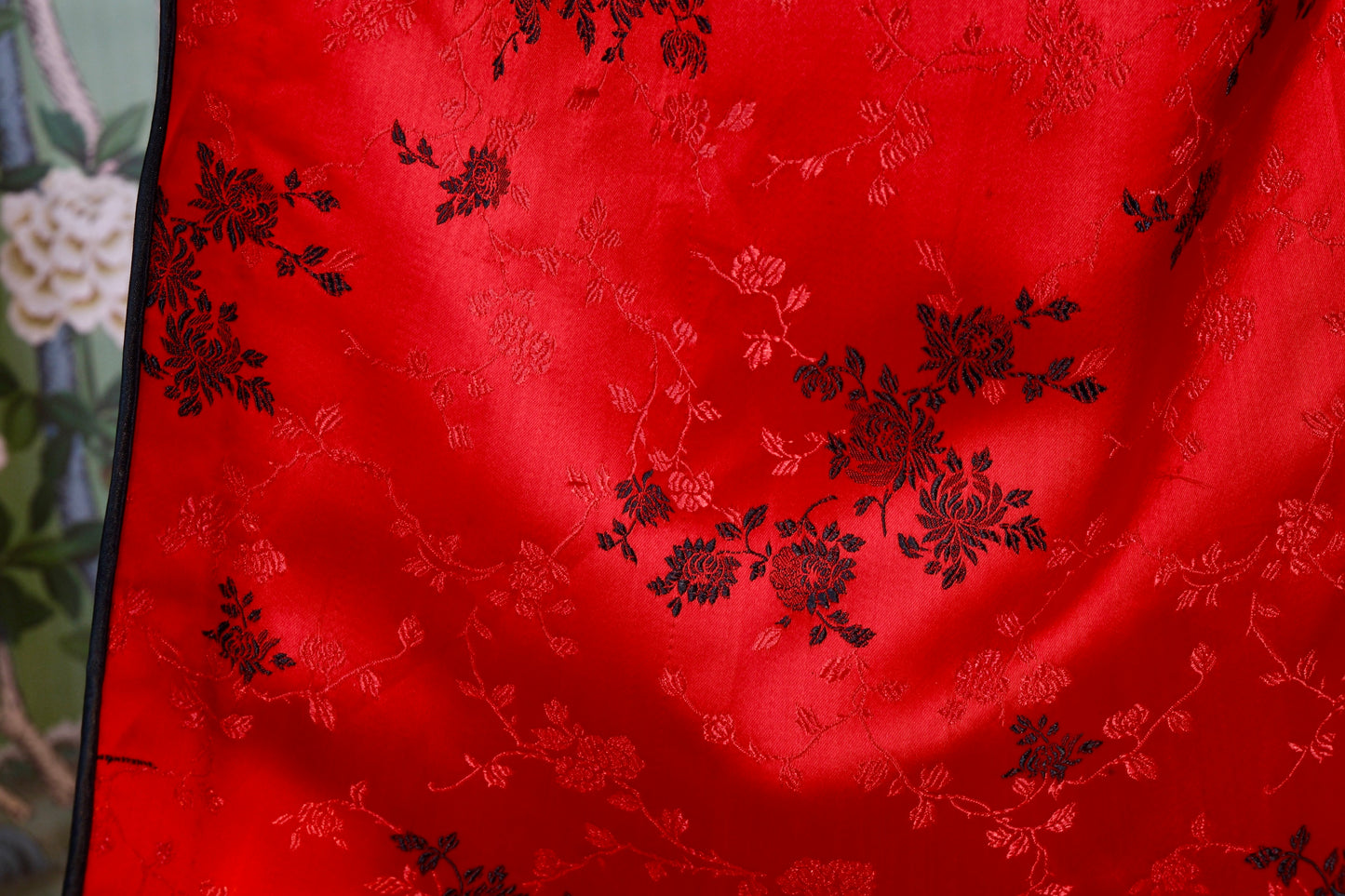
- 面料之贵: 选用的是顶级的提花织锦缎。这种面料质地厚实挺括,光泽感极强,自带一种富贵而不俗艳的气场。织锦缎通过复杂的经纬交织,将图案直接织入布料之中,而非后期印染,这使得花纹具有浮雕般的立体感和永不褪色的坚韧。
- 剪裁之精: 采用了经典的归拔工艺(熨烫塑形),使平面的布料能够顺应女性身体的曲线,无需省道便能贴合身形。高耸的立领紧扣咽喉,展现出东方女性的含蓄与矜持;而收紧的腰身与微微外扩的下摆,则勾勒出曼妙的S型曲线,这是六十年代审美对女性柔美极致的追求。
- 细节之美: 请注意那精致的“线香绲”。这是一种极细的包边工艺,如同游丝般勾勒出旗袍的边缘,既起到了加固作用,又在视觉上增加了层次感。黑色的滚边与红色的底色形成强烈的视觉反差,稳重而神秘。
【纹样解析:暗香浮动,墨色生花】
衣身上的图案设计极具文人画意趣,绝非普通的市井俗花。
- 主色调: 正红为底,象征着吉祥、喜庆与生命力,是中式礼服中最正统的颜色。
- 花卉纹样: 面料上布满了黑灰色的缠枝花卉纹。细看之下,这些花朵形态饱满,枝叶蜿蜒舒展,似牡丹之雍容,又带几分梅兰的清雅。这种深色提花在红色底布上若隐若现,营造出一种“暗香浮动”的视觉效果。它不张扬,却在光影流转间流露出低调的奢华。这种配色方案(红黑配)深受当时受西方现代主义影响的香港名媛喜爱,既有东方的古典韵味,又有现代的摩登感。
- 盘扣艺术: 领口处的黑色花扣,造型古朴典雅,宛如书法中的笔锋,苍劲有力,起到了画龙点睛的作用。
【历史回响:一件衣服的漂泊与归宿】
每一件古董衣都是有灵魂的幸存者。
想象一下,在1960年代的香港,或许是在中环的一家高级定制店(Bespoke Shop),一位技艺精湛的师傅在昏黄的灯光下,一针一线地缝制了这件旗袍。它可能曾被一位优雅的太太穿去参加子女的婚礼,或是在农历新年的晚宴上惊艳四座。那时的香港,电车的叮当声与留声机里的周璇歌声混杂在一起,这件旗袍见证了那个时代的繁华与喧嚣。
随着时间的推移,它被小心翼翼地折叠,放入樟木箱底,躲过了岁月的侵蚀和时尚的轮回。如今,它重新展现在世人面前,虽然历经半个多世纪的风霜,但那织锦缎的光泽依然温润如初,仿佛那位穿着它的女士刚刚转身离去。
【结语:稀缺的艺术孤品】
《诗经·秦风》云:“锦衣狐裘,颜如渥丹。”古人以锦衣华服喻君子淑女。这件六十年代的香港产提花织锦缎旗袍,不仅是服装史上的实物标本,更是不可再生的艺术孤品。随着老一代裁缝的凋零和传统织造工艺的失传,这样品相完好、工艺精湛的古董旗袍已属凤毛麟角。
它不属于快时尚的洪流,它属于博物馆,属于收藏家,属于每一个懂得欣赏东方美学、敬畏时光的有缘人。穿上它,你穿上的不仅是美丽,更是六十年的风华绝代。
注释:微瑕特价
Measurements / Size Guide:
Bust / Waist / Hips: 76/64/86 cm
Total Length: 121 cm
Detailed Description:
Within the technical domains of textile conservation, structural design history, and material culture analysis, an exceptional historical garment functions as an active social text. It documents a precise intersection of ancestral handcraft and localized modernization.
This magnificent 1960s Hong Kong-produced jacquard silk brocade qipao (红地黑折枝花卉纹提花织锦缎旗袍) stands as a pristine physical testament to that rare mid-century golden era. It materializes a complex sartorial dialogue where traditional mainland loom-work converges with Westernized, highly disciplined pattern architecture. For curators, textile historians, and institutional archives, this specimen preserves a critical chapter in the evolution of the iconic Hong Kong silhouette.
The physical construction of this qipao exemplifies the zenith of post-war textile manipulation, reflecting the absolute mastery of Hong Kong's mid-century bespoke tailoring network.
The 1960s Hong Kong bespoke framework relies on a high stiffened Mandarin collar for absolute postural enclosure. This structural foundation moves seamlessly into a micro-calibrated "incense-line" hand-piping border (线香绲), before utilizing advanced hot-iron blocking and damp-tension manipulation (归拔工艺) to shape the torso without modern visible seams, resulting in a highly tapered S-curve silhouette that elegantly drops into a slightly flared lower hem.
The Mechanics of Gui-Ba and Red-Group Craft: Tailored by elite artisans belonging to the legendary legacy lineages, the garment relies heavily on the complex methodology of Gui-Ba. Through precision heat, moisture, and dimensional stretching, the master tailor coaxed the thick, stubborn silk brocade matrix to curve fluidly around the bust and taper deeply into the waist without relying on excessive modern seams. The resulting S-curve silhouette achieves a sculptural precision that gracefully contours the anatomy while retaining traditional structural weight (骨架感).
The Precision of Xian-Xiang-Gun Piping: A crowning technical detail of this piece is the micro-calibrated "incense-line" piping. This hyper-fine, hand-turned border runs like a whisper along the structural edges of the collar and lapels. Rendered in deep midnight black, it serves a crucial dual function: structurally reinforcing the edges of the brocade weave while introducing a sharp, graphic linear contrast against the deep red ground.
Calligraphic Frog Closures: The collar is anchored by hand-formed black fabric frog closures (盘扣). Modeled with a stark, ancient minimalism, the contours mimic the confident, sweeping bone-structure of classical calligraphy strokes, functioning as the sharp visual anchor of the upper torso.
The visual and material character of this artifact depends heavily on its high-spec textile foundation: a high-density, structural jacquard silk brocade (提花织锦缎) utilizing complex multi-shuttle weaving patterns.
The Chromatic Contrast of the Red-Black Ground: The primary color field features a rich, deeply saturated celebratory red. Rather than reflecting ambient light in harsh, flat glares, the premium natural silk base absorbs light, rolling it across the tailored curves in velvety waves. Interwoven directly into this crimson matrix are muted black and charcoal-grey trailing floral motifs (黑灰缠枝花卉纹). This stark palette evokes the poetic aesthetic of classical ink-wash masterworks—offering a striking presentation that is deeply opulent yet intellectually reserved (低调的奢华).
Literati Botanical Iconography: The continuous, curving stems carry full, rounded flower heads that bridge the aristocratic majesty of the peony with the quiet resilience of winter plum blossoms. This sophisticated layout reflects the distinct lifestyle shift of 1960s Hong Kong high society; influenced by Western modernist restraint, elite madams discarded superficial, bright gold leaf imagery in favor of abstract, low-contrast, textile-woven textures that emphasize quiet cultural literacy.
To appreciate the rarity of this qipao is to understand the socio-industrial transformation of 1960s Hong Kong—a unique historical enclave where traditional mainland tailoring met a rapidly modernizing global market.
The Golden Age of Custom Ateliers: Following the mid-century geopolitical shifts, elite tailors relocated to Hong Kong, establishing exclusive custom ateliers across the Central District. This garment is a direct product of that fleeting historical pocket—conceived in an era when clothing operated as a personalized piece of theater (“衣服是一种言语,随身带着一种袖珍戏剧”). A dress of this caliber was commissioned exclusively for pinnacle life moments, such as formal family weddings or elite Lunar New Year banquets, soundtracked by the ambient chime of double-decker trams and vintage gramophone melodies.
The Horizon of Scarcity: Authentic 1960s original specimens preserved with this level of dye stability and textural crispness are exceptionally rare. Natural silk brocades are highly vulnerable to humidity-induced fiber embrittlement and atmospheric fading over a sixty-year horizon. The fact that this piece survived completely unblemished suggests it was wrapped securely and preserved within high-tier camphor heirloom chests, shielding it from decades of environmental degradation.
To properly situate this artifact within the broader text of material culture, its aesthetics can be cross-referenced with foundational Chinese literature and historical fashion essays:
The Metaphor of Virtue: The overarching visual weight of the gown mirrors the celebratory language found in the Book of Odes (诗经·秦风): "锦衣狐裘,颜如渥丹" (Brocade robes and fox furs, a countenance as radiant as cinnabar), where premium garments are treated not merely as decoration, but as physical evidence of personal refinement and dignity.
The Non-Renewable Hand: Because this piece predates the dawn of chemical-heavy mass production, the texture reveals a human touch in every stitch pass and iron blockade. It represents the final boundary of the hand-tailored clothing era before industrial ready-to-wear permanently altered the global fashion landscape.
As an irreplaceable, non-renewable piece of historical textile art, this black-ink jacquard qipao transcends standard vintage classifications, advancing directly into institutional and museum-grade collection spheres.
Collection Compatibility: This artifact is ideally spec'd for inclusion in institutional fashion archives, dedicated museum collections focusing on regional textile histories, high-end fine art auctions, or elite private conservation portfolios.
Preservation Mandate: To ensure the longevity of the natural silk fibers and prevent further oxidation of the celebratory red ground, the garment must be maintained under strict climate-controlled parameters (temperature 18°C–22°C, relative humidity 45%–55%), shielded entirely from direct ultraviolet exposure to prevent fiber breakdown.
Suyuan Archival Textile Registry — Documenting the material culture, preserving the technical lineage of ancestral craft.
Note:As-Is Special Price