墨缎裁春:一件民国旗袍里的宫廷绣影
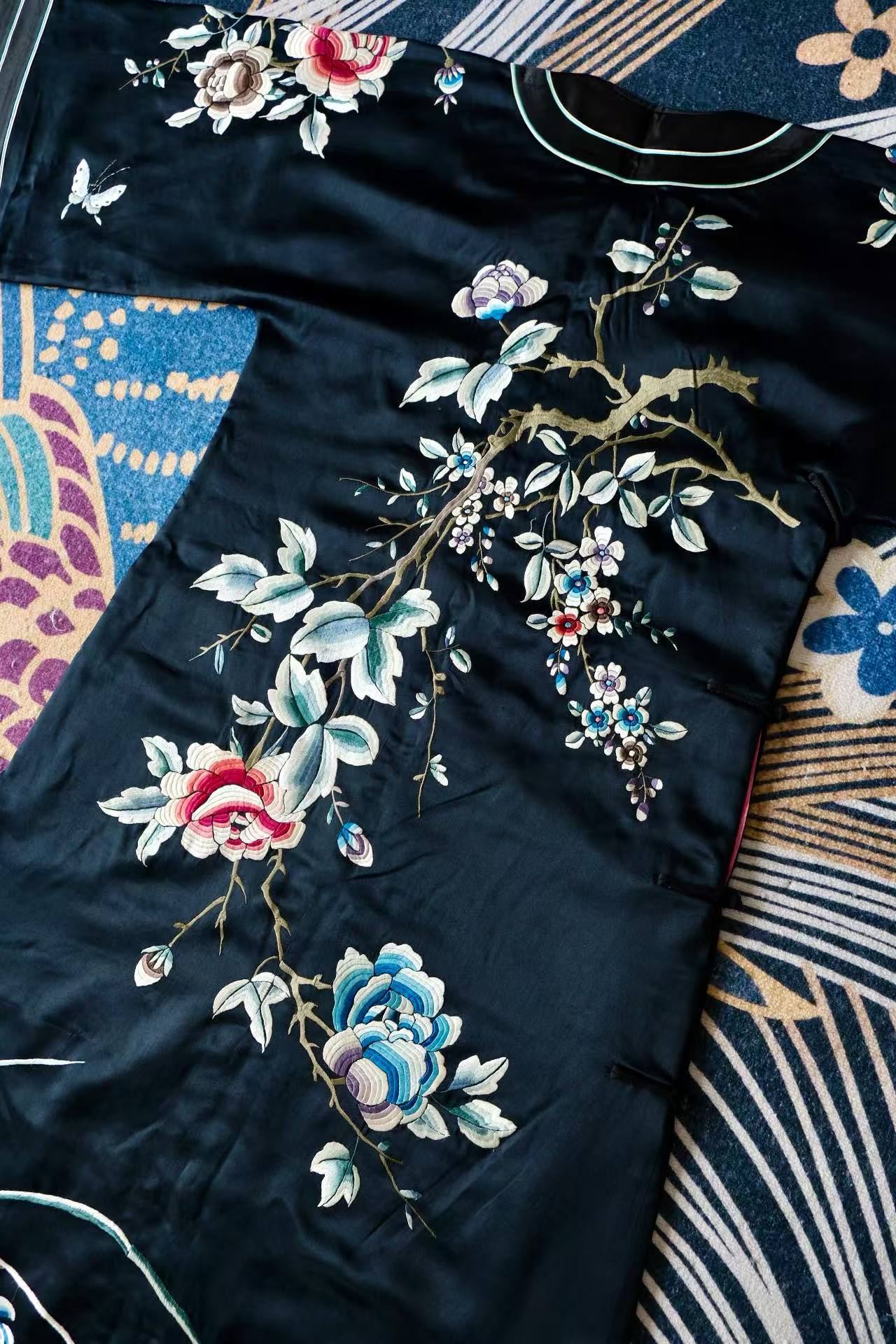
这件黑缎宽绲边倒大袖旗袍,以墨色为底,针线为墨,在民国二十年代的风华中,绣出了一幅“穿在身上的文人画”。
一、绣纹如诗:传统意象的当代转译
旗袍的刺绣布局暗合“天、地、人”三才之序:
- 上应天时:肩部与领口绣着缠枝牡丹与玉兰,牡丹以“三蓝一红”的渐变丝线绣成,花瓣边缘晕染出粉白渐变,恰似《长物志》所言“国色朝酣酒,天香夜染衣”;玉兰则以银线勾边,在墨缎上泛出冷光,如月下初绽。
- 中合人事:衣身主体是折枝梅花,枝干用“抢针”绣出皴裂质感,仿佛能触摸到岁月的纹理。
- 下接地气:下摆处绣着兰草与山石,兰叶以“滚针”绣出飘逸弧度,山石用“套针”层层晕染,墨绿、靛蓝、赭石色交织,如文人案头的盆景。这种“上花下草”的布局,源自宋代院体画的构图,却在民国旗袍上获得了新的生命。
二、衣中史话:从宫廷到民间的绣艺传承
这件旗袍的珍贵,在于它保留了晚清宫廷刺绣的余韵:
- 针法考究:全衣采用“京绣”中的“细绣”技法,每平方厘米针脚多达30针,花瓣的渐变、叶片的脉络,都纤毫毕现。这种工艺在民国时期已极为罕见,多为宫廷绣娘流落民间后的“绝唱”。
- 形制特殊:“倒大袖”是民国初年的典型特征,袖口宽大如喇叭,行走时如云袖轻扬,既保留了清代旗装的遗风,又融入了西式服装的宽松理念。而“宽绲边”的设计,不仅加固了衣缘,更以两道出芽(一道本色、一道湖蓝)勾勒出轮廓,如书画的装裱,让墨缎更显庄重。
三、稀缺之美:时光淬炼的孤品价值
在民国二十年代的上海,这样的旗袍是名媛闺秀的“战袍”。据《申报》记载,1925年一件手工刺绣旗袍的价格相当于普通职员六个月的薪水,而宫廷绣娘的作品更是“一衣难求”。
四、艺术之魂:东方美学的现代共鸣
这件旗袍的艺术价值,在于它将传统与现代、宫廷与民间、实用与审美完美融合。它不是简单的“复古”,而是民国女性对“新女性”形象的探索——既保留了东方的含蓄(如立领、宽绲),又展现了现代的洒脱(如倒大袖、修身剪裁)。
正如沈从文在《中国古代服饰研究》中所说:“服饰是一面镜子,照见时代的风貌。”这件旗袍,正是民国那个“新旧交替”时代的缩影,它用针线绣出了中国女性的觉醒,也绣出了东方美学的永恒魅力。
若说文物是凝固的历史,那么这件旗袍,便是流动的诗。当指尖拂过那些细腻的绣纹,仿佛能触摸到百年前那位穿着它的女子——她或许曾在霞飞路的咖啡馆里谈笑,或许曾在百乐门的舞池中旋转,而这件旗袍,便是她留给时光最美的注脚。
Spring Cut in Ink Satin: Palace Embroidery Shadows in a Republican Qipao
This black satin qipao, featuring wide piping and "inverted bell sleeves" (Dao Da Xiu), uses ink-colored silk as its canvas and needlework as its ink. Amidst the elegance of the 1920s, it stitched a "wearable literati painting."
I. Embroidered Poetry: Contemporary Translation of Traditional Imagery
The embroidery layout of this qipao aligns with the order of "Heaven, Earth, and Man":
-
Heaven (The Upper): The shoulders and collar feature intertwining peonies and magnolias. The peonies are rendered with the "Three Blues and One Red" gradient silk threads, with petal edges blurring into pinkish-white—echoing the line from Treatise on Superfluous Things: "National beauty is drunk with morning wine; celestial fragrance dyes the evening clothes." The magnolias, outlined in silver thread, emit a cold glow against the black satin like blossoms under the moon.
-
Man (The Center): The main body features plum blossoms on broken branches. The trunks use the "Pressing Stitch" (Qiang Zhen) to create a fissured texture, as if one could touch the very grain of time.
-
Earth (The Lower): The hem is adorned with orchids and scholar stones. The orchid leaves use the "Rolling Stitch" (Gun Zhen) for ethereal curves, while the stones use the "Layering Stitch" (Tao Zhen) for graduated shading in forest green, indigo, and ochre—resembling a bonsai on a scholar's desk. This "flowers above, grass below" composition originates from Song Dynasty court paintings, finding new life on a Republican garment.
II. History in Silk: The Heritage of Embroidery from Palace to People
The rarity of this piece lies in its preservation of late Qing Dynasty imperial embroidery:
-
Exquisite Needlework: The entire garment employs the "Fine Embroidery" technique of "Jing Xiu" (Beijing/Imperial Embroidery), with up to 30 stitches per square centimeter. Every petal gradient and leaf vein is visible in microscopic detail. Such craftsmanship was extremely rare in the Republican era, often being the "swan song" of imperial embroiderers scattered among the populace.
-
Distinctive Silhouette: The "Inverted Bell Sleeve" (Dao Da Xiu) is a hallmark of the early Republican era—cuffs as wide as trumpets that stir like clouds when walking. It retains the legacy of Manchu robes while integrating Western concepts of ease. The "Wide Piping" (Kuan Gun) not only reinforces the edges but uses two "sprouts" (Chu Ya—piping inserts), one tonal and one lake-blue, to frame the silhouette like the mounting of a scroll painting.
III. Scarcity: The Value of a Unique Specimen Tempered by Time
In 1920s Shanghai, such a qipao was the "armor" of socialites and noble ladies. According to The Shun Pao, in 1925, the price of a hand-embroidered qipao equaled six months' salary for an average clerk, while works by imperial-trained embroiderers were "impossible to find."
IV. Artistic Soul: Modern Resonance of Eastern Aesthetics
The artistic value of this qipao lies in its fusion of tradition and modernity, palace and folk, utility and beauty. It is not simple "retro," but an exploration of the "New Woman" image—retaining Eastern reserve (standing collar, wide piping) while showcasing modern panache (bell sleeves, slim-fit tailoring).
As Shen Congwen wrote in Researches on Ancient Chinese Costumes: "Clothing is a mirror, reflecting the spirit of the times." This qipao is a microcosm of that transitional era; it used needle and thread to stitch the awakening of Chinese women and the eternal charm of Eastern aesthetics.
Conclusion
If artifacts are solidified history, then this qipao is a flowing poem. When fingertips brush those delicate patterns, one can almost touch the woman who wore it a century ago—perhaps laughing in a café on Avenue Joffre or spinning on the dance floor of the Paramount. This qipao remains her most beautiful footnote left to time.