深圳溯源
无法加载取货服务可用情况
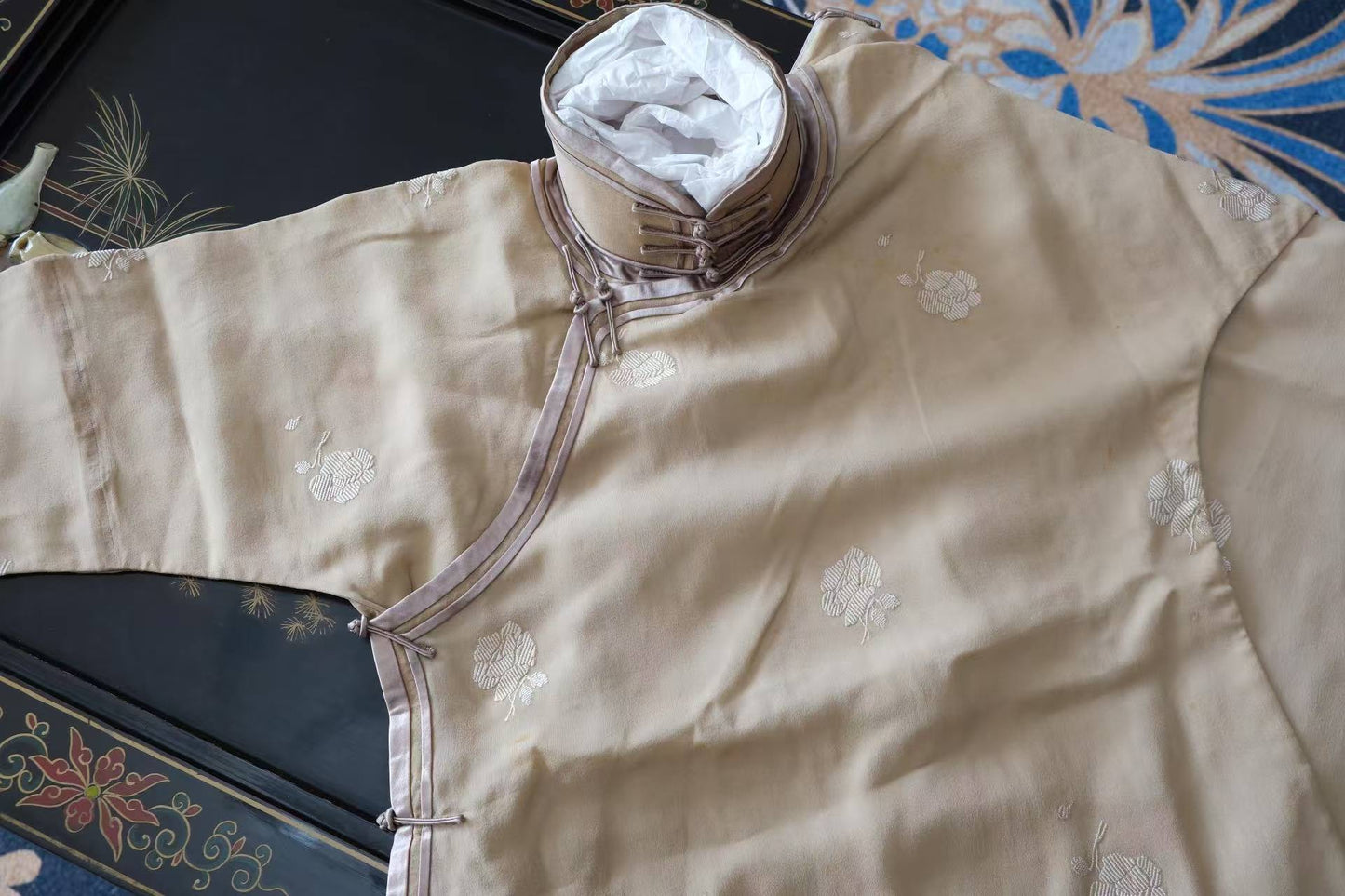
三十年代中期米色地真丝烂花绡旗袍:东方美学的流动诗篇
浅米色真丝绡为底,轻拢薄雾;白色烂花图案错落,似雪落海棠。
旗袍上的花卉图案,应是缠枝莲与折枝梅的变体,花瓣层叠如绡纱,
此袍的稀缺性,在于烂花绡工艺的濒危性。
当旗袍曳地,仿佛能看到张爱玲笔下的葛薇龙“沿着墙根走过去”,
1930s Mid-Era Beige Silk Devoré (Lan Hua Xiao) Cheongsam: A Fluid Poem of Oriental Aesthetics
Texture of Light and Mist Against a base of light beige silk gauze (xiao), which gathers like a thin mist, the white devoré patterns are scattered like snow falling on begonia blossoms. This shade of beige echoes the "Jiong" (fine silk) described in the ancient lexicon Shuowen Jiezi—resembling the first light of dawn soaking into plain silk, exuding an elegance polished by time. The devoré (lanhua) technique showcases supreme ingenuity; using chemical erosion to carve out translucent floral patterns, it achieves an ethereal quality beyond traditional embroidery. It perfectly captures the spirit of poet Li Qingzhao’s lines: "Pale is the light yellow, tender is the nature... leaving only fragrance behind," merging silk texture with floral form into something that feels like flowing clouds to the touch.
Motifs and Masterful Tailoring The floral patterns appear to be variations of the scrolling lotus and plum blossom, with petals layered like gossamer and vines winding like swimming dragons. The exquisite "Yi Gun Yi Dang" (one piping, one bordering) technique outlines the garment’s graceful silhouette, while the "Yizi Kou" (straight-bar frog buttons) are arranged like jade beads. This subtle detail aligns with the ancient Book of Rites (Li Ji) principle of "correct colors and intermediate shades." Positioned at the lapel, these buttons resemble the concise, powerful strokes of the character "One" in seal script—bridging ancient charm with modern poise.
A Rare Specimen of a Vanishing Craft The scarcity of this piece lies in the endangered nature of the devoré (lanhua xiao) process. In 1930s Shanghai, this technique required high-precision chemical erosion of the silk warp and weft to make the patterns as translucent as a cicada's wing. Today, fewer than a hundred such authentic pieces are known to exist.
A Witness to the "Shanghai Dream" When this floor-length cheongsam sways, one can almost see Eileen Chang’s characters—Ge Weilong walking along the wall or Bai Liusu treading through the shallow waters—each step a graceful undulation. Its artistic value rivals the Qing Dynasty "Kesi Bird and Flower Robes" in the Boston Museum of Fine Arts, yet the transparency of the devoré silk offers an even more transcendent beauty. As Shen Congwen wrote in Research on Ancient Chinese Costumes: "The lightness of silk carries the weight of civilization." This robe is a living testament to the old dreams of Shanghai, a modern translation of Oriental aesthetics that deserves museum-grade preservation.