深圳溯源
无法加载取货服务可用情况
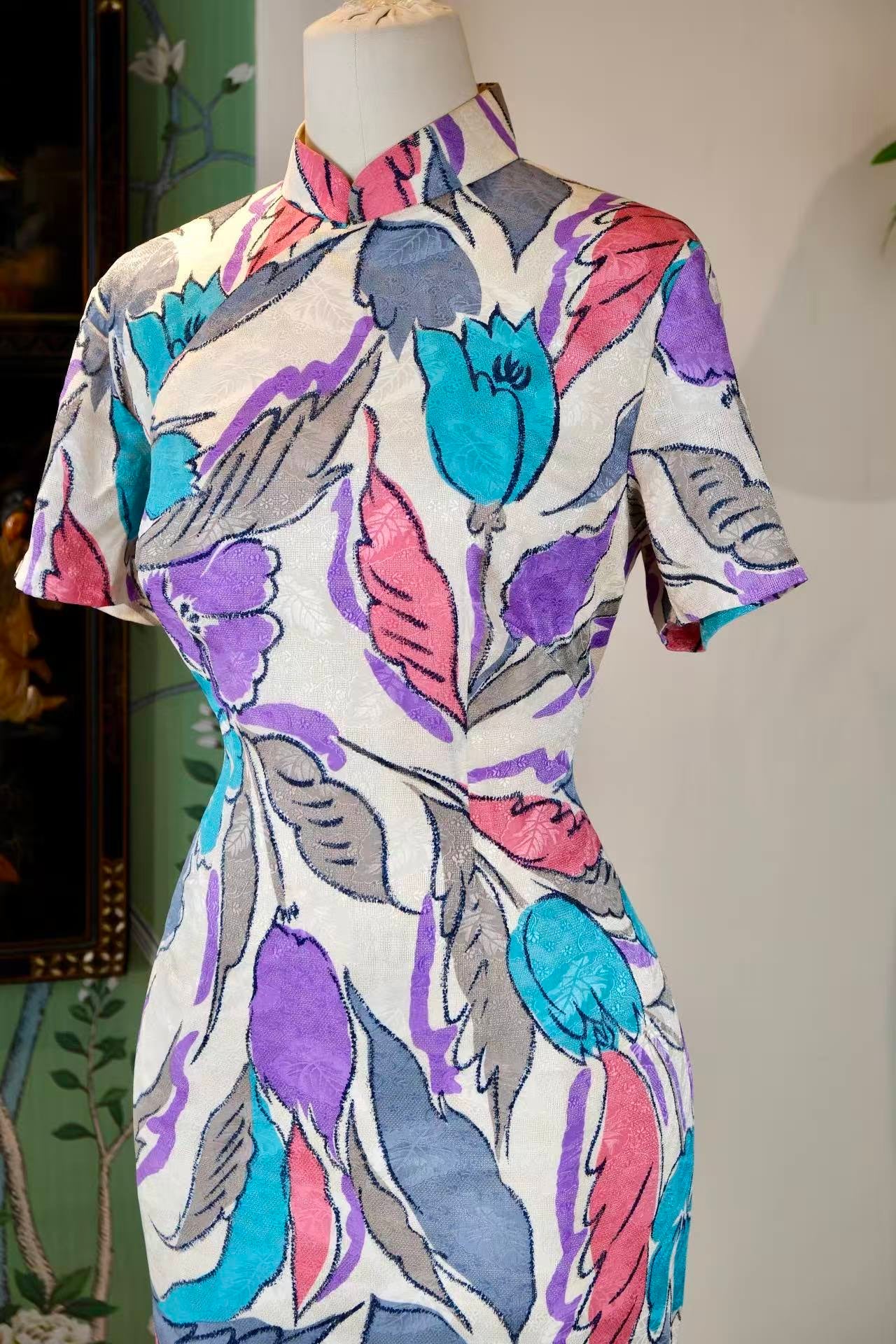
五十年代台湾产花萝印花旗袍:织就时光的诗性华章
当东方美学的婉约遇见五十年代的时代风华,
旗袍的印花以抽象化的花卉、枝叶为主题,色彩大胆而和谐,
这件旗袍的稀缺性,不仅在于其年代久远,
如今,当我们凝视这件古董旗袍,
When the grace of Oriental aesthetics meets the splendor of the 1950s, this antique Hualuo (patterned gauze-like weave) Qipao from Taiwan emerges like a lady stepping out of old memories. Using fabric as paper and Hualuo as ink, it composes a volume of flowing poetry. Hualuo, a textile carrying the wisdom of Eastern weaving, is interlaced with natural fibers like cotton, linen, and silk. Its texture is delicate yet breathable, allowing one to almost touch the warmth of the artisans' ingenuity from that era. The printed patterns further integrate natural imagery with humanistic sentiment, concealing artistic ciphers within every motif.
The prints focus on abstracted blossoms and foliage with a bold yet harmonious palette. The collision of purple and blue, and the fusion of pink and gray, mirror the "Boneless" (Mogu) technique of Song Dynasty literati painting—finding artistic conception in negative space and character in freehand expression. The purple clusters evoke the auspicious "purple air coming from the east"; the blue leaves suggest the elegance of "blue extracted from indigo"; the pink branches whisper the tenderness of "faces reflecting peach blossoms"; and the gray veins provide the stability of "shades of ink and wash." These patterns are not mere stacking but follow the principle of "Vivid Resonance" (Qi Yun Sheng Dong). Through the density of lines and the intensity of colors, they create a visual hierarchy where "clusters are seen from afar, yet branches are distinct up close," like a flowing Handscroll of a Hundred Flowers unfolding upon the silk.
The scarcity of this Qipao lies not only in its age but in the unique combination of local Taiwanese weaving techniques and the era's aesthetics. In the 1950s, Taiwan was in a special period of transition between tradition and modernity. This garment retains classic elements—the standing collar, diagonal bodice, and cinched waist—while boldly incorporating Western abstract expressionism in its prints, forming a distinctive "Taiwanese Style" Qipao. It witnessed the aesthetic evolution of Taiwanese women as they moved toward modernity and recorded the innovation of the local textile industry during post-war reconstruction. As The Classic of Poetry says: "Her artful smile so dimpled, her beautiful eyes so clear, it is the plain silk that provides the brilliance." This Qipao, with its plain base and radiant prints, perfectly interprets the Oriental pursuit of finding "brilliance in simplicity."
Gazing upon this antique Qipao today, one can almost hear the street bustle of 1950s Taiwan and see a woman walking gracefully through narrow alleys, her skirt swaying with the fragrance of the Hualuo weave. It is more than a garment; it is a solidified segment of time, a cultural legacy, and an eternal pursuit of beauty. As Eileen Chang wrote in Chronicle of Changing Clothes: "To those who cannot speak, clothes are a language, a miniature drama one carries around." This printed Hualuo Qipao is the most magnificent act in that miniature drama, worthy of careful appreciation and a place in the heart.