深圳溯源
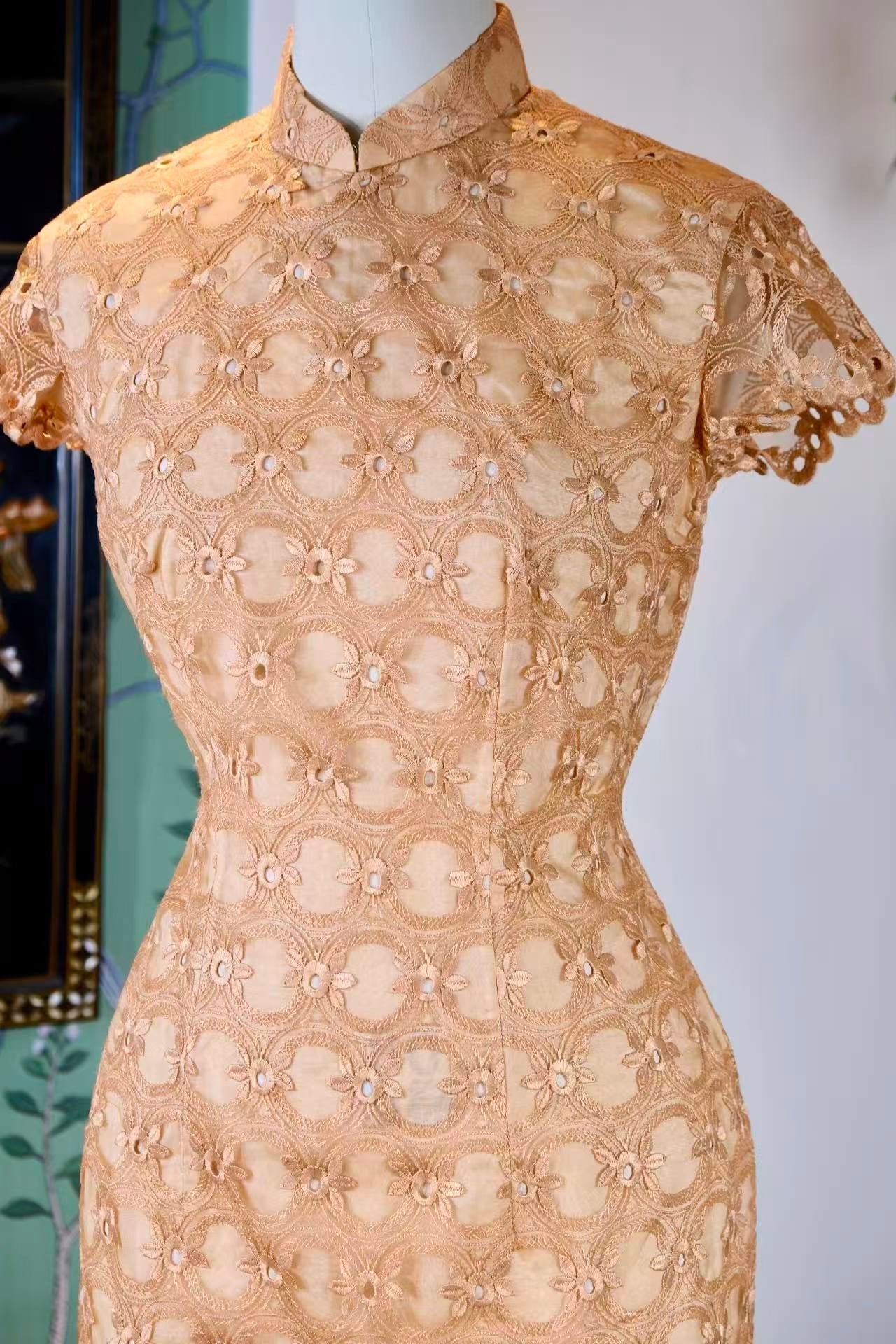
50年代 - 五十年代台湾制欧根纱机绣蕾丝古董旗袍:经纬间的东方美学史诗 | 1950s - 1950s Taiwanese Organza Machine-Embroidered Lace Qipao: An Epic of Oriental Aesthetics
50年代 - 五十年代台湾制欧根纱机绣蕾丝古董旗袍:经纬间的东方美学史诗 | 1950s - 1950s Taiwanese Organza Machine-Embroidered Lace Qipao: An Epic of Oriental Aesthetics
无法加载取货服务可用情况
五十年代台湾制欧根纱机绣蕾丝古董旗袍:经纬间的东方美学史诗
“衣者,形之表,德之符也。”——《礼记·丧大记》
这件上世纪五十年代台湾产的欧根纱机绣蕾丝旗袍,
从工艺史的维度审视,其稀缺性如“赵宋官窑”般珍贵:
《考工记》有言:“天有时,地有气,材有美,工有巧,合此四者,
这并非仅是一件衣裳,而是“穿在身上的东方美学史诗”——
1950s Taiwanese Organza Machine-Embroidered Lace Qipao: An Epic of Oriental Aesthetics
"Clothing is the manifestation of form and the symbol of virtue." — The Book of Rites
This 1950s antique Qipao from Taiwan resembles a frozen scroll of history: Champagne-gold organza flows like moonlight, while openwork lace uses the "Beaded String" (Lian Zhu) motif as its skeleton. It condenses the ancient worldview of "Round Heaven and Square Earth" into a perpetual circular pattern—a lineage traceable to Han Dynasty motifs, echoing the I Ching philosophy: "As Heaven’s movement is ever vigorous, so must a gentleman ceaselessly strive." Within these rings, five-petaled blossoms bloom with the calligraphic elegance of "Plum Blossom Seal Script," symbolizing the traditional blessings of Fortune, Prosperity, Longevity, Happiness, and Wealth.
From the perspective of craft history, its scarcity is comparable to Song Dynasty Imperial Ware. During this era, Taiwan’s textile industry was in a transformative phase of "inheriting Central Plain traditions while initiating island innovations." The lightness of the organza and the precision of the machine embroidery represent the first profound fusion of the "flat, neat, and dense" qualities of traditional Suzhou Embroidery with Western lace techniques. The stitches, described as "suspended needles and dripping dew," transform auspicious patterns into three-dimensional reliefs—a living testament to the "dance between hand and machine" at the dawn of the industrial age.
Kao Gong Ji states: "The season of Heaven, the breath of Earth, the beauty of Material, and the skill of Craft—only when these four converge can a masterpiece be created." This robe harmonizes the era's elegance (Heaven), Taiwan’s artisan spirit (Earth), the organza's ethereal soul (Material), and the divine skill of embroidered lace (Craft). As the hem sways, it evokes the goddess from Luo Shen Fu: "Treading upon the fragrant path, walking through the lush meadows." The flowing lines of the standing collar and diagonal closure recall the classical beauties of The Classic of Poetry.
This is not merely a garment; it is a "wearable epic of Oriental aesthetics." Every stitch hides the bloodlines of textile history across the Strait; every inch of lace reflects the light of Oriental craftsmanship’s mid-century transformation. It is as rare as the legendary Heshibi jade, deserving of being preserved in a "golden casket," allowing future generations to touch the warmth and character of that era through its warp and weft.
分享