深圳溯源
50年代 - 五十年代香港产醋酸缎如意云头钉珠古董旗袍:时光里的东方雅韵_HL | 1950s - 1950s Hong Kong Antique Acetate Satin Qipao with "Ruyi Cloud" Beading: Oriental Elegance Within Time_HL
50年代 - 五十年代香港产醋酸缎如意云头钉珠古董旗袍:时光里的东方雅韵_HL | 1950s - 1950s Hong Kong Antique Acetate Satin Qipao with "Ruyi Cloud" Beading: Oriental Elegance Within Time_HL
无法加载取货服务可用情况
五十年代香港产醋酸缎如意云头钉珠古董旗袍:时光里的东方雅韵
这件诞生于上世纪五十年代的香港产古董旗袍,以醋酸缎为底,
“云头”之形,源自魏晋壁画中的飞天祥云,经唐宋工艺淬炼,
钉珠工艺的精妙,更显时代匠心。
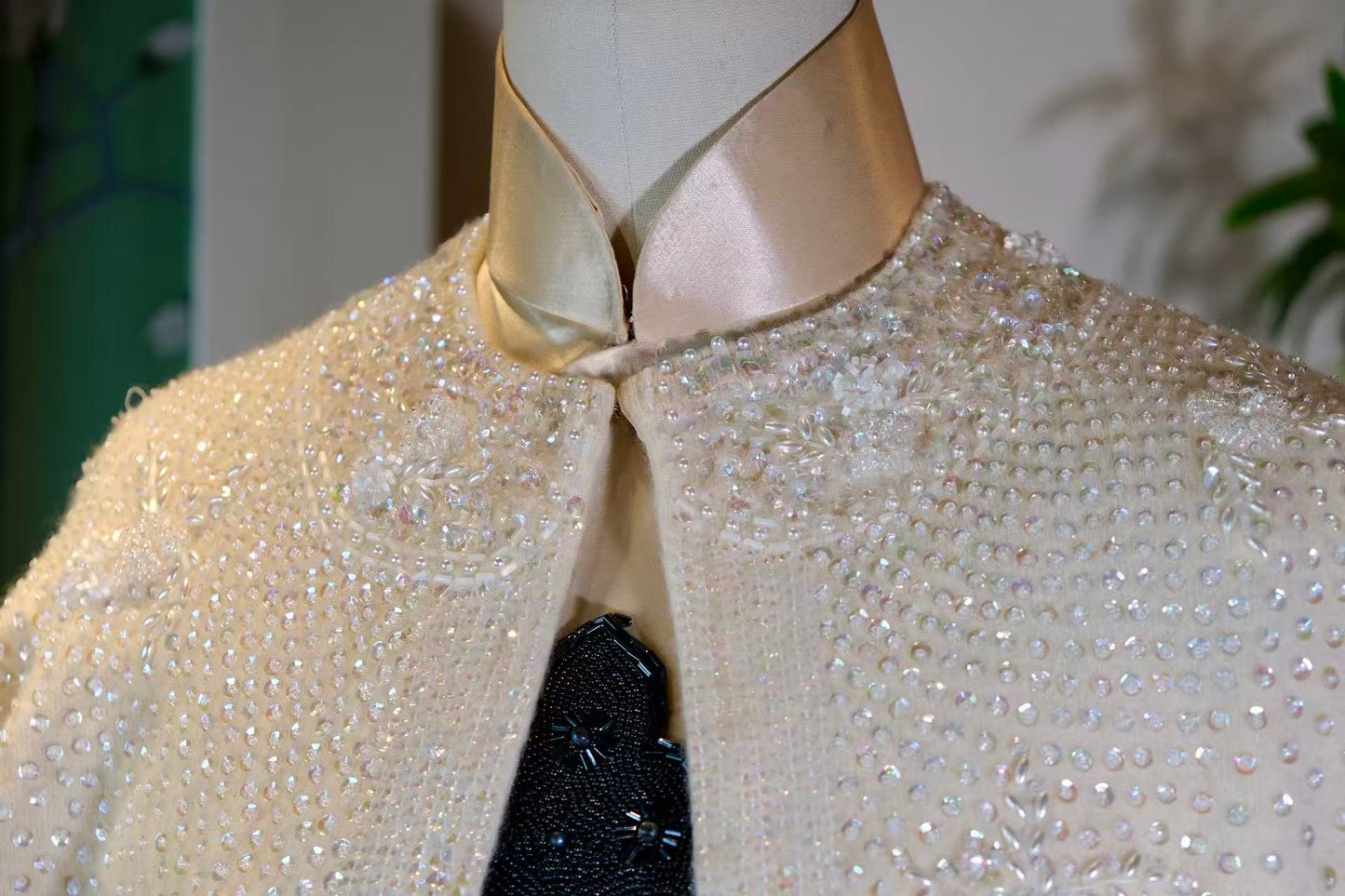
搭配同色系满绣珠光开衫,细密的莹润珠粒如碎钻般铺满襟怀,与旗袍的丝缎光泽交相辉映,形成**“浮光跃金”**的华贵意境。开衫的珠绣工艺堪称极致:设计师摒弃了留白,以全手工满绣的方式将大大小小的幻彩珠片缝缀于针织底基之上。领口与前襟处,珠粒排列成雅致的圆弧与几何纹路,仿佛月光凝聚成的鳞片;其间穿插着剔透的立体花簇绣,利用珠管的折射营造出流光溢彩的光影变幻。
在工业化制衣泛滥的今日,这样一件以手工钉珠、醋酸缎为材,
价格信息:
1950s Hong Kong Antique Acetate Satin Qipao with "Ruyi Cloud" Beading: Oriental Elegance Within Time
This antique qipao, crafted in Hong Kong during the 1950s, features an acetate satin base with a luster like flowing moonlight and a touch as smooth as cream. Its most captivating soul lies in the "Ruyi Cloud" beaded patterns across the chest and shoulders—a classic symbol of auspiciousness in traditional Chinese motifs and a vivid interpretation of the Oriental aesthetic principle of "conveying the Dao through patterns".
The form of the "Cloud Head" originates from the auspicious flying clouds in murals from the Wei and Jin Dynasties, refined through the craftsmanship of the Tang and Song, and becoming a fixed decorative motif for artifacts and garments by the Ming and Qing. Shuowen Jiezi defines "cloud" (云) as "the breath of mountains and rivers; derived from rain and clouds, resembling the swirling shape of clouds". Ancient people observed clouds as celestial omens, solidifying the flowing ethereal mist into the coiled contours of the "Ruyi Cloud". This captured both the natural principle of "clouds moving and rain falling, giving form to all things" and the human aspiration for "all things going as desired and everlasting blessings". The cloud motifs on this qipao are densely adorned with black beads: though as fine as stardust, they are arranged to create layers of surging mist. The central double coils resemble vortices, echoing the fluttering "cloud sleeves" described by Cao Zhi in Ode to the Goddess of the Luo River as "light as a startled swan, graceful as a soaring dragon". The beaded lines at the edges trace gentle arcs, much like the "Juan Sha" (curved reduction) technique mentioned in the Yingzao Fashi (Treatise on Architectural Methods), using the beauty of curves to subtly align with the cosmological view of "round heaven and square earth".
The ingenuity of the beadwork further reveals the era's craftsmanship. The 1950s Hong Kong qipao industry inherited Shanghainese techniques while integrating Lingnan aesthetics. During the beading process, fine needles were used to fix each bead individually onto the satin; this required uniform tension to avoid damaging the flexibility of the acetate satin while ensuring the luster of the beads complemented the sheen of the fabric. Upon close inspection, one can see beads of varying sizes within the cloud patterns: the main body is laid with fine beads like stars in the night sky, while certain areas are accented with slightly larger beads as "stamen," reminiscent of the "pearls and jade adorning garments" recorded in Tiangong Kaiwu (The Exploitation of the Works of Nature), revealing opulence in the details. This "beads-as-ink" embroidery philosophy gives the static pattern a sense of breath—as one moves, the beads tremble slightly with each step, and the shifting light and shadow make it seem as if ethereal mist is wandering through the dress, echoing the vivid charm of "white robes and green sashes, bringing joy to my heart" from the Classic of Poetry.
The ensemble is paired with a tonal, fully-embellished pearlescent cardigan. Myriads of fine, lustrous beads are scattered across the bodice like crushed diamonds, harmonizing with the silken sheen of the qipao to create a luxurious "shimmering gold on floating ripples" aesthetic. The beadwork on the cardigan represents the pinnacle of craftsmanship: the designer has eschewed empty space in favor of a full-coverage, hand-embroidered technique, sewing iridescent beads and sequins of varying sizes onto the knit foundation. Along the neckline and front placket, the beads are arranged in elegant arcs and geometric patterns, reminiscent of lunar scales formed by condensed moonlight; these are interspersed with translucent, three-dimensional floral clusters that utilize the refraction of bugle beads to evoke a kaleidoscopic play of light and shadow.
In today’s world of mass-produced industrial clothing, such an antique piece—crafted with hand-beading and acetate satin and carrying memories of the golden age of Hong Kong qipaos in the 1950s—is not merely a garment, but "history worn on the body". With the Ruyi Cloud as its brush and beads as its ink, it writes of the gentleness and resilience of Oriental women across the long scroll of time. As stated in the Kao Gong Ji (The Artificers' Record): "Heaven has its seasons, Earth has its Qi, materials have their beauty, and craftsmen have their skill; only when these four are combined can a 'fine work' (良) be made". This gown truly embodies that word "Fine".
Price Information:
1950s Antique Qipao - $1088 CAD
Matching Beaded Cardigan - $498 CAD
Complete Ensemble - $1586 CAD
分享