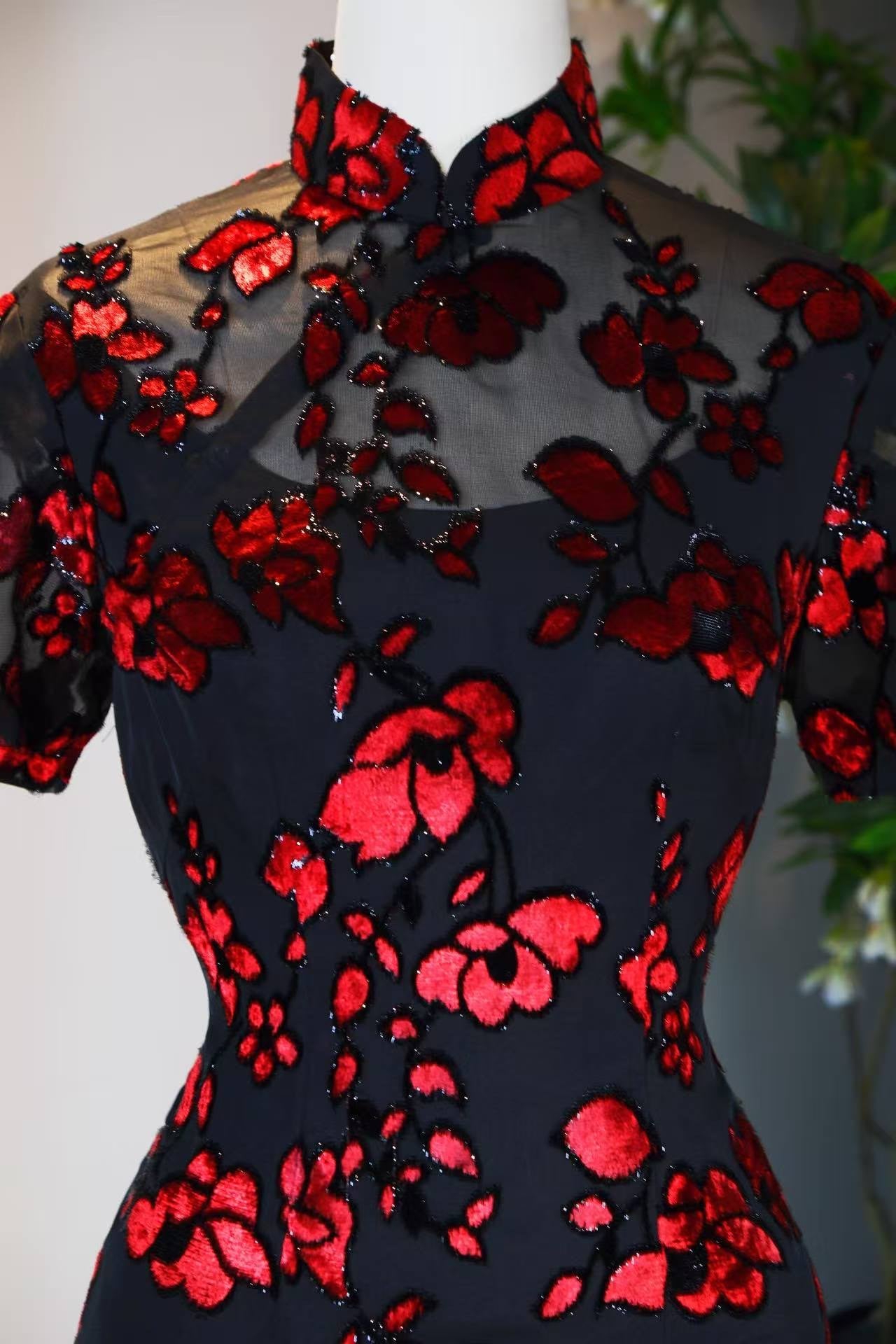
五十年代香港烧花织金丝绒挖胸旗袍:暗夜红莲,海上遗珍
此时值海派旗袍南徙,香港承其工艺精髓,更融殖民地摩登风尚,催生出“挖胸”这一突破性设计——胸前内衬镂空,以透明烧花丝绒覆之,肌肤微露而不失端庄,恰如《北里志》所言“浓淡适宜,如花解语”。此设计既承袭传统旗袍立领、斜襟、收腰之骨相,又以西式内衣结构暗藏性感,堪称“海上旧梦”的港版诠释。
面料为烧花丝绒,更在花型轮廓织入黑色金属丝,此工艺之稀缺性,可与“织金锦”相媲美。红色花卉在深黑底绒上立体浮凸,金属丝勾勒边缘,在光线下泛起幽微光泽,恍若《杜阳杂编》所载“光影百变,如星流电转”。此非普通烧花可比,金属丝的加入使花纹更具雕塑感,且需在织造时精准嵌入,稍有差池即前功尽弃,故存世者寥寥,堪为“织中之圣”。
衣身遍布大朵红莲,花瓣层叠,以烧花丝绒立体呈现,边缘织黑金丝为骨,如《楚辞》“芙蓉始发,杂芷荷些”之绮丽。莲之形态,或怒放,或含苞,枝蔓缠绕,红花与黑金丝交织,似《洛神赋》“灼若芙蕖出绿波”的绝美意象。红色象征吉祥与生命力,黑金丝则添华贵神秘,二者碰撞出“暗夜烈焰”的视觉张力,既承袭传统花卉纹样的吉祥寓意,又以现代设计语言重构东方美学。
此袍当属古董旗袍之翘楚,其艺术价值在于:以传统丝绒为纸,金属丝为笔,绘就一幅暗夜红莲图;以挖胸设计为桥,连接东方含蓄与西方性感。它不仅是五十年代香港时尚的缩影,更是中华民族服饰文化在时代变革中的创新印迹。藏此一袍,如藏一段海上旧梦,其稀缺性与艺术性,必将在旗袍史册中永绽光芒。
🌺 Dark Night Red Lotus: A 1950s Hong Kong Vintage Burnout Velvet Cheongsam with Keyhole Design
This era marked the southern migration of the Shanghai-style (Haipai) cheongsam. Hong Kong embraced the essence of its craftsmanship while integrating colonial modernism, giving rise to the breakthrough "Wa Xiong" (keyhole/chest cutout) design. By featuring a hollow-out bodice veiled with translucent burnout velvet, it allows a subtle glimpse of skin without losing decorum—just as the Bei Li Zhi describes: "Suitably rich or light, like a flower that understands speech." This design preserves the traditional bone structure of the standing collar, diagonal placket, and cinched waist, while concealing a Western-inspired sensuality, serving as a Hong Kong interpretation of the "Old Shanghai Dream."
The fabric is a masterpiece of burnout velvet (Devoré), uniquely woven with black metallic threads along the floral contours—a rarity comparable to the ancient "Zhi Jin" (Weaving Gold) brocade. The red blossoms stand in relief against the deep black velvet, with the metallic threads sketching their edges to create a faint, shimmering luster under the light, reminiscent of the description in Du Yang Za Bian: "Light and shadow in a hundred transformations, like drifting stars and revolving lightning." This surpasses ordinary burnout techniques; the addition of metallic threads grants the patterns a sculptural quality. These threads must be precisely embedded during weaving—a single error renders the entire piece ruined. Consequently, few such pieces survive, earning it the title "Saint of Weaving."
The body is covered with grand red lotuses, their petals layered and brought to life through the three-dimensional burnout velvet, edged with black-gold silk "bones." This mirrors the splendor in the Songs of Chu: "The lotuses begin to bloom, interspersed with fragrant angelica." The lotuses appear in various states—some in full bloom, others in bud—with winding vines interlacing. The intersection of red flowers and black-gold threads evokes the exquisite imagery of the Ode to the Goddess of the Luo River: "Bright as a lotus emerging from green ripples." Red symbolizes auspiciousness and vitality, while the black-gold threads add a regal mystery, creating a visual tension of "flames in the dark night" that reconstructs Oriental aesthetics through modern design.
This robe stands as a pinnacle of vintage cheongsams. Its artistic value lies in using traditional velvet as paper and metallic thread as a brush to paint a portrait of red lotuses in the dark; it uses the keyhole design as a bridge connecting Oriental reserve with Western allure. It is not merely a microcosm of 1950s Hong Kong fashion, but an innovative footprint of Chinese clothing culture amidst the shifting sands of time. To collect this robe is to preserve a fragment of the "Maritime Dream"—its scarcity and artistry destined to shine forever in the annals of cheongsam history.