深圳溯源
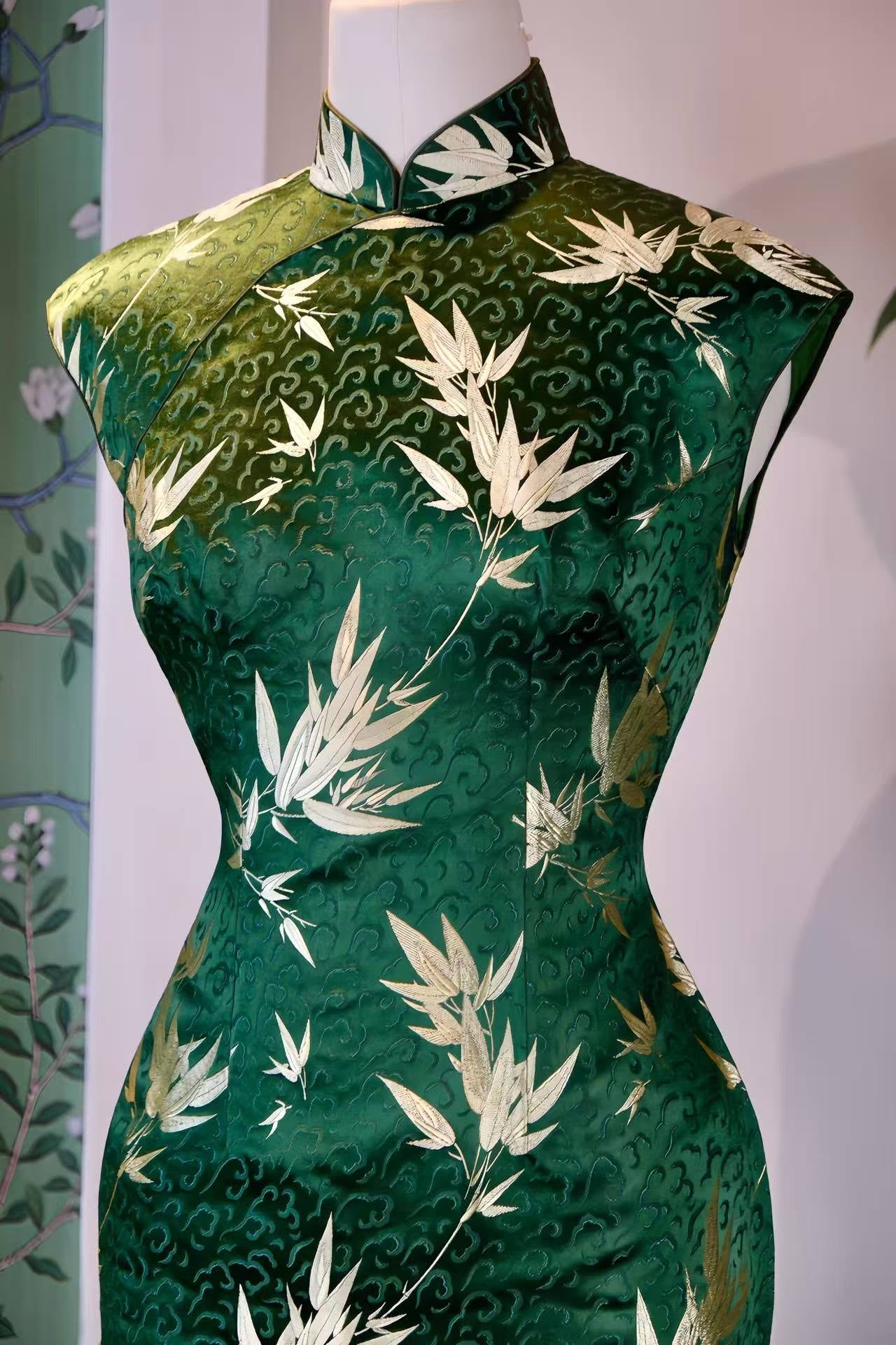
50年代 - 翠云摇金·五十年代香港织锦缎祥云如意金竹古董旗袍 | 1950s - Verdant Clouds and Shimmering Gold: A 1950s Hong Kong Vintage Cheongsam in Brocade Satin with Auspicious Clouds and Golden Bamboo
50年代 - 翠云摇金·五十年代香港织锦缎祥云如意金竹古董旗袍 | 1950s - Verdant Clouds and Shimmering Gold: A 1950s Hong Kong Vintage Cheongsam in Brocade Satin with Auspicious Clouds and Golden Bamboo
无法加载取货服务可用情况
翠云裁裳,竹韵流芳:五十年代香港古董旗袍的艺术密码
在东方美学的谱系中,面料纹样从来不只是装饰,
一、竹影摇金:君子品格的织锦注脚
旗袍上的金竹,并非简单的植物写生。
尤为难得的是,竹枝的分布遵循“疏可走马,密不透风”的章法:
二、祥云如意:吉祥纹样的千年传承
底纹的“祥云如意纹”,是传统云气纹与如意纹的融合。
《楚辞·九歌》有云:“乘清气兮御阴阳,吾将上下而求索。”
三、寸锦寸金:香港旗袍的工艺稀缺性
作为香港产古董旗袍,这件作品的稀缺性首先在于面料:
更珍贵的是,五十年代香港旗袍正处于“海派”向“港派”转型期:
当翠云般的锦缎裹住时光,金竹与祥云在衣襟上生长成永恒的诗。
🌿 Verdant Clouds and Golden Bamboo: The Artistic Code of a Vintage 1950s Hong Kong Cheongsam
In the genealogy of Oriental aesthetics, fabric patterns are never mere decoration; they are carriers of cultural DNA. This green jacquard brocade satin cheongsam from the 1950s, with a foundation of "Auspicious Clouds and Ruyi" pattern and ornamented with golden bamboo, is like a wearable Songs of Chu: "Riding on verdant clouds and driving white chī (dragons), I gather jade branches as sustenance, and use refined jade as grain." Its pattern arrangement subtly aligns with the image superposition of classical poetics, concealing the elegance of an era within its richly woven, "inch-of-brocade-is-an-inch-of-gold" fabric.
I. Bamboo Shadows in Gold: Brocade Annotation of a Noble Character
The golden bamboo on the cheongsam is not a simple botanical sketch. The bamboo leaves are woven with a three-dimensional texture using the jacquard technique, appearing like the "gold-inlaid knife" brushwork under light. This echoes the dynamic bamboo shadows described in Su Shi’s poem (Yú Qián Nǚ): "Scattered, chasing the wind and turning, having gone, they never return," and subtly aligns with the pure elegance of the Classic of Poetry: Weifeng verse: "Green bamboos enter the secluded path, moss dots the stone steps." In traditional culture, bamboo is one of the "Four Gentlemen," symbolizing humility, integrity, and resilience against the cold. The leaves woven with gold thread retain the bamboo's purity while adding a sense of "wealth and prosperity"—this aesthetic balance of "refined yet universally appreciated" is the essence of 1950s Hong Kong cheongsam craftsmanship.
Notably, the distribution of the bamboo branches adheres to the principles of composition: "sparse enough for a horse to run through, dense enough to block a needle." Bamboo branches slant across the shoulders, suggesting "the bamboo rustles as the laundry girls return"; leaves interlace on the skirt, like "the wind-blown bamboo scattering pure charm." This layout not only conforms to the cheongsam's curvilinear aesthetic but also subtly aligns with the negative space of Chinese painting, making it a "painting within the weaving."
II. Auspicious Clouds and Ruyi: The Millennia-Long Heritage of Propitious Motifs
The foundation pattern, "Auspicious Clouds and Ruyi," is a fusion of the traditional cloud motif and the ruyi (scepter) motif. The cloud motif originated from the "vortex pattern" on Warring States bronze ware, evolving into the "cloud qi pattern" in the Han Dynasty, symbolizing "perpetual vitality." The ruyi motif started in the Wei-Jin era and was formalized during the Ming-Qing dynasties, representing the auspicious wish for "everything as desired." The auspicious clouds on this cheongsam are rendered in dark green jacquard, like swirling mountain mist, while the ruyi motif transforms into scrolling grass forms, interwoven with the bamboo branches to create a visual rhythm of "clouds supporting bamboo, bamboo embracing clouds."
The Nine Songs in the Songs of Chu states: "Riding on the clear qi, guiding Yin and Yang, I shall ascend and descend to seek." The fluidity of the cloud motif is akin to this philosophical expression of "riding the qi and guiding Yin and Yang." The spiraling of the ruyi motif subtly aligns with the Oriental spatial aesthetic of "a winding path leading to a secluded place." This pattern combination not only inherits the ancient brocade tradition of "every pattern has meaning, every meaning is auspicious" but is also given fashionable vitality through modern tailoring—specifically, the "incense stick piping" (xiàn xiāng gǔn). The piping is thread-thin (only 3mm), perfectly containing the dynamism of the cloud and bamboo patterns with the cheongsam's subtle grace.
III. An Inch of Brocade, An Inch of Gold: The Craft Scarcity of Hong Kong Cheongsams
As a vintage Hong Kong cheongsam, the scarcity of this piece first lies in its fabric: jacquard brocade satin requires the traditional loom technique of "continuous warp and broken weft" (tōng jīng duàn wěi). The interweaving of the bamboo leaves and auspicious clouds demands precise control over the warp and weft threads, with every inch of fabric consuming days of labor—hence, "one inch of cloud bamboo, ten days of weaving." Secondly, the incense stick piping requires extremely high tailoring skill: the piping is only 3 millimeters wide, necessitating the careful unpicking and re-sewing of the brocade satin’s warp and weft threads; even a slight deviation would destroy the integrity of the pattern.
More valuable still is the fact that 1950s Hong Kong cheongsams were in a period of transition from the "Shanghai Style" (Hǎi Pài) to the "Hong Kong Style" (Gǎng Pài): retaining the finesse of Shanghai tailoring (such as the nuanced curve of the side waist darts) while incorporating the Lingnan culture’s preference for auspicious motifs (such as the fusion of golden bamboo and auspicious clouds). This innovation of "traditional patterns + modern tailoring" makes this cheongsam a "living fossil" for studying the history of post-war Hong Kong fashion—it is more than clothing; it is the Oriental aesthetic code hidden within the folds of history.
As the verdant cloud-like brocade enfolds time, the golden bamboo and auspicious clouds grow on the garment into an eternal poem. Every warp and weft of this cheongsam narrates the ancient wisdom of "clothing as a carrier of the Way" (yī yǐ zài dào): the integrity of bamboo, the transcendence of clouds, and the ingenuity of the brocade collectively weave an enduring Oriental elegance.
分享