深圳溯源
50年代 - 醉红凝香:五十年代港工剪花丝绒旗袍考释 | 1950s - Crimson Fragrance: A Research of a 1950s Hong Kong-Crafted Devoré Velvet Cheongsam
50年代 - 醉红凝香:五十年代港工剪花丝绒旗袍考释 | 1950s - Crimson Fragrance: A Research of a 1950s Hong Kong-Crafted Devoré Velvet Cheongsam
无法加载取货服务可用情况
醉红凝香:五十年代港工剪花丝绒旗袍考释
衣服尺寸:
胸围/腰围/臀围:96/92/96 厘米
衣长:108 厘米
细节描述:
“罗衣何飘飘,轻裾随风还。”
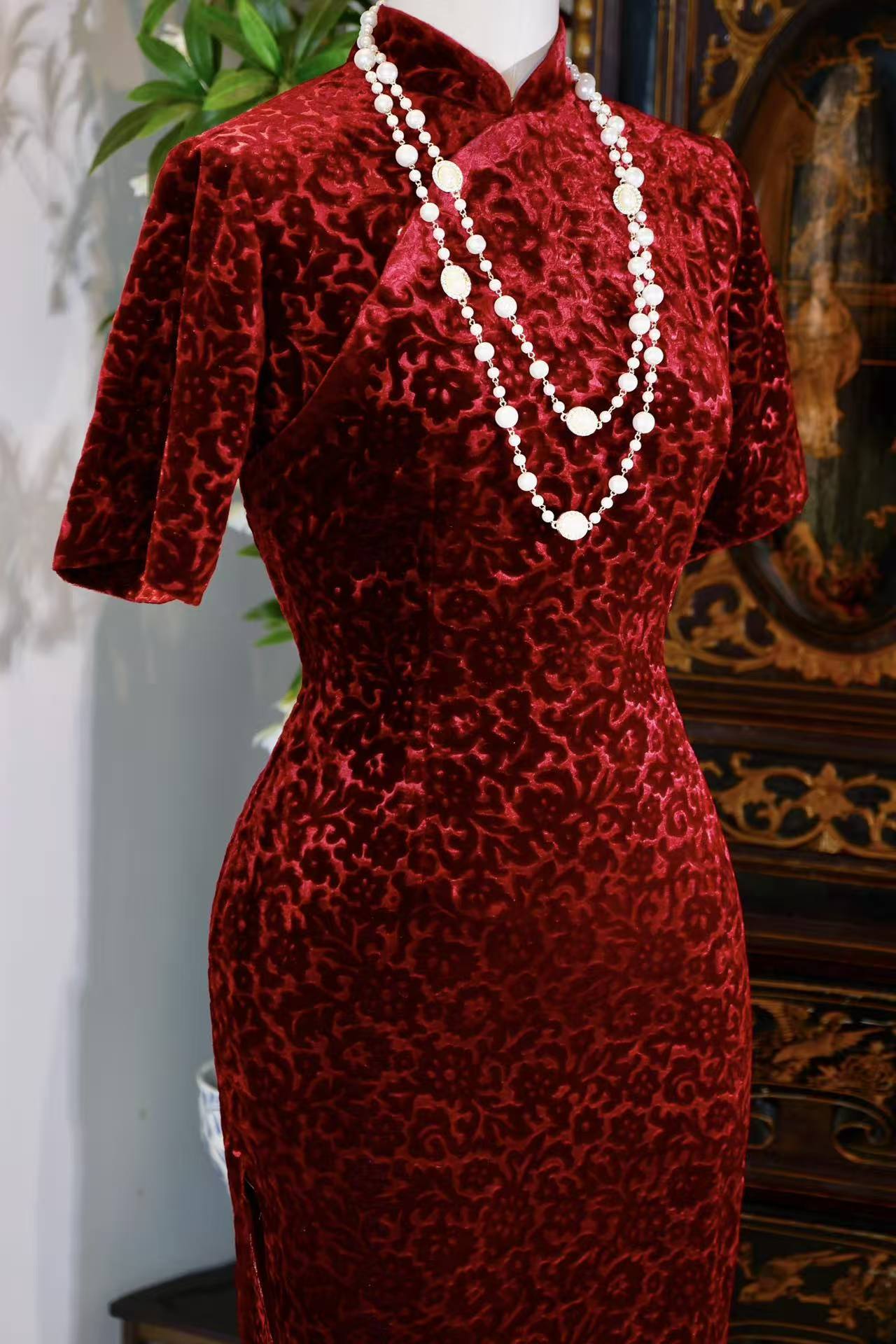
这袭酒红色的剪花丝绒旗袍,静静地伫立在那里,仿佛是从王家卫电影《花样年华》的胶片中剪裁下来的一帧。它产自上世纪五十年代的香港——那个东西方文化剧烈碰撞、旗袍工艺达到最后巅峰的黄金时代。
一、纹样重释:缠枝宝相,富贵连绵
- 纹样解读:这是一种将牡丹、莲花或菊花的特征抽象化、理想化后的艺术造型。工匠利用剪花工艺,在丝绒表面制造出凹凸的浮雕感。花朵形态饱满圆润,枝叶呈“S”形卷曲延伸,这种“缠枝”结构在中国传统纹样中寓意着“生生不息、富贵连绵”。
- 光影美学:这种纹样并非印染,而是通过丝绒的倒顺毛原理呈现。在光线下,花卉若隐若现,如同暗夜中浮动的暗香,正应了宋词中“云破月来花弄影”的意境。它摒弃了明清时期繁复的具象描摹,转而追求一种现代主义的抽象韵律,既保留了传统的吉祥寓意,又符合五十年代摩登女性的审美。
二、材质与工艺:绝响的“港工”丝绒
五十年代的香港,承接了上海沦陷后南迁的顶尖裁缝与资本,形成了独特的“港派旗袍”风格。
- 剪花丝绒的稀缺:这件旗袍的面料极为考究。丝绒(Velvet)本是舶来品,但在五十年代的香港被运用到了极致。这种面料厚实、垂坠感极佳,且自带一种奢华的哑光色泽。那个年代的剪花工艺需要人工在织机上通过提花和剪绒完成,废品率极高。随着六十年代合成纤维的普及和人工成本的上升,这种纯天然、高工时的真丝/人丝混纺剪花绒,已成绝响。
- 剪裁的巧思:请注意它的肩袖处理。不同于旧式旗袍的平肩,它采用了“装袖”工艺,使肩部线条更加圆润挺括,这是西式剪裁融入中式服装的明证。腰身的收省(Darts)极其精准,完美贴合人体曲线,将女性的S型身段勾勒得淋漓尽致,却又含蓄内敛。
三、古董衣的故事:维多利亚港的夜与昼
试想这件旗袍的主人,她或许是一位生活在半山区的富商太太,亦或是当时著名的粤剧名伶。
- 昼:在1950年代的香港,丝绒旗袍是出席正式场合的“战袍”。她或许曾穿着它出席跑马地的马会,酒红色的丝绒在阳光下泛着低调的贵气,与周围的洋装形成鲜明对比,宣示着东方女性的自信。
- 夜:夜晚,当她在半岛酒店的咖啡厅小憩,或是去利舞台听戏,这袭旗袍上的缠枝花卉在灯光下流转,仿佛将维多利亚港的波光都穿在了身上。
四、结语:穿在身上的历史
这件五十年代的剪花丝绒旗袍,不仅仅是一件衣物,它是一段凝固的时光。
它见证了那个“东方之珠”初露锋芒的年代,见证了海派文化与岭南文化的交融。如今,当我们抚摸那细腻的丝绒,感受那凹凸有致的宝相花纹,我们触摸到的,是半个多世纪前那个风华绝代、暗香浮动的香江旧梦。
“花自飘零水自流,一种相思,两处闲愁。” 这件旗袍,便是那流年里最美的注脚。
Crimson Fragrance: A Research of a 1950s Hong Kong-Crafted Devoré Velvet Cheongsam
Measurements / Size Guide:
Bust / Waist / Hips: 96/92/96 cm
Total Length: 108 cm
Detailed Description:
"How gracefully her silken robes flutter, as her light skirts swirl with the wind."
This wine-red devoré (cut-flower) velvet cheongsam (qipao) stands silently, appearing like a frame cut directly from the celluloid of Wong Kar-wai’s In the Mood for Love. It originates from 1950s Hong Kong—the golden age when Eastern and Western cultures collided fiercely, and qipao craftsmanship reached its final peak.
I. Reinterpreting the Motifs: Intertwining Baoxiang Flowers, Everlasting Prosperity
-
Pattern Interpretation: This is an artistic stylization that abstracts and idealizes the features of peonies, lotuses, or chrysanthemums. Utilizing the devoré (cut-flower) technique, artisans created a raised, relief-like texture on the velvet surface. The blossoms are full and rounded, with "S-shaped" curling vines. This "intertwining" structure symbolizes "endless vitality and continuous prosperity" in traditional Chinese iconography.
-
The Aesthetics of Light and Shadow: This pattern is not printed; it is revealed through the principle of light reflection on the velvet pile. Under varying light, the flowers appear and disappear, like hidden fragrances floating in the dark night—echoing the Song lyric: "The clouds break, the moon emerges, and the flowers play with shadows." It discards the redundant realism of the Ming and Qing dynasties in favor of a modernist abstract rhythm that retains traditional auspicious meanings while fitting the sensibilities of the 1950s modern woman.
II. Material and Craft: The Swan Song of "Hong Kong-Crafted" Velvet
In the 1950s, Hong Kong became the sanctuary for elite tailors and capital migrating south from Shanghai, leading to the birth of the distinct "Hong Kong-style qipao."
-
The Scarcity of Devoré Velvet: The fabric of this qipao is exceptionally sophisticated. While velvet was originally a Western import, it was utilized to its zenith in 1950s Hong Kong. This material is thick, has an excellent drape, and possesses a signature luxurious matte luster. The devoré process of that era required manual jacquard weaving and pile-cutting on the loom, resulting in a high rate of wastage. With the rise of synthetic fibers and labor costs in the 1960s, this natural silk/rayon blend devoré velvet has become an extinct art.
-
Tailoring Ingenuity: Note the treatment of the shoulders and sleeves. Unlike the flat-cut shoulders of old-style qipaos, this piece adopts Western "set-in sleeve" construction, creating a more rounded and structured shoulder line—a clear testament to Western tailoring merging with Chinese attire. The darting at the waist is incredibly precise, perfectly contouring the body's curves to delineate the "S-silhouette" with both boldness and Eastern restraint.
III. Story of the Garment: Night and Day at Victoria Harbour
Imagine the owner of this qipao: perhaps a socialite living in the Mid-Levels, or a renowned Cantonese opera star of the era.
-
Day: In 1950s Hong Kong, a velvet qipao was the "battle dress" for formal occasions. She might have worn it to the Jockey Club in Happy Valley; the wine-red velvet exuding a low-key nobility under the sun, standing in stark contrast to Western dresses, declaring the confidence of the Oriental woman.
-
Night: At night, as she rested in the cafe of The Peninsula Hotel or attended a performance at the Lee Theatre, the intertwining blossoms on the qipao shimmered under the chandeliers, as if she were wearing the rippling lights of Victoria Harbour itself.
Conclusion: History Worn on the Body
This 1950s devoré velvet qipao is more than a garment; it is a segment of frozen time.
It witnessed the era when the "Pearl of the Orient" first began to shine, and the fusion of Shanghai and Lingnan cultures. Today, as we touch the delicate velvet and feel the raised textures of the Baoxiang motifs, we reach back across half a century to that peerless, fragrance-filled dream of old Hong Kong.
"Flowers wither and water flows on its own; one kind of longing, two places of idle sorrow." This cheongsam is the most beautiful footnote to those fleeting years.
分享