深圳溯源
无法加载取货服务可用情况
衣服尺寸:
胸围/腰围/臀围:88/72/92 厘米
衣长:93 厘米
细节描述:
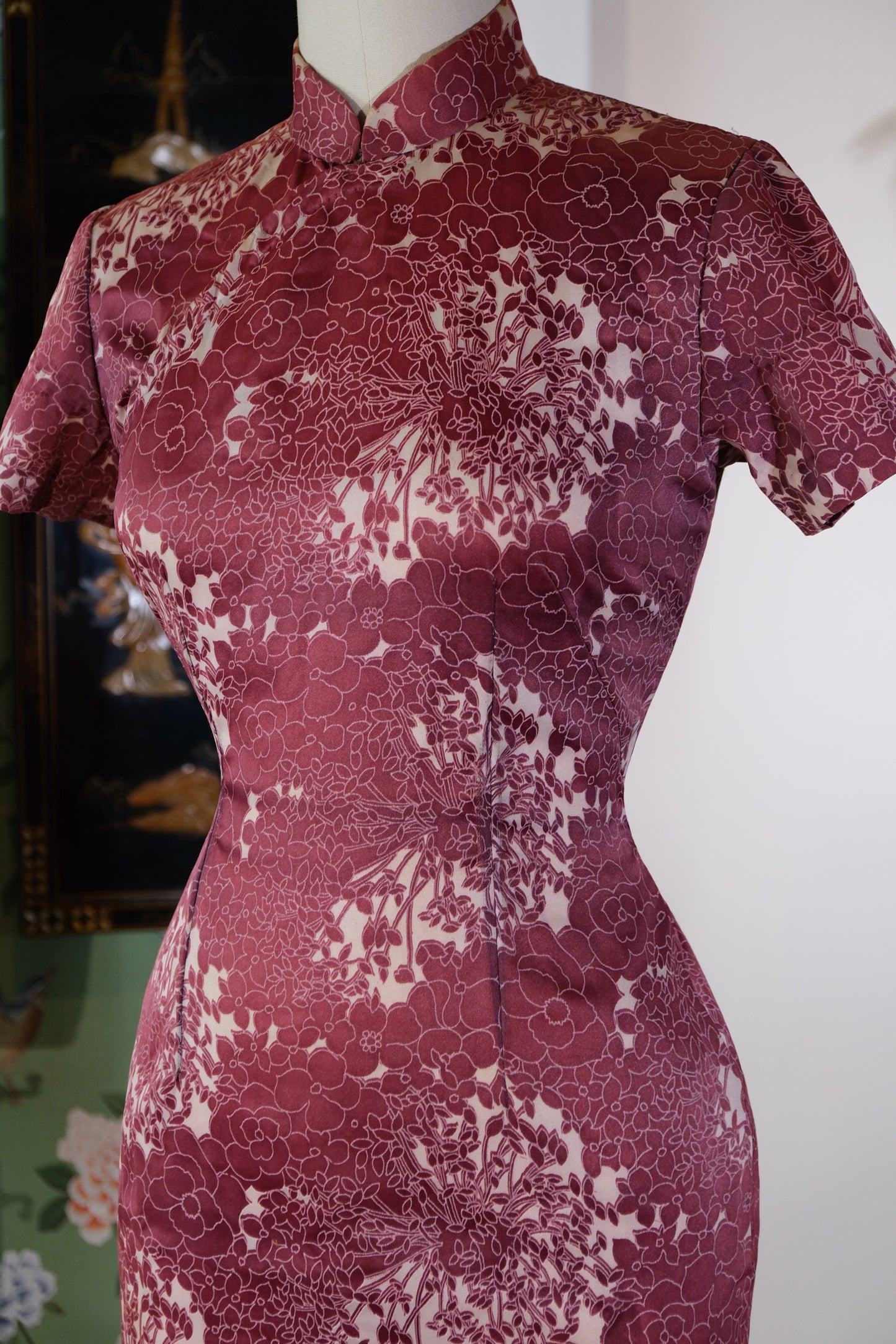
衣上繁花:浮世绘影,暗香浮动
此件旗袍之纹样,堪称“繁花似锦,暗香盈袖”。其图案并非寻常工笔花鸟,而是以一种近乎印象派的笔触,将牡丹、芍药、菊蕊等东方名卉,化作一片氤氲的花海。酒红色的底料上,以米白或淡金勾勒花叶轮廓,线条流畅而写意,似有若无,如月下花影,又似水墨晕染。这种“满地印花”的设计,在五十年代香港旗袍中极为罕见,它摒弃了传统旗袍的留白与对称,转而追求一种视觉上的丰盈与流动感,仿佛将整个江南春色,都织入了这方寸之间。
细观其纹,花叶交错,疏密有致,既有“乱花渐欲迷人眼”的繁复,又不失“疏影横斜水清浅”的雅致。这种图案风格,实则暗合了当时香港社会中西文化交融的审美趣味——既保留了东方花卉的吉祥寓意,又融入了西方现代艺术的抽象表现,堪称“东情西韵,浑然天成”。
衣中故事:香江旧梦,流金岁月
此件旗袍诞生于上世纪五十年代的香港,彼时正值战后经济复苏,社会风气渐开,女性地位提升,旗袍亦随之进入“黄金时代”。香港作为东西方文化交汇的港口,其旗袍设计既承袭了上海旗袍的精致剪裁,又融入了本地的实用主义与时尚气息。此件旗袍的短袖设计、修身廓形,正是这一时代特征的体现——它不再仅仅是传统礼服,更是都市女性日常穿着的时尚单品。
据考,五十年代香港旗袍多由本地裁缝铺手工制作,面料多取自欧美或东南亚,而印花工艺则多借鉴日本或欧洲的纺织技术。此件旗袍的印花工艺,极有可能是采用当时先进的“滚筒印花”技术,其色彩层次丰富,图案细腻,非一般作坊所能企及。其稀缺性,不仅在于年代久远,更在于其工艺的精湛与设计的独特,堪称“港产旗袍中的孤品”。
艺术风格:新古典主义与装饰艺术的交响
从艺术风格而言,此件旗袍堪称“新古典主义与装饰艺术的完美交响”。其廓形遵循了旗袍传统的“S”型曲线,强调女性的腰臀比例,这是对古典美的致敬;而其图案设计,则充满了装饰艺术的几何感与节奏感,花叶的排列虽繁复,却暗含秩序,如音乐般富有韵律。
这种风格,与当时国际上流行的“新艺术运动”不谋而合。正如英国艺术评论家赫伯特·里德所言:“装饰艺术的本质,在于将自然形态转化为几何图案,赋予其现代感。”此件旗袍的印花,正是将自然花卉转化为抽象图案的典范,它既保留了东方的诗意,又彰显了现代的理性,堪称“中西合璧,古今交融”的艺术杰作。
稀缺性:时光淬炼,孤品难求
在古董旗袍收藏界,五十年代港产旗袍本就稀缺,而如此件这般印花精美、保存完好的,更是凤毛麟角。据《香港旗袍史》记载,五十年代香港旗袍年产量虽达数十万件,但因战乱、迁移、日常损耗,留存至今者不足千分之一。而此件旗袍,历经七十余载风雨,仍能保持色泽如新、纹样清晰,实属难得。
其稀缺性,更在于其不可复制性。彼时的印花工艺、面料选择、剪裁手法,皆已随时代变迁而消逝。今日即便有匠人欲复刻,亦难觅当年之原料与技艺。正如法国哲学家罗兰·巴特所言:“时尚的本质,在于其短暂性与不可逆性。”此件旗袍,正是这一本质的最佳注脚——它不仅是衣物,更是时光的标本,是历史的见证,是艺术的永恒。
结语:衣以载道,梦回香江
此件五十年代港产印花旗袍,以其独特的图案、精湛的工艺、深厚的历史底蕴,成为古董旗袍收藏中的瑰宝。它不仅是女性身体的修饰,更是时代精神的载体——它承载着战后香港的繁华与希望,承载着东西方文化的碰撞与融合,承载着东方美学的现代转型。
穿上它,仿佛能听见维多利亚港的汽笛声,看见霓虹灯下的舞影婆娑,感受那个流金岁月的温度与呼吸。它是一件衣服,更是一段历史,一个梦——一个关于香江、关于女性、关于美的永恒之梦。
Measurements / Size Guide:
Bust / Waist / Hips: 88/72/92 cm
Total Length: 93 cm
Detailed Description:
Blossoms on the Garment: Floating World Shadows, Lingering Fragrance The pattern of this Qipao can be described as "blossoms like a brocade, fragrance filling the sleeves." Its motifs are not common fine-brush birds and flowers, but rather an Impressionistic touch that transforms traditional Oriental blooms like peonies, herbaceous peonies, and chrysanthemums into a misty sea of flowers. On a burgundy base, the outlines of petals and leaves are sketched in cream-white or pale gold with flowing, freehand lines. They appear ethereal, like flower shadows under the moon or ink-wash gradients. This "all-over print" design was extremely rare in 1950s Hong Kong Qipaos; it discarded traditional "white space" and symmetry in favor of visual abundance and fluidity, as if weaving the entire Jiangnan springtime into this small space.
Observing closely, the interlaced leaves and flowers are spaced with rhythmic density. It possesses both the complexity of "disordered flowers threatening to dazzle the eye" and the elegance of "sparse shadows slanting across clear, shallow water." This stylistic approach aligns with the aesthetic of cross-cultural fusion in Hong Kong society at the time—preserving the auspicious symbolism of Oriental flora while integrating the abstract expression of Western modern art. It is a masterpiece of "Eastern Sentiment, Western Charm."
Stories within the Garment: Hong Kong Dreams, Golden Years This Qipao was born in 1950s Hong Kong, a period of post-war economic recovery, social opening, and the rising status of women. The Qipao entered its "Golden Age" during this time. As a port where East met West, Hong Kong's Qipao design inherited the exquisite tailoring of Shanghai while incorporating local pragmatism and fashion flair. The short sleeves and slim-fit silhouette of this piece are quintessential hallmarks of the era—it was no longer just a traditional formal dress, but a fashionable staple for the everyday life of urban women.
Records suggest that 1950s Hong Kong Qipaos were mostly handcrafted in local tailor shops using fabrics sourced from Europe, America, or Southeast Asia, while printing techniques often drew from Japanese or European textile technologies. The printing on this Qipao likely utilized the advanced "roller printing" technology of the time, achieving a richness of color layers and pattern delicacy that average workshops could not reach. Its rarity lies not only in its age but also in its artisanal excellence and unique design, making it a "one-of-a-kind treasure among Hong Kong-made Qipaos."
Artistic Style: A Symphony of Neoclassicism and Art Deco Artistically, this Qipao is a "perfect symphony of Neoclassicism and Art Deco." Its silhouette follows the traditional "S-curve," emphasizing the waist-to-hip ratio as a tribute to classical beauty. Meanwhile, the pattern design is filled with the geometric sense and rhythm of Art Deco. Though the arrangement of leaves and flowers is complex, it contains an underlying order, as rhythmic as music.
This style coincides with the "Art Nouveau" movement popular internationally at the time. As British art critic Herbert Read noted: "The essence of decorative art lies in transforming natural forms into geometric patterns, endowing them with modernity." The print on this Qipao is a paradigm of transforming natural flowers into abstract patterns; it preserves Oriental poetry while manifesting modern rationality—a masterpiece of "East-West fusion, ancient-modern dialogue."
Rarity: Refined by Time, a Rare Gem In the world of antique Qipao collection, 1950s Hong Kong-made pieces are already scarce, and one as exquisitely printed and well-preserved as this is truly a "phoenix feather or unicorn horn." According to The History of Hong Kong Qipao, although the annual output in the 1950s reached hundreds of thousands, less than one-thousandth have survived due to war, migration, and daily wear. That this piece remains as vivid as new with clear patterns after seventy years is truly remarkable.
Its rarity further lies in its irreproducibility. The printing processes, fabric selections, and tailoring methods of that era have vanished with the passage of time. Even if artisans today wished to replicate it, the original materials and skills would be impossible to find. As French philosopher Roland Barthes said: "The essence of fashion lies in its transience and irreversibility." This Qipao is the best footnote to that essence—it is not just clothing, but a specimen of time, a witness to history, and an eternal piece of art.
Conclusion: Clothing as a Vessel, Dreaming of Old Hong Kong With its unique pattern, exquisite craftsmanship, and deep historical roots, this 1950s Hong Kong-made printed Qipao has become a jewel of antique collections. It is more than a decoration for the female body; it is a vessel for the spirit of an era—carrying the prosperity and hope of post-war Hong Kong, the collision and fusion of East and West, and the modern transformation of Oriental aesthetics.
Putting it on is like hearing the whistles of Victoria Harbour, seeing the swaying shadows of dancers under neon lights, and feeling the warmth and breath of those golden years. It is a garment, but more so a history, a dream—an eternal dream of Hong Kong, of women, and of beauty.