深圳溯源
无法加载取货服务可用情况
五十年代台湾产古董烧花丝绒旗袍:黑丝绒上的牡丹辞章与时光刻痕
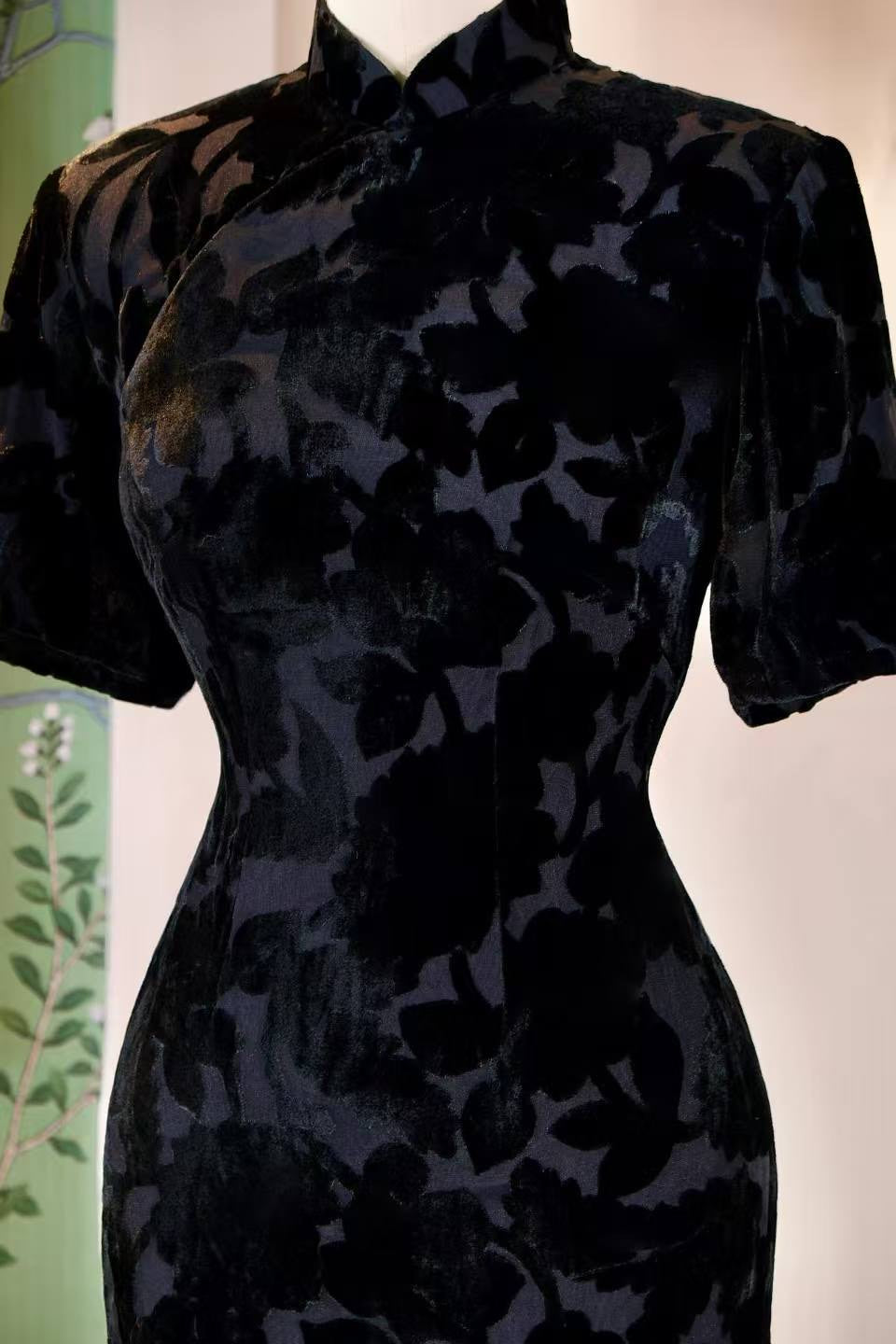
这件藏品以黑色烧花丝绒为基底,
旗袍上的主体纹样为缠枝牡丹,花朵以写意笔触勾勒,
旗袍的形制承袭民国末期的修身风格,高领、短袖、侧开衩,
这件旗袍不仅是一件衣物,更是一个时代的文化符号。
This collection piece is based on a black devoré velvet (shāo huā sī róng) fabric. The velvet pile reflects a subtle, matte quality under light, and the intervention of the devoré (burn-out) technique gives the fabric an almost bas-relief three-dimensional texture.
The main motif on the cheongsam is the scrolling peony. The flowers are outlined with freehand strokes (xieyi), the petals layered like clouds, and the branches and leaves winding like flowing water, aligning with the traditional Chinese pattern philosophy of pairing the "Flower Prime Minister" (peony) and the "Flower Queen" (peony/rose). The peony has symbolized "national beauty and heavenly fragrance" since the Tang Dynasty; the Shu Wu Ji Yuan records: "The Tang people called the peony the wooden peony; during the Tianbao era, the thousand-layered peony appeared in the Forbidden City, and the Emperor would often bestow it upon officials during banquets, circling the flowers." However, the peony on this cheongsam adds a modern touch: abstract lines break the realistic framework at the petal edges, which aligns with the deconstruction of Oriental motifs in the Western "Art Nouveau" movement of the early 20th century (often conflated with similar influences in the 50s), marking a superb fusion of "Chinese imagery and modern aesthetics."
The cheongsam's silhouette inherits the fitted style of the late Republican era: high collar, short sleeves, side slit, and a waist cinched to the extreme, delineating the curved beauty of the female body. This design retains the "solemnity" of the traditional cheongsam while incorporating the 1950s Taiwanese society's pursuit of "modernity." According to the Taiwan Garment Chronicle, 1950s Taiwanese cheongsams primarily adopted "modified" tailoring and favored heavy materials like velvet and satin to signify status. This specific black devoré velvet cheongsam was considered a "must-have evening wear" for upper-class Taiwanese women at the time, making its scarcity self-evident.
This cheongsam is not just a garment; it is a cultural symbol of an era. It witnesses Taiwan's adherence to and innovation of Chinese tradition after World War II, and it carries the transformation of the cheongsam from "everyday wear" to "ceremonial attire." Today, when we cast our gaze upon this collection piece, we see not only the blooming of the peony on black velvet but also a nation's persistent pursuit of beauty—just as Eileen Chang stated in Rondeau of Clothes: "The purpose of the cheongsam is not to tightly bind the body, but to outline an Oriental, subtle, and flowing line of beauty." And this 1950s devoré velvet cheongsam is the ultimate presentation of this "beauty of line."