深圳溯源
无法加载取货服务可用情况
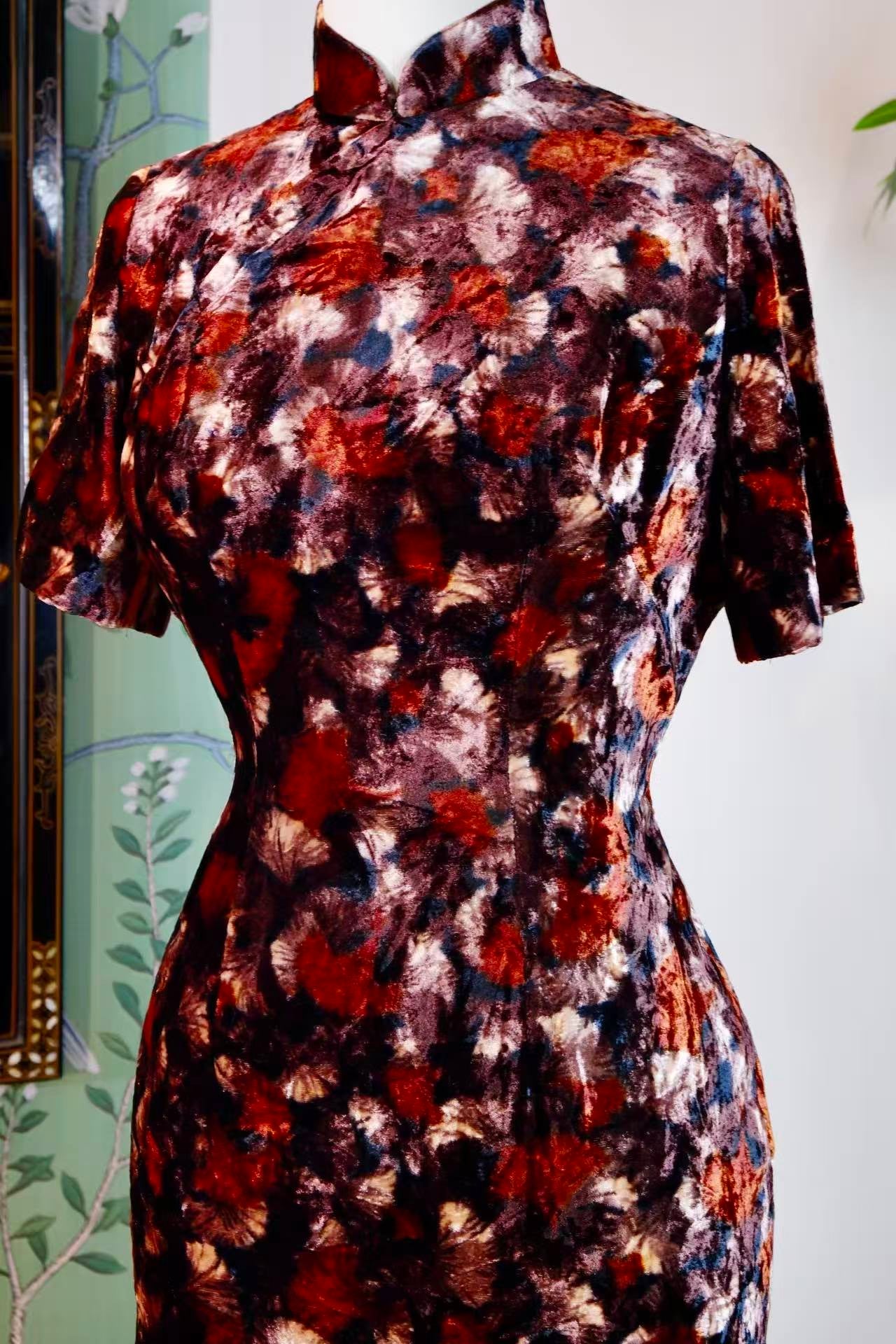
当日本绞染的“几何秩序”遇见金丝绒的“华贵质感”,
一、面料溯源:日本绞染(Shibori)与金丝绒的“
这件旗袍的核心价值,在于其采用的“日本进口绞染金丝绒面料”—
日本绞染(Shibori)作为“日本版的扎染”,
而金丝绒(Velvet)作为一种“以桑蚕丝或人造丝为经,
这件旗袍的面料,正是日本绞染技艺与和式金丝绒的“完美联姻”:
二、图案解码:银杏绞染的“抽象写意”
这件旗袍的图案设计,堪称“以布为纸,以染为墨”
1. 银杏叶的“形”与“神”:图案中银杏叶的轮廓并非写实的“扇形”
2. 色彩的“秋意哲学”:绞染的渐变效果,将银杏叶从“初秋的嫩黄”
3. 金丝绒的“材质叙事”:与传统丝绸绞染不同,
三、古董衣的故事:六十年代的“工艺迁徙”与“文化对话”
这件旗袍的诞生,恰逢东亚纺织业的“黄金转型期”。
这种“工艺迁徙”背后,是六十年代东亚社会的“文化对话”:
四、稀缺性与艺术价值:一件“行走的东方美学史”
作为六十年代日本进口绞染金丝绒旗袍,其稀缺性体现在三个层面:
- 工艺的不可复制性:日本绞染的“手工捆扎”与“自然晕染”,
- 材质的珍贵性:和式金丝绒的“短绒密织”工艺,使其光泽柔和、
- 文化的交融性:这件旗袍不仅是“日本工艺”的载体,更是“
五、结语:一袭旗袍,半部东方美学史
当您穿上这件六十年代日本进口绞染金丝绒旗袍,
这件旗袍,是“时间的礼物”,也是“文化的桥梁”——
When the "geometric order" of Japanese Shibori meets the "sumptuous texture" of velvet, and the "Oriental imagery" of the ginkgo leaf merges into the "abstract expressionism" of tie-dyeing, this cheongsam ceases to be a mere garment. It becomes a "mobile museum of Oriental aesthetics," carrying the artisanal dialogue between China and Japan, period memories, and cultural metaphors.
The core value of this piece lies in its fabric—Japanese imported Shibori gold velvet. This material represents the pinnacle of "modernizing traditional craft" in the 1960s Japanese textile industry and serves as a rare material witness to the fusion of Sino-Japanese aesthetics.
Japanese Shibori: As the Japanese iteration of tie-dye, its history dates back to the Nara period (8th century), evolving into dozens of techniques like Kanoko Shibori (fawn-spot) and Kumo Shibori (spider-web). Compared to Chinese tie-dye, Japanese Shibori emphasizes a sense of geometric order and exquisite hand-wrought precision. Every tie and thread alignment requires millimeter-level control, resulting in "natural patterns that cannot be perfectly replicated by machine."
Gold Velvet: Historically a "tribute" fabric in the Ming and Qing dynasties, velvet saw a technological localization in Japan after the Meiji Restoration (1868). By the early 20th century, "Washiki" (Japanese-style) velvet was developed, characterized by shorter, denser piles and a softer luster—perfect for expressing the nuanced color gradients of Shibori.
The fabric of this cheongsam is the perfect union of these two: the "hand-crafted soul" of Shibori complements the "refined luxury" of velvet. Under light, the contrast between the "standing pile" and "crushed pile" creates a dynamic shimmer, making the ginkgo leaves appear to "float" on the surface. This "dynamic stillness" is the embodiment of the Japanese Wabi-sabi spirit—perfection within the imperfect, eternity within the ephemeral.
The design is a masterclass in Oriental expressionist aesthetics—using "cloth as paper and dye as ink." Through tying, folding, and compressing, the Shibori process creates irregular resist zones, resulting in a hazy, "is-it-a-flower-or-a-leaf" atmosphere.
Form and Spirit of the Ginkgo: The silhouettes are not realistic fans but dynamic captures of "ginkgo leaves tossed by the wind." The deep reds and ochres at the edges evoke leaves scorched by autumn frost, while the cream-white "negative space" mimics dappled sunlight piercing through branches. This echoes the spirit of Song Dynasty painter Liang Kai: "Seeking the spirit, not the likeness."
The "Autumnal Philosophy" of Color: The gradients condense the life cycle of a ginkgo leaf—from the tender yellow of early autumn to the rust-red of mid-autumn and the charred brown of late autumn. These tones collide to create a harmony of Heaven (nature), Earth (material), and Man (craft).
Material Narrative: Unlike silk Shibori, the velvet pile allows the dye to seep into the fibers to create a "velveteen blur." In the light, the deep reds glow like vintage burgundy, while the cream-whites shimmer like moonlight on snow. This makes the ginkgo pattern a tactile autumn landscape.
The birth of this cheongsam coincided with a "golden transition" in East Asian textiles. Post-1949, master tailors from the Jiangsu and Zhejiang regions migrated to Taiwan, bringing the "Haipai" (Shanghai-style) cut. Simultaneously, post-war Japan was integrating traditional crafts with modern production.
This garment is a cross-cultural byproduct: A Taiwanese tailor selected Japanese imported velvet, using the "mandarin collar and diagonal closure" as the Chinese skeleton to house Japanese abstract patterns and the shared cultural icon of the ginkgo. This created a style that is traditional yet modern, Oriental yet international.
As a 1960s Japanese imported Shibori velvet piece, its rarity is three-fold:
Irreproducibility: The manual tying and natural diffusion mean no two patterns are identical; it is truly wearable art.
Material Preciousness: The specific "short-pile dense weave" of Washiki velvet is a lost standard of quality, rarely seen in contemporary vintage markets.
Cultural Fusion: It is a material archive of the "artisanal migration" of the 1960s, documenting the transformation of Oriental aesthetics from tradition to modernity.
To wear this 1960s cheongsam is to wear a "walking history of Oriental aesthetics." As Okakura Kakuzō wrote in The Book of Tea: "True beauty could be discovered only by one who mentally completed the incomplete." The mottled gradients of this Shibori pattern do not seek flawless perfection; instead, they reveal the deepest poetry and philosophical thought of the East.
It is a gift from time and a bridge of culture, allowing us, sixty years later, to touch that golden age where craft and beauty were one.