深圳溯源
无法加载取货服务可用情况
六十年代香港制法国刺绣蕾丝旗袍:绽放在时光里的东方绮梦
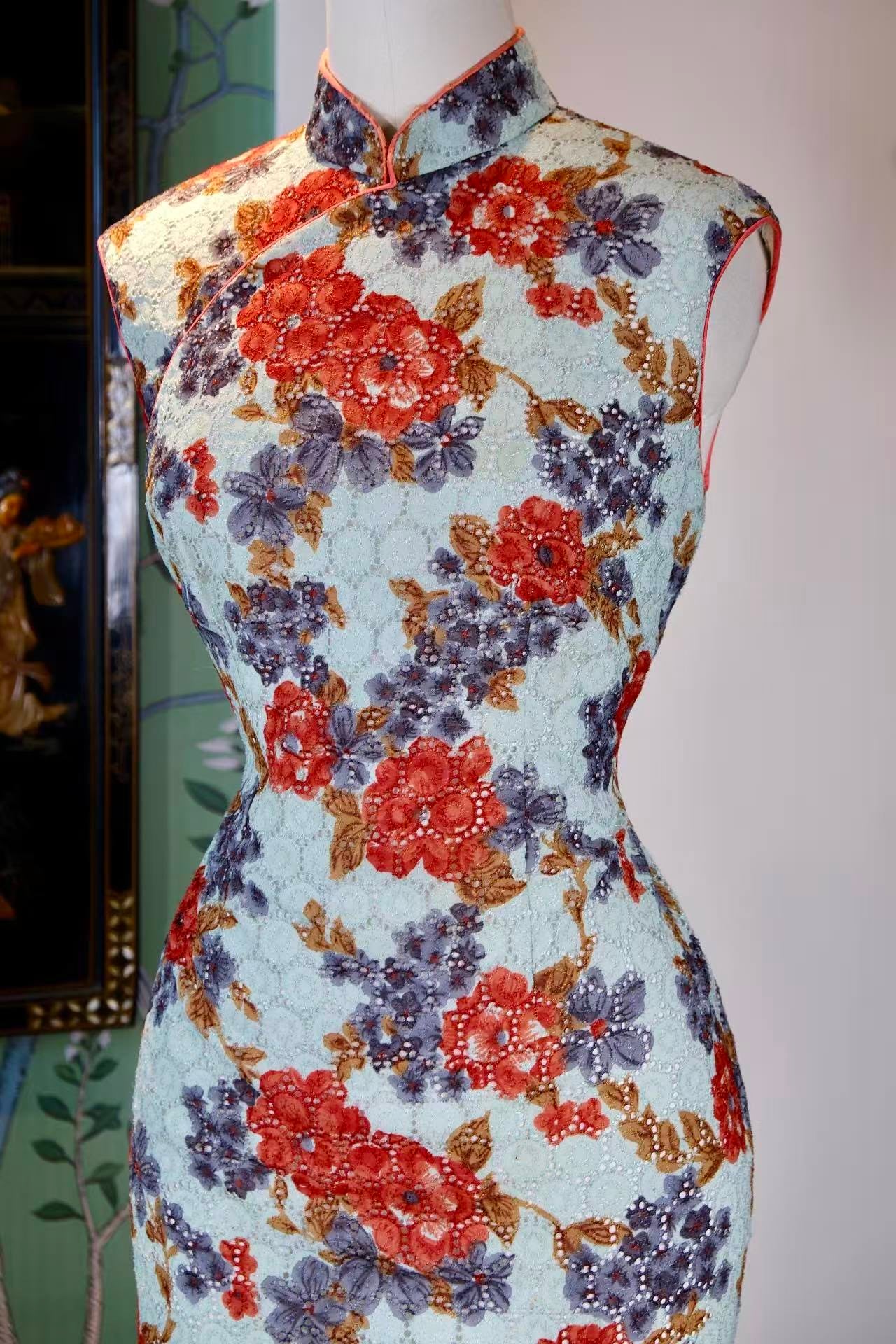
当目光触及这件六十年代的古董旗袍,首先被征服的是那幅“活”
旗袍主体以大朵珊瑚红牡丹与紫罗兰色芍药为骨,
背景暗纹是细密的六角菱格,如同宋代吉州窑剪纸贴花的几何肌理,
这件旗袍的稀缺性,藏在“法国刺绣蕾丝”与“香港手工坊”
而香港作为当时远东最大的旗袍制作中心,
六十年代的香港,正处于殖民文化与本土意识交织的特殊时期。
牡丹象征富贵,芍药代表情思,缠枝纹暗合“生生不息”,
当现代时尚在快消浪潮中不断更迭,
When one's gaze falls upon this vintage cheongsam from the 1960s, the immediate capture is the "living" embroidered pattern—a magnificent creation where Oriental floral charm is embroidered onto the texture of a Western fabric, using French embroidered lace as the base. The pale cyan lace is like a thin veil in the mist of Jiangnan, and the interwoven floral patterns on it resemble the romantic imagery from the Songs of Chu: "Wearing jiāng lí and pì zhǐ (fragrant plants), threading autumn orchids as a pendant," while subtly aligning with the brilliant sentiment from the Classic of Poetry: "You threw me a wood peach, I repaid with a precious jade."
The cheongsam body is structured around large coral red peonies and violet purple peonies, intertwined with brownish-ochre branches to form an undulating "S" curve rhythm. The petals of the peonies are built up with three-dimensional embroidery threads, each stitch carrying the delicate luster of French embroidery, reminiscent of the dense flowers on the robes of court ladies in the Northern Song painting Court Lady Adorning Herself, yet shedding the restraint of gōng bǐ (meticulous) style for the airy lightness of lace.
The background's hidden pattern is a fine hexagonal grid, like the geometric texture of the paper-cut appliqué from Song Dynasty Jizhou kilns, or perhaps the geometric abstraction of the Western Art Deco style. This "East-West stitching" design is the unique signature of 1960s Hong Kong as a cultural confluence—it retains the Chinese structure of the cheongsam's stand collar and diagonal placket while using the translucent texture of French lace to break the heaviness of traditional brocade, allowing the subtle grace of the Oriental woman to shimmer in the light and shadow.
The scarcity of this cheongsam is hidden in the dual code of "French embroidered lace" and "Hong Kong bespoke tailoring." In the 1960s, the embroidery workshops in Lyon, France, still continued the 17th-century tradition of "royal textiles," using silk threads to embroider three-dimensional floral patterns onto the lace base. This process was extremely time-consuming and labor-intensive; every inch of fabric was the crystallization of the artisan's time.
Hong Kong, as the largest cheongsam production center in the Far East at the time, gathered a group of master tailors who were adept at blending traditional cutting with Western fabrics. They used Chinese techniques like "splitting seams" (pī fēng) and "shrinking and stretching" (guī bá) to ensure the lace cheongsam fit the Oriental woman's curves while preserving the dynamism of the French embroidery. This "fusion of East and West" craftsmanship gradually disappeared after the late 1960s with the popularization of mechanized production, making this cheongsam an "out-of-print artwork" from before the industrial transition.
The 1960s in Hong Kong was a special period marked by the interweaving of colonial culture and local consciousness. This cheongsam, with its combination of "French material + Hong Kong manufacturing + Chinese silhouette," is a microcosm of Hong Kong in that era: it maintained a keen assimilation of Western fashion (like the use of lace) while firmly adhering to the core of Oriental aesthetics (like the auspicious symbolism of the floral patterns).
Peony symbolizes wealth, violet represents sentiment, and the scrolling vine motif alludes to "perpetual vitality." These traditional symbols were reinterpreted in the Western embroidery language. As scholar Xu Zidong once said: "Hong Kong culture is a 'blossoming in the缝隙'"—this cheongsam is precisely that unique flower blooming in the cultural gap between East and West, serving not only as a garment but as a cultural specimen of an era.
While modern fashion constantly changes in the tide of fast consumption, this 1960s vintage cheongsam proves the eternal value of "slow work yields fine results" through its rare craftsmanship and cultural depth. It allows the wearer to be not just a follower of fashion, but a collector of time—every stitch tells the story of an era filled with the warmth of the artisan's fingers and an extreme dedication to beauty and craftsmanship.