深圳溯源
无法加载取货服务可用情况
衣服尺寸:
胸围/腰围/臀围:82/64/88 厘米
衣长:96 厘米
细节描述:
一、纹样解码:从波斯宫廷到南洋雨林的“生命之树”
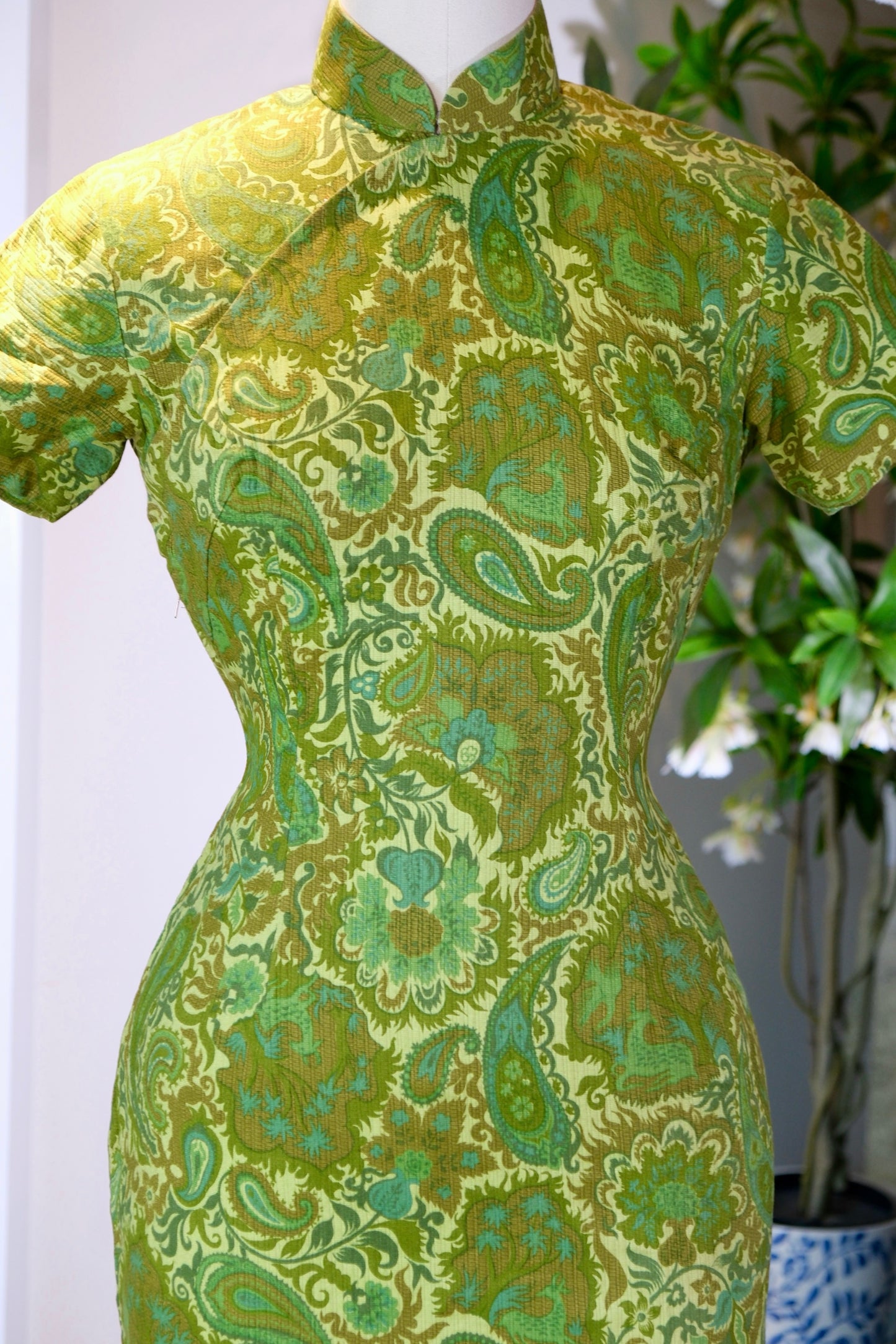
这件旗袍最摄人心魄的,是其满幅铺陈的佩斯利(Paisley)纹样——那如松果、似泪滴、若火焰的卷曲图案,实为古波斯语中的“Kashmir”(克什米尔)纹,在印度莫卧儿王朝时期被赋予“生命之树”的宗教寓意,象征着宇宙生生不息的循环。而在这件五十年代的香港旗袍上,佩斯利纹却褪去了中东的肃穆,被南洋的繁茂浸染:橄榄绿与柠檬黄的底色交织,如热带雨林中穿透叶隙的阳光;纹样间点缀的浅蓝小花与卷草纹,又似马六甲海峡的潮湿水汽,将波斯纹样的庄重转化为南洋风情的灵动。
值得注意的是,纹样的排布暗藏匠心——佩斯利主体纹样以“S”形曲线纵向延伸,恰好呼应旗袍的收腰剪裁,使穿着者的身形如纹样般流转生姿。这种“纹随形走”的设计,正是五十年代香港旗袍“中西合璧”的缩影:既承袭了民国旗袍的平面纹样美学,又吸纳了西方立体剪裁对“人体曲线”的强调,让千年纹样在东方女性的腰肢间获得新生。
二、衣以载史:南洋侨眷的“海上丝路”记忆
这件旗袍的稀缺性,首先在于其“香港制造”的身份。五十年代的香港,是战后东亚纺织业的中转站,更是南洋华侨与内地文化的交汇点。彼时,新加坡、槟城的侨眷常将南洋的布料(如马来蜡染、印度棉)运至香港,委托当地裁缝制成旗袍,再带回南洋穿着。
从历史语境看,五十年代的香港旗袍正处于“黄金时代”的尾声。一方面,它延续了民国旗袍的“海派”精致;另一方面,因南洋华侨的审美影响,开始融入热带地区的明艳色彩与繁复纹样。这件旗袍的短袖设计(不同于民国长旗袍的长袖)、略低的领口(约4.5厘米高),正是为适应南洋湿热气候的改良,堪称“海上丝路”上文化交融的实物见证。
三、艺术风格:装饰主义与东方美学的共振
从艺术史角度,这件旗袍的纹样可追溯至19世纪的“佩斯利复兴”运动——当时欧洲设计师将印度克什米尔披肩的纹样引入西方时装,形成维多利亚时期的装饰风潮。而这件五十年代旗袍,则将这种西方装饰主义与东方美学巧妙嫁接:
- 色彩的“南洋性”:摒弃了传统佩斯利纹的深红、靛蓝,转而采用橄榄绿、柠檬黄等热带色调,与同期香港电影(如《不了情》)中女星的旗袍色彩一脉相承,折射出战后香港对“现代性”与“异域风情”的双重追求。
- 纹样的“抽象化”:传统佩斯利纹多为具象的花卉或动物变形,而这件旗袍的纹样经过简化,更接近几何化的卷草纹,暗合1950年代西方“原子时代”对抽象图案的偏好,却以东方线条的流畅感消解了机械感,形成独特的“东方装饰主义”风格。
四、结语:穿在身上的文明对话
这件旗袍,是波斯纹样穿越丝路的旅程,是南洋季风与香港烟火的邂逅,更是五十年代东方女性对“美”的倔强表达。当指尖抚过那橄榄绿的佩斯利纹,仿佛能触摸到半个世纪前,一位侨眷在维多利亚港的夕阳下,穿着它赴宴时的从容与骄傲——那是文明的对话,是时光的私语,更是一件古董衣超越服饰本身的艺术价值:它让历史有了温度,让文化有了形状。
Measurements / Size Guide:
Bust / Waist / Hips: 82/64/88 cm
Total Length: 96 cm
Detailed Description:
The most soul-stirring feature of this Qipao is the all-over Paisley motif—those curling patterns resembling pinecones, teardrops, or flames. Originally known as the "Kashmir" pattern in ancient Persian, it was imbued with the religious symbolism of the "Tree of Life" during India's Mughal Empire, representing the eternal cycle of the universe. On this 1950s Hong Kong Qipao, however, the Paisley loses its Middle Eastern solemnity and becomes saturated with the lushness of the Nanyang (South Seas): a base of olive green and lemon yellow interweave like sunlight piercing through canopy gaps in a tropical rainforest. The light blue florets and scrolling grass scattered among the motifs evoke the humid mist of the Strait of Malacca, transforming the gravity of Persian patterns into the vitality of Nanyang exoticism.
Notably, the arrangement of the patterns hides a master’s touch—the primary Paisley motifs extend vertically in "S" curves, perfectly echoing the cinched-waist tailoring of the Qipao, making the wearer’s silhouette flow as gracefully as the patterns themselves. This "pattern following form" design is a microcosm of the "East meets West" philosophy in 1950s Hong Kong Qipaos: inheriting the flat pattern aesthetics of the Republican era while absorbing Western three-dimensional tailoring's emphasis on "body curves," allowing a thousand-year-old motif to find new life on the waist of an Oriental woman.
The rarity of this Qipao lies first in its "Made in Hong Kong" identity. Hong Kong in the 1950s was a transit hub for East Asian textiles and a meeting point for Overseas Chinese and mainland culture. At that time, families in Singapore and Penang often shipped Nanyang fabrics (such as Malaysian Batik or Indian cotton) to Hong Kong to commission local tailors to make Qipaos, which were then brought back to Southeast Asia.
From a historical perspective, 1950s Hong Kong Qipaos stood at the twilight of a "Golden Age." They continued the refined "Shanghai style" of the Republican era while integrating the vibrant colors and complex patterns of the tropics due to the aesthetic influence of Nanyang Chinese. The short-sleeved design (different from the long sleeves of Republican full-length Qipaos) and the slightly lower collar (approx. 4.5 cm high) were specific modifications for the hot and humid Nanyang climate—a physical witness to cultural fusion along the "Maritime Silk Road."
From an art history perspective, the patterns of this Qipao can be traced back to the 19th-century "Paisley Revival," when European designers introduced Indian Kashmiri shawl patterns into Western fashion, creating a Victorian decorative trend. This 1950s piece cleverly grafts this Western decorationism onto Oriental aesthetics:
The "Nanyang Nature" of Color: It discards the traditional deep reds and indigos of Paisley, opting instead for tropical tones like olive green and lemon yellow. This aligns with the Qipao colors of actresses in contemporary Hong Kong films (such as Love Without End), reflecting post-war Hong Kong’s dual pursuit of "modernity" and "exoticism."
Abstraction of the Motif: Traditional Paisley patterns were often representational flowers or animal deformations. The patterns on this Qipao have been simplified, leaning toward geometric scrolling grass, which aligns with the Western "Atomic Age" preference for abstract patterns in the 1950s. Yet, it dissolves mechanical stiffness with the fluidity of Oriental lines, forming a unique "Oriental Decorationism" style.
This Qipao is a journey of Persian motifs traversing the Silk Road, an encounter between Nanyang monsoons and Hong Kong’s daily bustle, and a defiant expression of "beauty" by Oriental women in the 1950s. When one's fingertips brush over those olive-green Paisley patterns, it feels as if one can touch the composure and pride of an overseas Chinese lady attending a banquet under the sunset of Victoria Harbour half a century ago. It is a dialogue of civilizations, a whisper of time, and an artistic value that transcends the garment itself: it gives history warmth and culture a shape.