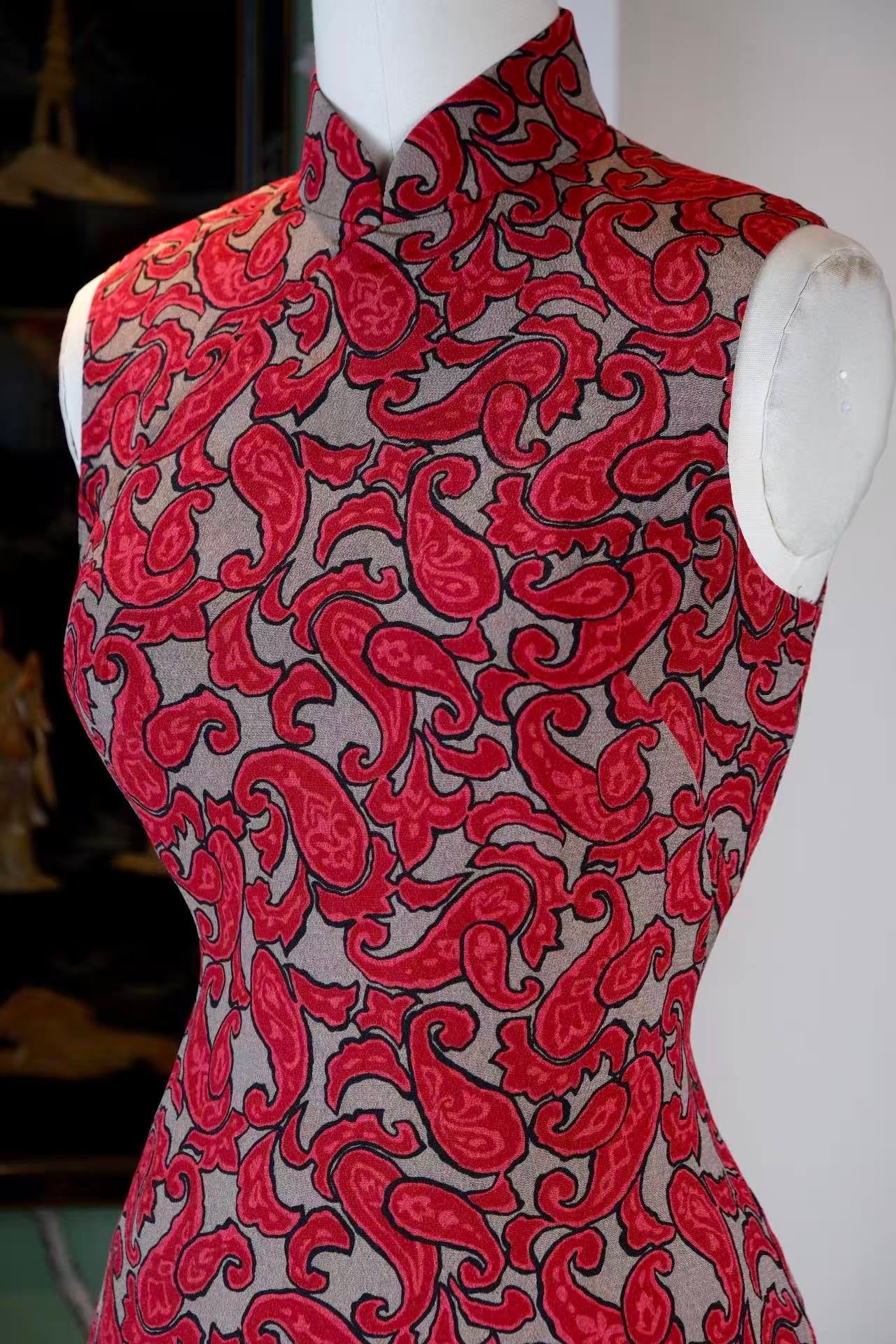
六十年代台湾佩斯利纹古董旗袍:云纹流转间的东方叙事
这件诞生于上世纪六十年代的台湾古董旗袍,以佩斯利纹为笔,在丝缎上勾勒出一场东西方美学的千年对话。其纹样并非简单的装饰堆砌,而是承载着跨文明符号的流转与再造,堪称“穿在身上的史诗”。
旗袍通体铺陈的佩斯利纹,形若弯曲的水滴,又似抽象化的菩提叶,其源头可追溯至古巴比伦的“生命之树”图腾,后经波斯、印度的演变,成为莫卧儿王朝织物上的经典符号。在这件旗袍上,设计师以东方审美重构了这一异域纹样:水滴状的轮廓被柔化出中国传统的“云纹”意蕴,曲线流转如行云流水,暗合《考工记》中“天有时,地有气,材有美,工有巧”的造物哲学。红色纹样在灰褐色底布上盘旋游走,恰似《诗经》所咏“青雀白鹄,集于中庭”的灵动,又似敦煌壁画中飞天飘带的凝练,将印度的神秘、波斯的华贵与东方的含蓄融为一体。
作为一件承载历史记忆的织物,它不仅是六十年代台湾社会风貌的缩影,更是一份关于“纹样迁徙”的活态档案。当佩斯利纹从印度的菩提树叶,化作东方旗袍上的云纹意象,这件旗袍便超越了服饰的范畴,成为文明互鉴的见证。它静立于时光中,却仿佛能听见丝绸之路的驼铃,看见海上贸易的帆影,最终凝结成衣襟上那一道道流转的曲线——这是东方美学对世界符号的诗意诠释,亦是古董旗袍永不褪色的灵魂。
1960s Taiwanese Paisley Antique Qipao: An Oriental Narrative Amidst Flowing Cloud Motifs
Born in the 1960s, this antique Qipao from Taiwan uses the Paisley motif as its brush to sketch a millennial dialogue between Eastern and Western aesthetics upon silk satin. These patterns are no simple accumulation of decoration; they carry the circulation and reconstruction of cross-civilizational symbols, standing as a "wearable epic."
The Paisley patterns laid across the Qipao—shaped like curved droplets or stylized bodhi leaves—trace their lineage back to the "Tree of Life" totems of ancient Babylon. After evolving through Persia and India, they became a classic symbol of Mughal textiles. On this Qipao, the designer has reconstructed this exotic motif through an Oriental lens: the droplet outlines are softened to evoke the traditional Chinese "Cloud Motif" (Yun Wen). The curves flow like moving clouds and running water, aligning with the philosophy of "The seasons of Heaven, the energy of Earth, the beauty of materials, and the skill of the artisan" from Kao Gong Ji. The red patterns swirl across the taupe base, capturing the spirit of "Green sparrows and white swans gathering in the courtyard" from The Classic of Poetry, while echoing the concise elegance of the flying apsaras' ribbons in Dunhuang murals. It seamlessly blends Indian mystery, Persian opulence, and Oriental restraint.
As a textile carrying historical memory, this piece is not only a microcosm of 1960s Taiwanese society but also a living archive of "pattern migration." When the Paisley motif transforms from an Indian bodhi leaf into a cloud-like image on an Oriental Qipao, the garment transcends the realm of fashion to become a witness to mutual learning between civilizations. Standing silently in time, it seems to echo the camel bells of the Silk Road and reflect the sails of maritime trade, eventually condensing into the flowing curves upon its lapels. This is a poetic interpretation of global symbols by Oriental aesthetics, and the unfading soul of an antique Qipao.