六十年代波普旗袍:当东方丝绸遇见西方像素
衣服尺寸:
胸围/腰围/臀围:96/78/102 厘米
衣长:107 厘米
细节描述:
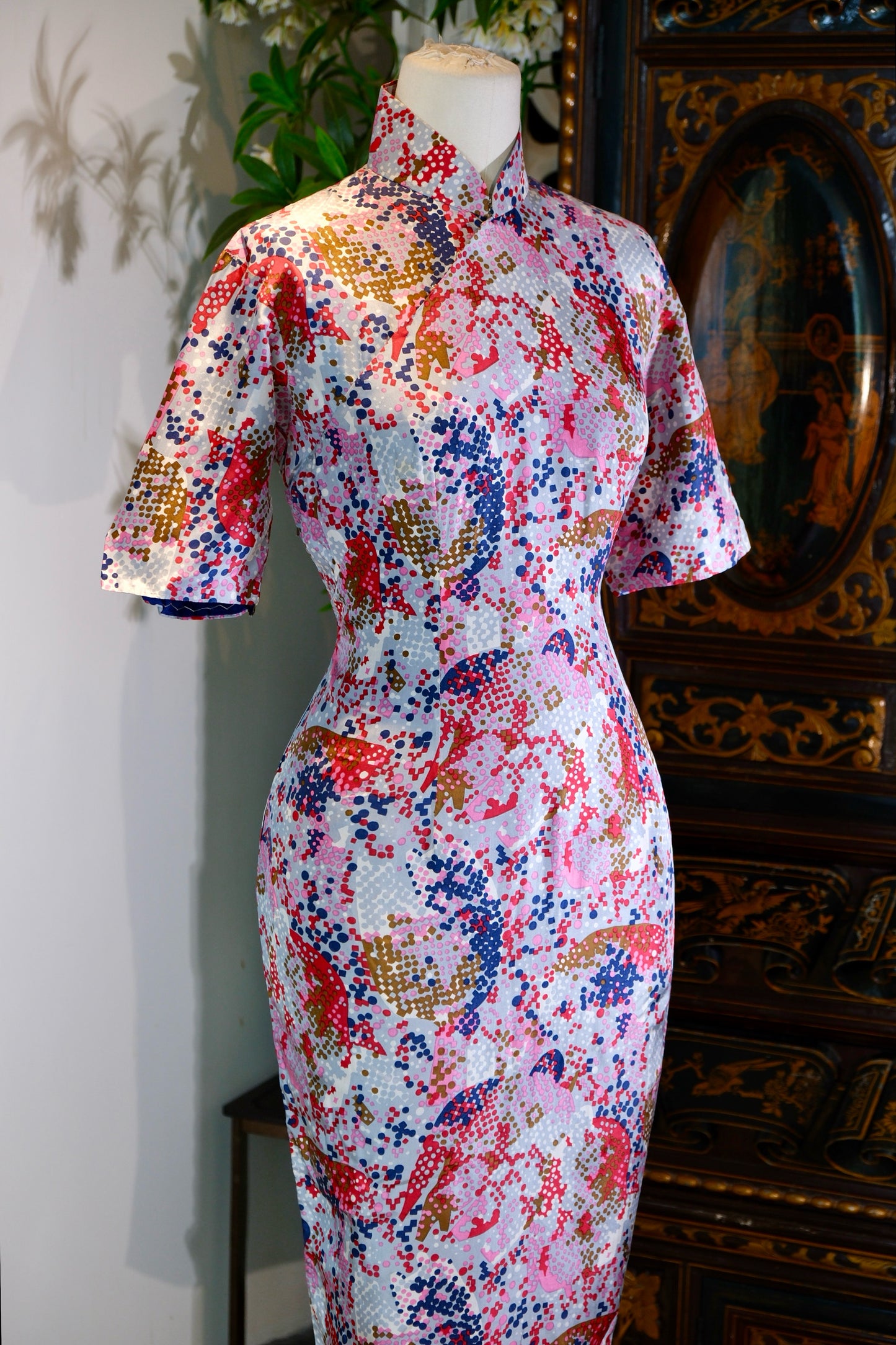
这件香港制的六十年代波普旗袍,以银灰为底,缀满红、粉、蓝、金的像素化圆点与几何色块,如老式电视机的噪点,又似霓虹灯下的碎影,将西方波普艺术的叛逆,注入东方旗袍的婉约。
六十年代的香港,是东西方文化的熔炉。彼时,西方波普艺术随电影、杂志涌入,安迪·沃霍尔的“玛丽莲·梦露”、罗伊·利希滕斯坦的漫画网点,成为年轻人的新宠。香港裁缝以东方智慧解构这种潮流:保留旗袍的立领、斜襟、收腰,却用像素化图案打破传统花鸟的沉闷,让旗袍从“闺阁礼服”变为“街头风景”。
这种融合并非偶然。正如艺术史家贡布里希所言:“艺术的生命在于对话。”六十年代的香港女性,穿旗袍逛铜锣湾、喝咖啡、跳恰恰,她们需要一件既符合东方审美、又彰显现代身份的衣服。波普旗袍,正是这种需求的产物——它用西方的“点”,织就东方的“韵”,成为时代的符号。
如今,这样的旗袍已近乎绝迹。六十年代的香港,虽为制衣重镇,但波普风格因“过于前卫”,产量极少。多数旗袍仍以传统花卉、龙凤为主,而像素化图案的旗袍,多为学生、艺人的定制款,留存至今者,不足百件。
它的稀缺,更在于工艺的不可复制。彼时香港制衣,仍用手工剪裁、扞边,每一针都藏着温度。如今机器印染虽能复制图案,却无法复刻那份“手工的呼吸”。正如本雅明在《机械复制时代的艺术作品》中所说:“原作的‘光晕’,在于它的独一无二。”
这件旗袍,是六十年代香港的“切片”:它见过弥敦道的霓虹,听过丽风唱片的爵士,也感受过少女的心跳。如今,它静静挂在衣架上,银灰底色泛着微光,像素图案如流动的星河,诉说着一个关于融合、叛逆与美的故事。
如果你懂它,便会明白:这不仅是一件衣服,更是一段历史,一种态度,一份值得珍藏的艺术。
1960s Pop Art Cheongsam: When Eastern Silk Meets Western Pixels
Measurements / Size Guide:
Bust / Waist / Hips: 96/78/102 cm
Total Length: 107 cm
Detailed Description:
This 1960s Hong Kong-made Pop Art cheongsam (qipao), with its silver-grey base adorned with pixelated dots and geometric blocks in red, pink, blue, and gold, resembles the static of a vintage television or the fragmented reflections of neon lights. It injects the rebellion of Western Pop Art into the grace of the Eastern qipao.
1960s Hong Kong was a melting pot of East and West. At that time, Western Pop Art surged in through films and magazines; Andy Warhol’s Marilyn Monroe and Roy Lichtenstein’s comic-style Ben-Day dots became the new darlings of the youth. Hong Kong tailors deconstructed this trend with Eastern wisdom: they retained the standing collar, diagonal bodice, and cinched waist, but used pixelated patterns to break the monotony of traditional birds and flowers, transforming the qipao from a "boudoir gown" into "street scenery."
This fusion was no accident. As art historian E.H. Gombrich noted: "The life of art lies in dialogue." Hong Kong women in the 60s wore qipaos to stroll through Causeway Bay, drink coffee, and dance the Cha-Cha. They needed a garment that aligned with Eastern aesthetics while manifesting a modern identity. The Pop Art qipao was the product of this demand—using Western "dots" to weave an Eastern "rhyme," becoming a symbol of the era.
Today, such qipaos have nearly vanished. Although Hong Kong was a garment powerhouse in the 1960s, Pop Art styles were produced in very limited quantities due to being "too avant-garde." While most garments still featured traditional flora or dragons, pixelated patterns were mostly bespoke orders for students and artists. Fewer than a hundred such pieces remain today.
Its scarcity also lies in the irreproducibility of its craft. At that time, Hong Kong garment making still relied on manual cutting and hand-stitched hemming; every stitch held a sense of warmth. While modern industrial printing can replicate patterns, it cannot recreate that "breath of handwork." As Walter Benjamin said in The Work of Art in the Age of Mechanical Reproduction: "The 'aura' of the original lies in its uniqueness."
This qipao is a "slice" of 1960s Hong Kong: it has seen the neon of Nathan Road, heard the jazz of Lifeng Records, and felt the heartbeat of a young girl. Now, it hangs quietly on the rack, its silver-grey base shimmering faintly, its pixel patterns like a flowing galaxy, recounting a story of fusion, rebellion, and beauty.
If you understand it, you will realize: this is more than a garment; it is a segment of history, an attitude, and a work of art worthy of preservation.