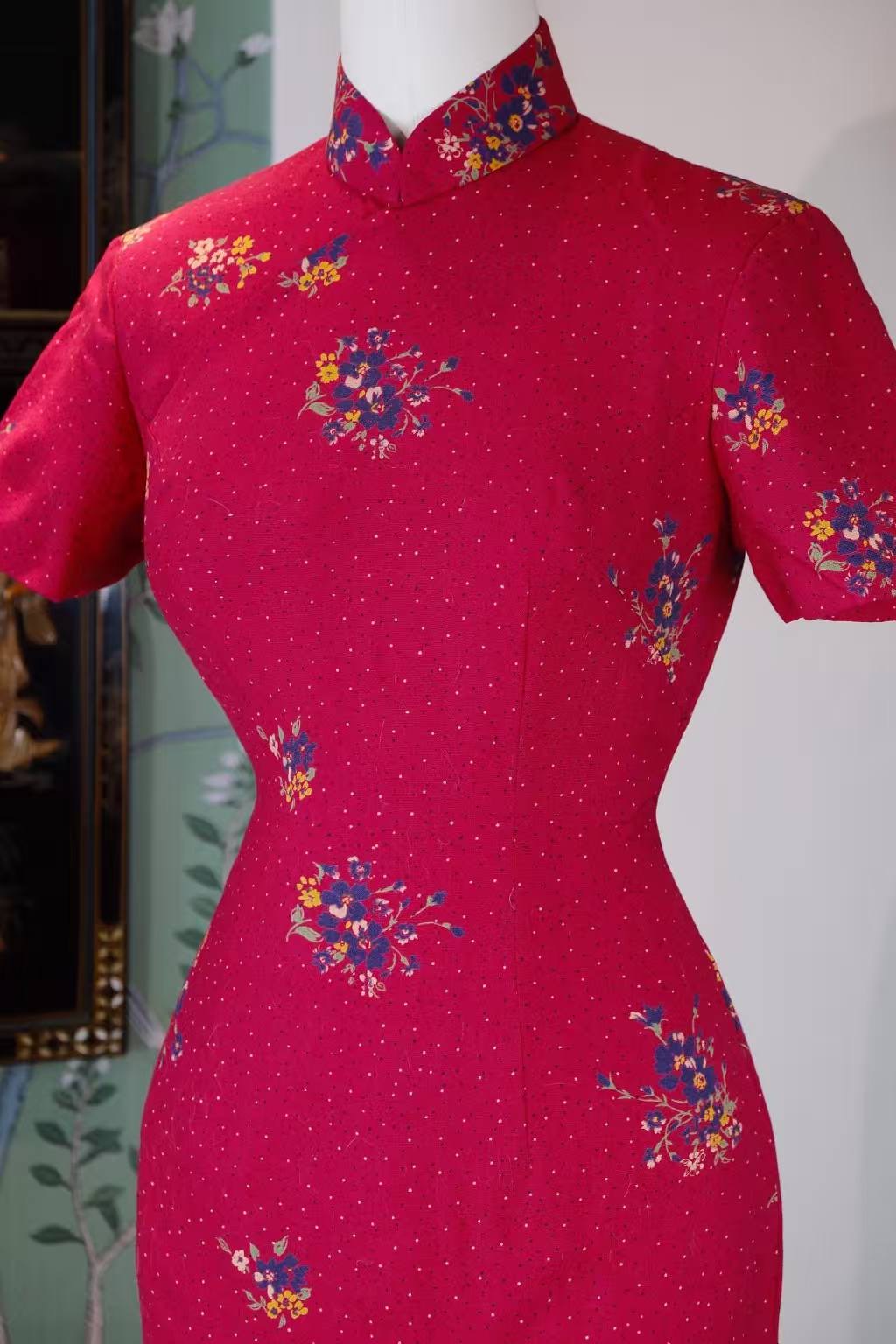
1960s Worsted Wool Printed Qipao: A Woven Poem of Oriental Aesthetics
The pattern design of this Qipao is a masterclass in "using weaving as painting and blossoms as poetry." The base tone is 胭脂红 (Carmine Red), rich as congealed sunset glow, sprinkled with tiny white dots resembling scattered starlight. The printed motifs employ a classic "broken-branch floral" composition: clusters of bluish-purple irises and bright yellow winter jasmines are interspersed with tender green foliage. The petal edges are tinged with a faint rouge gradient, as if freshly moistened by morning dew. These floral clusters vary in size and are arranged with rhythmic precision, adhering to the traditional principle of "Sparse enough for a horse to gallop, yet dense enough to block the wind," while aligning with the cadence of modern aesthetics.
If one were to use the line "The peach tree is young and elegant; brilliant are its flowers" from The Classic of Poetry as a metaphor, the splendor of this robe lies not in heavy colors, but in that word "brilliant" (灼灼). The unique soft luster of the wool fabric makes the red both fervent and gentle. The leap of bluish-purple and bright yellow against the red base embodies the dialectic beauty of "Blue extracted from indigo is even deeper than indigo." Even more remarkable is the "Worsted Wool" technique unique to 1960s Taiwan. This fabric uses wool as the warp and silk as the weft; through a specialized weaving process, it retains the crisp warmth of wool while possessing the silky luster of silk. It feels as smooth as jade to the touch and drapes like flowing water—an exclusive fabric for high-end bespoke Qipaos of that era.
"Clothing is that which adorns the body; beauty and goodness bring mutual joy." This 1960s worsted wool printed Qipao is more than a garment; it is a segment of solidified history and a poem in motion. It uses red as paper and blossoms as ink to write of the gentleness and resilience of Oriental women, witnessing the aesthetic evolution of an era. Today, as we gaze upon it in a museum gallery, we can almost hear the winds of the 1960s crossing the Taiwan Strait, lightly brushing past every tiny flower on the lapel, whispering stories cherished by time.