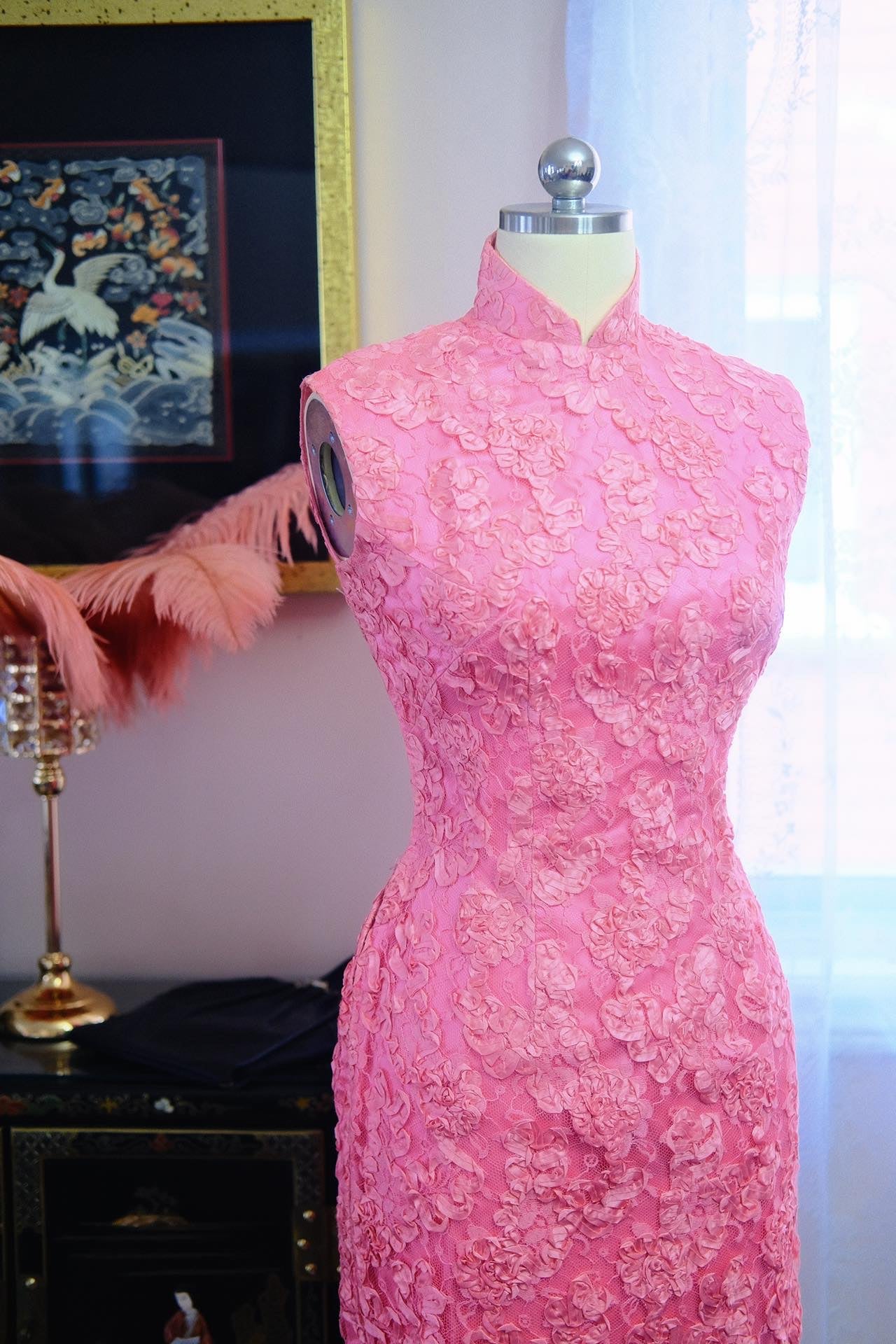
六十年代香港产法蕾香韵旗袍
粉若桃夭映绣帷,法蕾精雕燕尾姿。
云鬓斜簪花解语,香江裁月作裳衣。
旗袍通体以法国进口手工蕾丝织就,纹样取“折枝缠枝”之法,朵朵花簇如《诗经》“桃之夭夭,灼灼其华”所咏,每朵花瓣皆以三重蕾丝叠绣,边缘作燕尾分叉,宛若《考工记》“天有时,地有气,材有美,工有巧”之造物精神。蕾丝孔洞暗合“冰裂纹”意趣,光线穿织时,恍见《长物志》所言“疏影横斜水清浅”的文人画境。
此袍承袭海派旗袍“中体西用”之魂:立领高至锁骨,暗合《礼记》“衣正色,裳间色”之制;无袖设计则融汇巴黎六十年代“新风貌”剪裁,恰似张爱玲笔下“华丽而苍凉”的都市美学。香港工匠以“滚边藏针”绝技收束蕾丝边缘,针脚细密如《天工开物》所载“寸锦寸金”,使西洋蕾丝生出东方骨相。
现存六十年代法蕾旗袍不足百件,此件尤以“粉霞色”独步——当年染坊以胭脂虫提取天然色素,经三染三晒方得此温润色泽,今已失传。袍身未见补缀痕迹,蕾丝经纬仍保有“蝉翼纱”之透光性,堪称“可移动的纺织史标本”,其工艺价值堪比故宫藏《乾隆嫔妃便服图》中衣饰之精妙。
此袍非衣,乃半世纪东西方美学共振之证,着之可感《说文》“衣,依也”之真谛——以衣为媒,依附时光,依偎文明。
1960s Hong Kong "French Lace Fragrance" Antique Qipao
"Pink as young peaches reflecting embroidered curtains; French lace exquisitely carved in swallowtail grace." "With blossoms as whispers in slanted hair, Hong Kong tailors the moon into a radiant gown."
This Qipao is crafted entirely from imported French handmade lace. The motifs employ the "broken and intertwining branch" method; each floral cluster evokes the vibrant vitality of "The peach tree is young and elegant; brilliant are its flowers" from The Classic of Poetry. Every petal is rendered with triple-layered lace embroidery, with edges branching out like swallowtails—a testament to the creative spirit of "The seasons of Heaven, the energy of Earth, the beauty of materials, and the skill of the artisan" recorded in Kao Gong Ji. The intricate apertures of the lace subtly mirror the charm of "ice-crackle" patterns. As light filters through the weave, it creates a literati painting atmosphere: "Sparse shadows slant across the clear, shallow water."
The garment inherits the soul of "Chinese essence with Western utility": the standing collar reaches the collarbone, aligning with the ancient codes of the Book of Rites, while the sleeveless design integrates the "New Look" tailoring of 1960s Paris. It captures the "magnificent yet desolate" urban aesthetic famously depicted by Eileen Chang. Hong Kong artisans utilized the "hidden-stitch piping" technique to finish the lace edges, with stitches as meticulous as the "inch of brocade, inch of gold" described in Tiangong Kaiwu, bestowing an Oriental skeletal grace upon the Western lace.
Fewer than a hundred French-lace Qipaos from the 1960s survive today; this piece is particularly peerless for its "Rosy Cloud Pink" hue. In that era, dyeworks extracted natural pigments from cochineal insects, achieving this warm luster through three rounds of dyeing and sun-drying—a technique now lost to time. The body shows no traces of repair, and the lace still retains the translucency of "cicada-wing gauze." It is truly a "mobile specimen of textile history," with a craft value rivaling the exquisite garments seen in the Portraits of Emperor Qianlong’s Concubines in Casual Dress from the Palace Museum.
This is more than a garment; it is evidence of the half-century resonance between Eastern and Western aesthetics. To wear it is to feel the true essence of the definition from Shuowen Jiezi: "Clothing (Yi) is that which one relies upon (Yi)." Using the robe as a medium, one relies upon time and nestles within civilization.