深圳溯源
无法加载取货服务可用情况
六十年代香港印花棉绸旗袍:墨彩流芳里的东方叙事
一、图案考释:写意花卉与几何构成的摩登对话
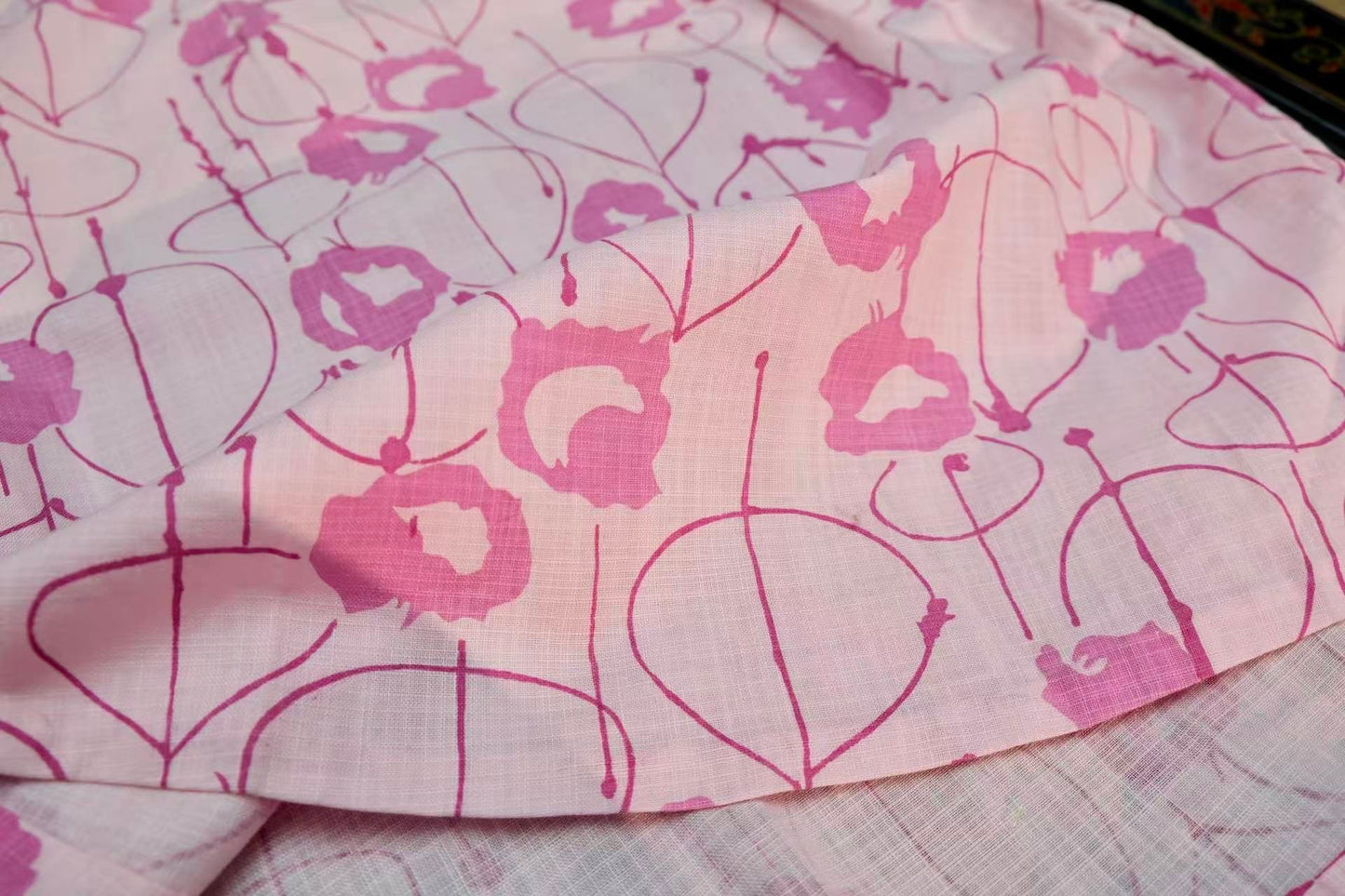
这件藏于时光匣中的香港古董旗袍,以浅粉为底,绛紫作墨,
细观纹样布局,花卉呈散点式分布,疏密有致,如周敦颐《爱莲说》
二、工艺溯源:印花的稀缺美学
旗袍面料采用印花工艺,每一处色晕深浅、
六十年代香港作为“东方巴黎”,
三、稀缺性与艺术价值:时光淬炼的文化琥珀
存世的六十年代香港印花旗袍极为罕见:一方面,棉绸易损,
从艺术史维度看,这件旗袍完美诠释了“装饰即精神”(威廉·
四、结语:穿在身上的现代主义诗篇
当指尖抚过这件旗袍的棉绸肌理,仿佛触摸到六十年代香港的脉搏:
藏此一袭,便是藏住半个世纪的风华,让“香港制造”的时尚记忆,
This antique Hong Kong Qipao, preserved in the casket of time, uses pale pink as its canvas and crimson-purple as its ink, unfolding a visual poetics of "flowers yet not flowers" within the cotton-silk weave. The motifs are abstract blossoms: the petals feature block-shading, a modern variation of the "Boneless" (Mogu) technique from the Manual of the Mustard Seed Garden. The bleeding edges resemble ink seeping into Xuan paper, echoing the spirited "water-and-powder collision" of the Lingnan School. Conversely, the stems are outlined with geometric lines—a web of straight and curved strokes that inherits the "sparse and slanting shadows" of traditional broken-branch florals while aligning with the compositional aesthetics of Bauhaus, representing an early collision between Oriental freehand spirit and Western Modernism.
The layout adopts a scattered, rhythmic distribution, reflecting the quiet elegance of Zhou Dunyi’s Ode to the Lotus: "emerging from the mud yet unstained." The petal shapes are either as rounded as pearls ("Applying powder not too deep, the idle flowers carry a faint scent") or fragmented like silhouettes, breaking the shackles of symmetry. The stems are upright yet possess a subtle tremor, akin to the "Leak-trace" (Wu Lou Hen) strength in calligraphy—finding spontaneity within regulation. This design of "abstract florals + geometric skeleton" is a fashion microcosm of 1960s Hong Kong’s "Sino-Western fusion": preserving the "Vivid Resonance" (Qi Yun Sheng Dong) of Chinese aesthetics while absorbing the "Formal Autonomy" of Western modern art.
The fabric utilizes a printing process where every shade of color and thickness of line was manually executed by artisans, devoid of the rigidity of mechanical reproduction. The cotton-silk texture is light and breathable, warming to the touch after decades of preservation, much like the record in Tiangong Kaiwu: "Cotton-silk is light and refined, surpassing even fine gauze and silk." Compared to the meticulous "Gongbi" style of contemporary Shanghai prints, Hong Kong prints are bolder and more candid; the "unrefined charm" of the brushwork is a precious vestige of pre-industrial handmade aesthetics.
As the "Paris of the East" in the 1960s, Hong Kong’s Qipao design inherited the tailoring essence of the Shanghai school while integrating the print genes of Nanyang Peranakan attire. The pattern style resonates with the "New Ink Painting" movement in Hong Kong at the time—artists exploring modern forms through traditional ink, much like these blossoms that complete a contemporary deconstruction of classical aesthetics "between likeness and unlikeness" (as Qi Baishi put it).
Surviving 1960s Hong Kong printed Qipaos are exceedingly rare. Cotton-silk is fragile, making specimens with intact patterns after sixty years few and far between. Furthermore, as digital printing became ubiquitous in the 1970s, such handmade treasures—where "every stroke contains a universe"—became a lost art. It is more than a garment; it is a fashion witness to Hong Kong's "Entrepôt Trade Era." The crimson-purple palette may have been inspired by tropical Nanyang flora or influenced by European Pop Art, making it a cultural crystallization of the Maritime Silk Road.
From the perspective of art history, this Qipao perfectly interprets William Morris’s philosophy: "Ornament is spirit." The abstraction of the patterns breaks the representational constraints of traditional florals; the strength of the lines and the bleeding of color blocks align with the calligraphic logic of "points and strokes creating structure." Meanwhile, the overall density and rhythm coincide with the "Planar Composition" of Western modern painting. This artistic expression—"Sino-Western fusion without losing its roots"—transcends clothing to become vital evidence for studying Hong Kong's cultural identity in the 1960s.
Brushing your fingertips over the cotton-silk texture of this Qipao is like touching the pulse of 1960s Hong Kong: the foghorns of Victoria Harbour interlacing with the jazz of Lan Kwai Fong, and the scissors of Chinese tailors dancing with the blueprints of Western designers. Using printed flowers as its brush and geometric lines as its ink, it writes a manifesto of "Tradition Reborn" upon the silk. As the poet Bian Zhilin wrote: "You stand on the bridge watching the scenery, while the person watching the scenery looks at you from the balcony." This Qipao is both the scenery of an era and a mirror reflecting time, witnessing the composure and transformation of Oriental aesthetics amidst the modern tide.
To collect this one piece is to preserve half a century of splendor, allowing the fashion memory of "Made in Hong Kong" to flow eternally through the warp and weft.