深圳溯源
无法加载取货服务可用情况
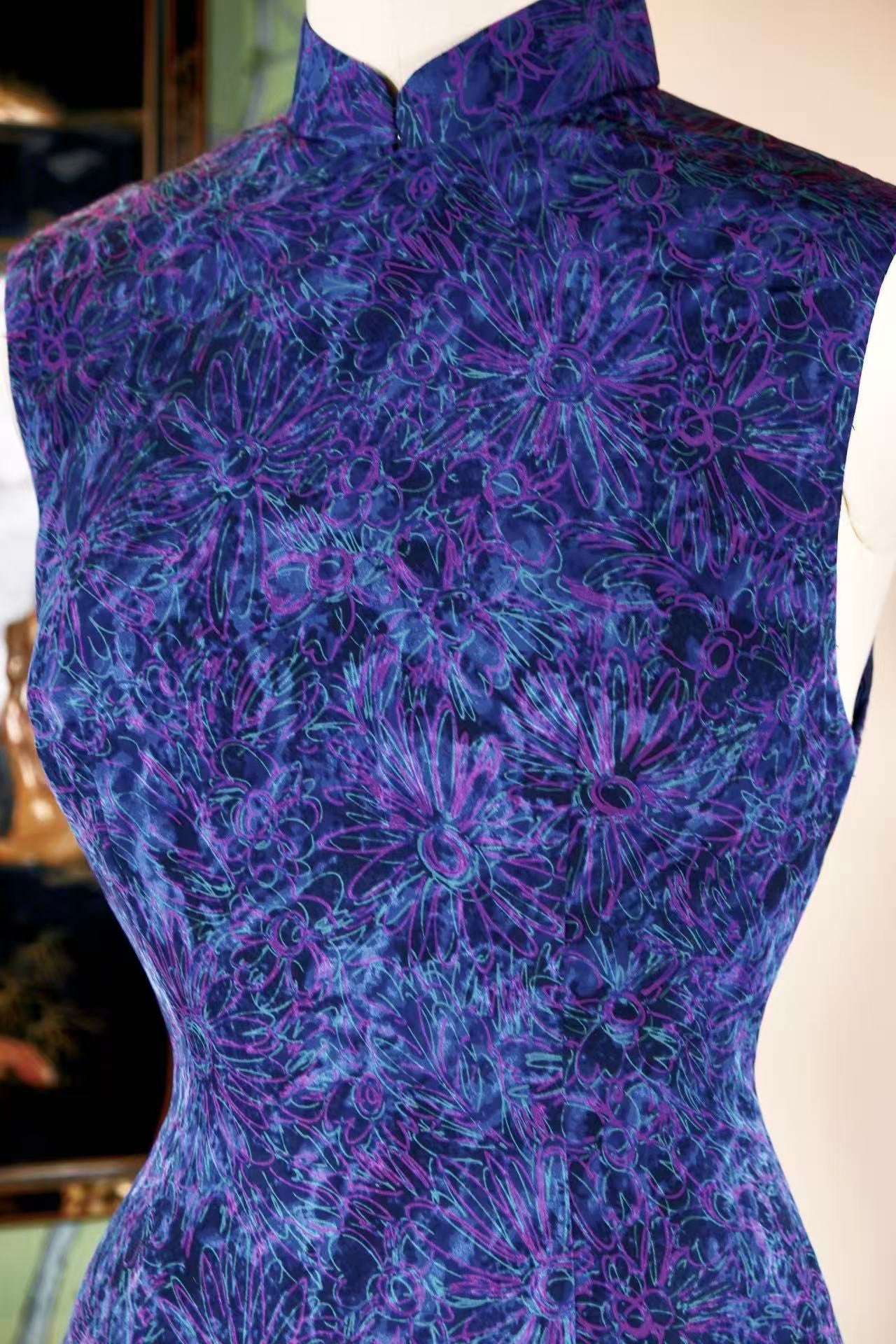
六十年代香港古董旗袍:丝绒上的抽象诗学与时代回响
此件香港产古董旗袍,诞生于上世纪六十年代——
旗袍图案堪称“东方写意与西方抽象的表现主义对话”。
六十年代的香港,作为东西方文化交汇的“孤岛”,
当现代时尚反复轮回,这件沉睡半个世纪的丝绒旗袍,
Abstract Poetics and Echoes of an Era: A 1960s Hong Kong Antique Velvet Cheongsam
This Hong Kong-made antique cheongsam was born in the 1960s—a golden age where Eastern aesthetics collided with Western modernism. Featuring a sleeveless design with a standing collar and a silhouette that contours the body, it is a quintessential example of the "Westernized refinement" of Hong Kong cheongsams from that era. While preserving the traditional soul of the standing collar and cinched waist, the sleeveless form and tailored lines echo the liberation of body aesthetics found in Western modern dress. The deep blue velvet drapes like a night veil, upon which abstract blossoms of purple and teal interweave like a galaxy spilling onto brocade. The tactile texture of the velvet and the layered prints carry the unique, soulful warmth of a vintage masterpiece.
The pattern serves as an "expressionist dialogue between Oriental ink-wash and Western abstraction." The floral forms are not mechanical reproductions of nature but are outlined with ink-splashed brushstrokes. The petal lines resemble the Feibai (streaked) strokes of cursive calligraphy, while the stamens are punctuated with dense ink dots, and the foliage is traced in teal—a modern deconstruction of traditional motifs like the "scrolling lotus." This aesthetic pursuit of being "between likeness and unlikeness" perfectly aligns with the philosophy of master painter Qi Baishi: "The brilliance lies between likeness and unlikeness; to be unlike is to deceive the world, to be too like is to lack spirit." Even more ingenious is the contrast of purple (symbolizing nobility) and blue (signifying serenity), creating a fluid play of light on the velvet that evokes the "Auspicious Purple Air from the East" seen on Song Dynasty Ru Ware glazes.
In the 1960s, Hong Kong served as a "cultural island" at the crossroads of East and West, and the cheongsam industry experienced a brief but brilliant explosion. During this period, Hong Kong garment factories fused the technical mastery of Shanghai (Haipai) tailoring with Southeast Asian (Nanyang) aesthetics to create "Modern Cheongsams" that were both practical and artistic. However, due to the delicate nature of velvet and the complexity of abstract printing, sleeveless slim-fit models like this one are extremely rare today. As traditional workshops vanished during the industrial shifts surrounding the handover, this unique piece—with its original cut and intact print—has become a "living fossil" of the modernization of Chinese dress. Its scarcity lies not only in its physical form but in its role as a "cultural container" for the creative vitality of a specific historical moment.
As modern fashion cycles back, this velvet cheongsam, which has slumbered for half a century, still speaks of Hong Kong’s cultural ambition through its bold abstract language and lofty craftsmanship. To collect it is to collect a narrative of Oriental modernity polished by time—within the folds of the velvet hides the breath of 1960s Hong Kong and the pulse of Chinese sartorial history.