深圳溯源
无法加载取货服务可用情况
六十年代香港古董旗袍:流动的色谱,织物上的抽象诗篇
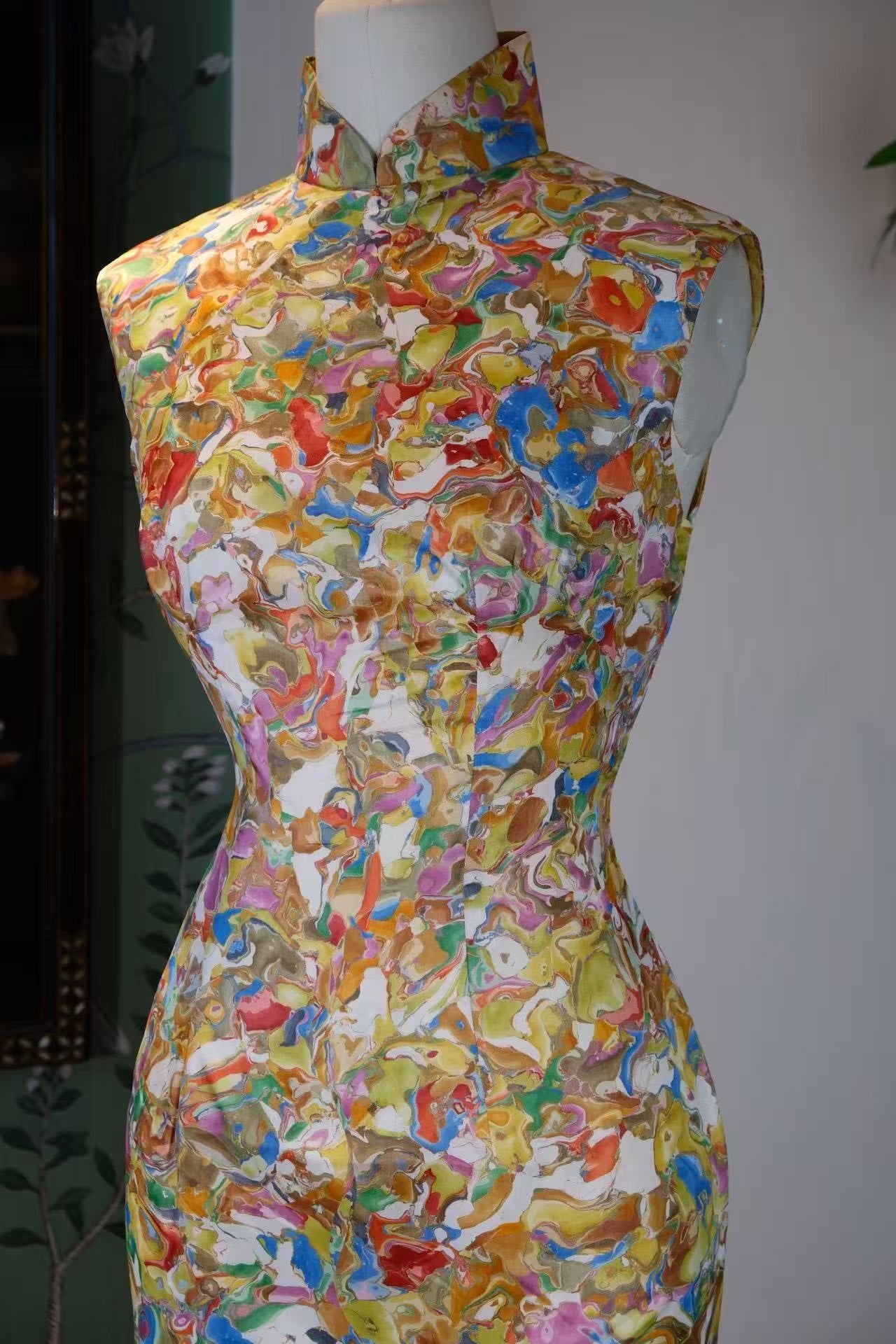
此件旗袍最为夺目之处,
这种技法在当时被称为“流霞染”或“泼彩印”,其难度在于“
远观,面料呈现出一种“大写意”的视觉张力。黄、金、红、
- 色彩肌理:色块边缘晕染自然,深浅过渡如水波荡漾,
- 空间构成:繁复的色彩中透出底色的留白,暗合中国画“计白当黑”
在1960年代,香港的纺织业虽已开始工业化,
据《香港纺织史稿》记载,这种技法因依赖工匠个人经验,
此袍之纹,非画也,乃“天工”与“人工”的共谋。
这是一件“拒绝被定义”的古董旗袍。
The most striking feature of this Qipao lies in its fabric, which utilizes a manual liquid dyeing and printing process that was extremely rare in 1960s Hong Kong. Unlike the regularity of traditional woodblock printing or the visible strokes of hand-painting, this craft involves artisans allowing various mineral dyes to naturally blend and collide within a liquid medium, instantly freezing the result onto heavyweight silk.
Known at the time as "Floating Rosy Cloud Dyeing" (Liu Xia Ran) or "Splashed-color Printing," the difficulty of this technique lies in "controlling without suppressing"—the artisan must precisely manage the viscosity and temperature of the dyes while surrendering to the natural trajectory of the fluid's flow. The patterns on every bolt of fabric are unique, resembling cellular structures under a microscope or the explosive instant of a cosmic nebula; no two are ever the same.
From a distance, the fabric presents a visual tension of "Great Freehand" (Da Xieyi) style. Yellow, gold, red, and blue surge and fuse across the off-white base like turbulent currents, forming countless color vortices. This is not a representational depiction of flora or fauna, but rather the translation of the Lingnan School’s splashed-ink spirit into a textile language.
Color Texture: The edges of the color blocks bleed naturally, with depth transitions resembling rippling water—a "sense of breath" that mechanical printing cannot simulate.
Spatial Composition: Amidst the complex colors, the "negative space" of the base fabric peeks through, aligning with the Chinese painting philosophy of "treating white space as black" (Ji Bai Dang Hei), finding ethereal lightness within complexity.
In the 1960s, while Hong Kong’s textile industry had begun to industrialize, such high-difficulty manual dyed fabrics—due to being time-consuming and having an extremely high rejection rate—existed only on the bespoke lists of a few elite tailor shops (such as the old-brand houses "Nanyang" or "Shui Hing").
According to the Draft History of Hong Kong Textiles, this technique relied heavily on the personal experience of individual artisans, and because the dye formulas have long been lost, the surviving quantity is exceedingly low. This Qipao is not merely a garment but a piece of "solidified colored liquid"—a living fossil for the study of 1960s Hong Kong textile chemistry and fashion aesthetics.
The patterns on this robe are not "painted," but are a conspiracy between "Nature’s craftsmanship" and "human skill." It evokes Eileen Chang’s famous line about "a gorgeous robe," yet adds a layer of modern art’s detachment and fervor. To wear it is to drape a fluid abstract oil painting over the body; with every step, light flows across the silky fabric, and the colors breathe and transform accordingly.
This is an antique Qipao that "refuses to be defined." Born in the golden age where Eastern traditional forms collided with Western abstract art, it uses the most traditional silk to express the most avant-garde visual language. For collectors, this is more than clothing; it is the most brilliant mark left upon fabric by the "dare to be first" modern spirit of 1960s Hong Kong.