深圳溯源
无法加载取货服务可用情况
衣服尺寸:
胸围/腰围/臀围:98/84/100 厘米
衣长:118 厘米
细节描述:
当指尖抚过这件六十年代香港羊毛印花旗袍,仿佛触到了时光的经纬——羊毛面料的挺括质感里藏着维多利亚港的海风,繁复印花中沉淀着东方美学的千年密码。作为上世纪中叶香港旗袍黄金时代的遗珍,它以“中西合璧”的剪裁与“图必有意”的纹样,成为研究华人服饰史与移民文化的重要标本,其稀缺性不仅在于岁月磨损后的存世量,更在于它凝固了一个时代的文化碰撞与审美自觉。
一、图案:东方美学的视觉史诗
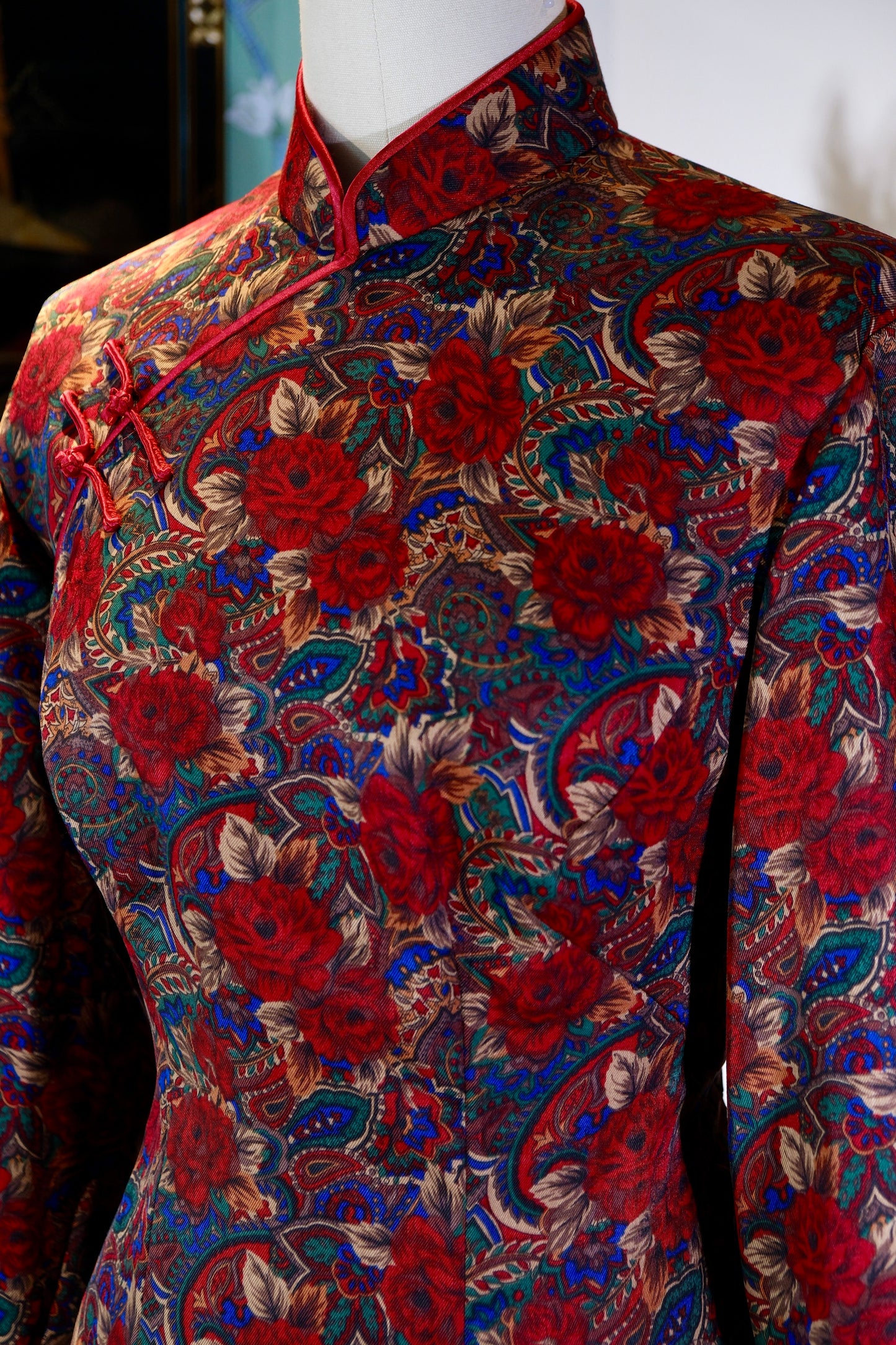
旗袍的印花以“缠枝牡丹”为核心母题,借鉴了宋锦“锦上添花”的构图逻辑,却融入了波斯细密画的色彩层次——深红牡丹为“主花”,象征富贵吉祥;靛蓝卷草纹作“枝蔓”,暗合“生生不息”的哲学;其间点缀的宝相花纹(佛教艺术中“宝相庄严”的变体),则通过羊毛纤维的立体印花工艺,呈现出“远看有势,近看有质”的视觉效果。这种“多文化纹样共生”的设计,恰如六十年代香港作为“东方之珠”的文化缩影:本土粤绣的细腻、江南织锦的典雅与西方印染技术的精准,在方寸面料上达成微妙平衡。
从艺术风格看,印花的“满铺式构图”打破了传统旗袍“留白”的含蓄,却通过色彩的深浅渐变(如牡丹花瓣从绯红到朱砂的过渡)维持了视觉韵律,这种“密而不乱”的设计,暗合了明代计成《园冶》中“虽由人作,宛自天开”的造园美学,将东方美学的“秩序感”藏于繁复表象之下。
二、故事:流金岁月里的文化摆渡
这件旗袍的诞生,与六十年代香港的社会语境密不可分。彼时,大量上海裁缝南迁香港,将海派旗袍的“收腰开衩”与广府旗袍的“实用主义”结合,而羊毛面料的选择,则是对香港亚热带气候与西方生活方式的妥协——既保留了旗袍的优雅形制,又以羊毛的保暖性适应空调环境与秋冬穿着,这种“改良中的坚守”,恰如张爱玲在《更衣记》中所写:“旗袍的演变,是中国人对‘美’的韧性表达。”
从流传脉络推测,它或许曾属于一位穿梭于中环写字楼与兰桂坊茶餐厅的“新女性”:白天,羊毛的挺括衬出职业女性的干练;夜晚,牡丹的华贵又暗合传统闺秀的风韵。这种“一衣多面”的穿着场景,正是六十年代香港女性身份转型的缩影——她们既拥抱西方现代性,又无法割舍文化根脉,而旗袍,便成了她们与世界对话的“身体语言”。
三、稀缺性:时光淬炼的文化孤本
在古董旗袍的收藏谱系中,六十年代香港羊毛印花款式的稀缺性,源于三重“不可复制”:
1. 面料工艺的断层:彼时香港纺织业尚未完全工业化,羊毛印花需依赖意大利进口染料与本地手工套色工艺,这种“半手工半机械”的生产方式,在七十年代后随流水线普及而消失,现存同类面料的旗袍不足百件(据香港纺织及成衣研发中心2018年统计)。
2. 文化语境的消逝:六十年代是香港“本土意识”觉醒的关键期,旗袍作为“华人身份”的符号,其设计中的文化杂糅性(如波斯纹样与中式剪裁)是特定历史阶段的产物,此后随着全球化加速,这种“在地化创新”逐渐被标准化时尚取代。
3. 保存难度的限制:羊毛面料易受虫蛀与潮湿影响,六十年代的印花技术又缺乏现代固色工艺,能完整留存至今且纹样清晰者,多需专业恒温恒湿保存,民间流传的完整品极为罕见。
这件旗袍的价值,早已超越了“衣物”本身——它是六十年代香港的文化切片,是东方美学与现代性碰撞的视觉档案,更是“穿在身上的历史”。当我们在博物馆或私人收藏中凝视它,看到的不仅是牡丹的盛放,更是一个时代的风华绝代,以及华人文化在全球化浪潮中“守正创新”的永恒命题。
Measurements / Size Guide:
Bust / Waist / Hips: 98/84/100 cm
Total Length: 118 cm
Detailed Description:
When your fingertips brush across this 1960s Hong Kong printed wool qipao, it feels as if you are touching the warp and weft of time itself—the crisp texture of the wool conceals the sea breezes of Victoria Harbour, while the intricate prints settle with the thousand-year-old codes of Oriental aesthetics. As a rare vestige of the golden age of Hong Kong qipaos in the mid-20th century, it stands as a vital specimen for studying Chinese costume history and migrant culture through its "East-meets-West" tailoring and "meaningful motifs." Its scarcity lies not only in the surviving numbers after decades of wear but also in its solidification of an era’s cultural collision and aesthetic self-awareness.
The core motif of the qipao is the "Intertwining Peony," borrowing the compositional logic of "adding flowers to brocade" from Song Dynasty silks while integrating the color layering of Persian miniatures. The deep crimson peonies serve as the "primary flower," symbolizing wealth and auspiciousness; the indigo scrolling grass patterns act as "vines," echoing the philosophy of "endless vitality." Interspersed are Baoxiang floral patterns (a variant of the "solemn and dignified" motifs in Buddhist art), which, through the 3D printing process on wool fibers, present a visual effect of "power from a distance, and texture up close." This design of "multicultural motif symbiosis" is a miniature of 1960s Hong Kong as the "Pearl of the Orient": the delicacy of local Cantonese embroidery, the elegance of Jiangnan brocade, and the precision of Western printing technology achieve a subtle balance within the square inches of fabric.
From an artistic perspective, the "all-over composition" breaks the traditional qipao's restraint of "white space," yet maintains visual rhythm through color gradients (such as the transition of peony petals from crimson to cinnabar). This "dense but not chaotic" design aligns with the landscaping aesthetics of Ji Cheng’s Yuan Ye from the Ming Dynasty: "Though made by human hands, it appears as if created by heaven," hiding the Oriental sense of "order" beneath a complex surface.
The birth of this qipao is inextricably linked to the social context of 1960s Hong Kong. At that time, a large number of Shanghainese tailors migrated south, blending the "cinched waist and side slits" of the Haipai style with the "utilitarianism" of Cantonese qipaos. The choice of wool was a compromise between Hong Kong’s subtropical climate and a Western lifestyle—preserving the elegant form of the qipao while using wool’s warmth to adapt to air-conditioned environments and autumn/winter wear. This "persistence within modification" is exactly what Eileen Chang wrote in A Record of Changing Clothes: "The evolution of the qipao is the resilient expression of the Chinese people toward 'beauty'."
Inferred from its lineage, it may have belonged to a "New Woman" frequenting Central office buildings and Lan Kwai Fong tea houses. By day, the crispness of the wool highlighted the efficiency of a professional; by night, the opulence of the peonies matched the grace of a traditional lady. This "multi-faceted" wearing scenario reflects the identity transformation of Hong Kong women in the 1960s—embracing Western modernity while unable to sever their cultural roots. The qipao thus became their "body language" for conversing with the world.
In the genealogy of antique qipao collection, the rarity of the 1960s Hong Kong printed wool style stems from a triple "irreproducibility":
Fault Line in Fabric Craftsmanship: At that time, Hong Kong’s textile industry was not fully industrialized. Wool printing relied on imported Italian dyes and local manual color-matching processes. This "semi-manual, semi-mechanical" production disappeared after the 1970s with the rise of assembly lines. Fewer than 100 qipaos of similar fabric remain (according to 2018 statistics from the Hong Kong Research Institute of Textiles and Apparel).
Vanishing Cultural Context: The 1960s was a key period for the awakening of "local consciousness" in Hong Kong. The qipao, as a symbol of "Chinese identity," featured a cultural hybridity (such as Persian patterns with Chinese tailoring) that was a product of a specific historical stage. Subsequently, with accelerated globalization, this "localized innovation" was replaced by standardized fashion.
Constraints of Preservation: Wool is susceptible to moths and humidity, and 1960s printing lacked modern color-fixing techniques. Examples that remain intact with clear patterns today mostly require professional constant temperature and humidity storage; complete pieces circulating in the private sector are extremely rare.
The value of this qipao has long surpassed the "garment" itself—it is a cultural slice of 1960s Hong Kong, a visual archive of the collision between Oriental aesthetics and modernity, and "history worn on the body." When we gaze upon it in a museum or private collection, we see not only the blooming of peonies but the peerless grace of an era and the eternal theme of "integrity and innovation" for Chinese culture amidst the waves of globalization.