深圳溯源
无法加载取货服务可用情况
衣服尺寸:
胸围/腰围/臀围:84/64/92 厘米
衣长:139 厘米
细节描述:
这不仅仅是一件旗袍,更像是一段被精心封存的、流动的黄金岁月。这件由上世纪六十年代台湾“華美旗袍”号出品的红色祥云龙纹古董旗袍,正是那个时代风华的缩影。
图案描述:赤缎上的“银龙出海”
这件旗袍的视觉核心,在于那条打破传统规制、极具现代张力的“银龙出海”图景。
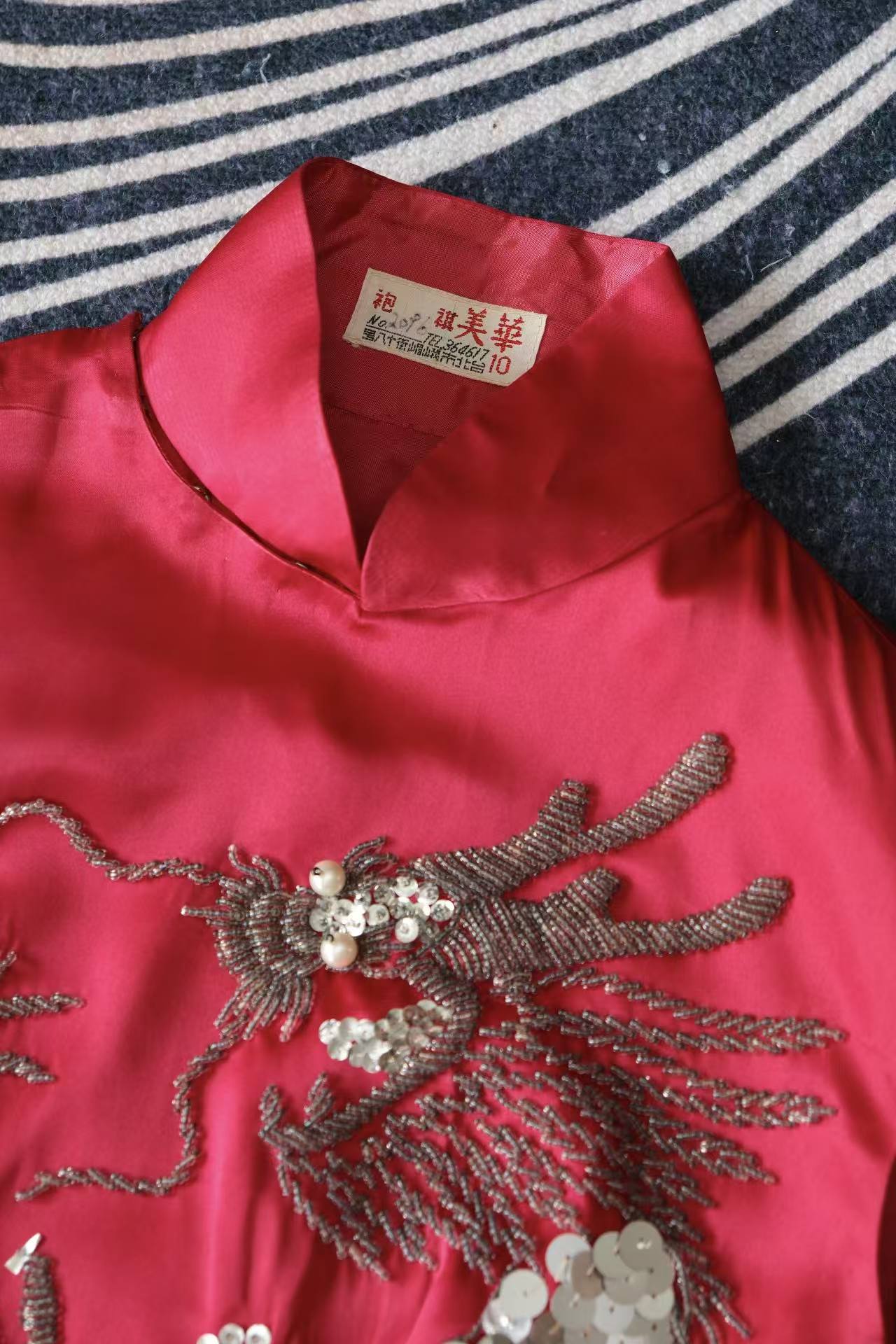
- 赤缎为底,流光溢彩:衣身采用高光泽度的红色醋酸缎,这种面料在六十年代是奢华与摩登的代名词。它比传统丝绸更具骨感,垂坠感极佳,在灯光下泛着如红宝石般深邃而冷艳的光泽。
- 银鳞蜿蜒,打破沉寂:与传统旗袍讲究的对称不同,这条龙纹采用了不对称的构图。银色的亮片(Sequins)如同坚硬的龙鳞,紧密排列,从右肩斜向贯穿至左下摆。这种设计在视觉上极大地拉长了身形,符合六十年代追求修长、纤细的审美趋势。
- 珠绣点睛,刚柔并济:龙首位于右肩处,以精细的米珠和几颗温润的珍珠作为龙眼与龙须,神态威仪却不狰狞。龙身周围缭绕的云纹,并非传统的刺绣填色,而是用透明或银色的管珠勾勒轮廓,呈现出一种“镂空的轻盈感”。这种“钉珠”工艺,让原本厚重的龙凤题材变得摩登、轻盈,宛如夜空中划过的流星。
古董衣的故事:台北洋场的“流光岁月”
把目光投向1960年代的台北。那是一个新旧交替、东西方文化剧烈碰撞的“黄金时代”。
- 华美旗袍号的印记:领标上清晰的“華美旗袍”及“台北市汉口街”字样,是这件衣服最珍贵的身份证明。当时的汉口街,是台北著名的成衣与布料集散地,汇聚了从大陆迁台的顶尖裁缝。这件旗袍,极有可能是当时名门闺秀或交际名媛在“圆山大饭店”的晚宴、或是西门町戏院首映礼上的战袍。
- 材质的时代隐喻:六十年代是化学纤维工业蓬勃发展的时期。醋酸缎的使用,象征着当时人们对“现代性”的崇拜。它既保留了东方的丝绸质感,又迎合了西方工业文明的审美。这件旗袍,就是那个时代“中体西用”美学的最佳注脚。
- 未完成的留白:旗袍并未缝制传统的盘扣,而是采用了隐形的侧拉链(这是六十年代改良旗袍的典型特征)。它不再束缚女性的脖颈与呼吸,而是赋予穿着者行动的自由。它讲述的,是一个关于女性从深闺走向社交舞台,自信展示身体曲线的故事。
艺术风格与稀缺性:引经据典
若要为这件旗袍的艺术价值定调,我想借用宗白华先生在《美学散步》中的话:“错彩镂金,芙蓉出水。”
- 艺术风格:装饰主义与东方神韵的合流
这件旗袍的纹样设计,明显受到了西方Art Deco(装饰艺术风格)的影响。传统的龙纹被几何化、抽象化处理,银色的亮片排列具有强烈的节奏感和机械美感。它不再是封建皇权的象征,而演变成了一种纯粹的装饰符号。这种“摩登中式”风格,在当时极为前卫,即便置于今日的高级定制秀场,也毫不过时。
- 稀缺性:指尖上的绝响
1. 工艺的不可复制性:请注意那些细密的钉珠。在六十年代,这完全依赖于绣娘的手工。每一颗亮片、每一粒米珠都需要手工穿针引线,稍有不慎便会崩裂。这种耗费工时的“笨功夫”,在如今快节奏的成衣工业中已成绝响。
2. 面料的岁月痕迹:醋酸缎是一种娇贵的面料,历经六十年仍能保持如此完整的色泽与光泽,且没有严重的脆化或断裂,实属“幸存者”。它承载的时间包浆,是任何做旧工艺都无法模仿的。
3. 历史的孤本:“華美”虽非唯一的字号,但带有明确地址与编号的实物留存至今者寥寥。这件旗袍不仅是衣物,更是台湾服装史上一段具体的、可触摸的记忆。
结语
这件红色祥云龙纹旗袍,是六十年代台北风华的“幸存者”。它以一种张扬而优雅的姿态,定格了那个时代的摩登与浪漫。拥有它,便是拥有了一段关于美、关于历史、关于东方女性觉醒的珍贵叙事。
Measurements / Size Guide:
Bust / Waist / Hips: 84/64/92 cm
Total Length: 139 cm
Detailed Description:
This is not merely a garment; it is a meticulously preserved segment of the flowing "Golden Years." Produced by the renowned "Hua-Mei Qipao" house in 1960s Taiwan, this red vintage qipao with auspicious clouds and dragon motifs serves as a perfect microcosm of that era's elegance.
The visual core of this qipao lies in its "Silver Dragon Emerging from the Sea"—a depiction that breaks traditional conventions with immense modern tension.
Crimson Satin, Radiant and Lustrous: The body utilizes high-luster red acetate satin, a fabric synonymous with luxury and modernity in the 1960s. More structured than traditional silk, it possesses an exceptional drape and emits a deep, cold, ruby-like radiance under the light.
Sinuous Silver Scales, Breaking the Silence: Departing from the traditional pursuit of symmetry, this dragon motif employs an asymmetrical composition. Silver sequins, arranged tightly like hardened dragon scales, traverse diagonally from the right shoulder to the left hem. This design visually elongates the silhouette, aligning with the 1960s aesthetic pursuit of a slender, graceful form.
Beadwork Details, Strength Meets Softness: The dragon’s head rests on the right shoulder, with fine seed beads and lustrous pearls forming the eyes and whiskers—majestic yet not fierce. The surrounding cloud motifs are not filled with traditional embroidery but are outlined with transparent or silver tube beads, creating an "ethereal, hollowed-out lightness." This beading craft (Dingzhu) renders the traditionally heavy dragon-phoenix theme modern and airy, like a meteor streaking across the night sky.
Look back at Taipei in the 1960s—a "Golden Age" where the old met the new and Eastern and Western cultures collided fiercely.
The Mark of Hua-Mei Qipao: The label, clearly bearing "Hua-Mei Qipao" and "Hankou Street, Taipei," is the most precious proof of identity. Hankou Street was then a famous hub for ready-to-wear and textiles, home to top-tier tailors who had migrated from mainland China. This qipao was likely a "battle robe" for a socialite or a lady of a prominent family, worn to a banquet at the Grand Hotel or a film premiere in Ximending.
Era Metaphor of Material: The 1960s saw the rapid development of the chemical fiber industry. The use of acetate satin symbolized the era's worship of "Modernity." It preserved the Oriental texture of silk while catering to the aesthetics of Western industrial civilization—a perfect footnote to the "Chinese Essence, Western Utility" aesthetic.
The Unfinished "White Space": Notably, the qipao eschews traditional frog buttons for an invisible side zipper (a hallmark of modified qipaos of the 60s). It no longer constricts the neck or breath; instead, it grants the wearer freedom of movement. It tells the story of women stepping out of secluded courtyards onto the social stage, confidently showcasing their curves.
To define the artistic value of this piece, one might borrow the words of Zong Baihua in Aesthetic Wanderings: "Intricate gold-work and exquisite carving, like a lotus emerging from water."
Art Style: The Convergence of Art Deco and Oriental Spirit The pattern design is clearly influenced by Western Art Deco. The traditional dragon is treated with geometric and abstract techniques; the silver sequins are arranged with a strong sense of rhythm and mechanical beauty. It has evolved from a symbol of imperial power into a pure decorative sign. This "Modern Chinese" style was extremely avant-garde then and remains timeless today.
Scarcity: An Echo on the Fingertips
Irreplicable Craftsmanship: Note the dense beadwork. In the 1960s, this relied entirely on the manual labor of embroiderers. Every sequin and seed bead required painstaking hand-threading—a "slow labor" that has vanished in today's fast-paced garment industry.
Traces of Time on Fabric: Acetate satin is delicate. That it has maintained such vibrant color and luster for sixty years without significant embrittlement or breakage makes it a true "survivor." Its temporal patina is something no modern distressing technique can imitate.
A Historical Unique Specimen: While "Hua-Mei" was not the only tailor house, surviving pieces with clear addresses and serial numbers are few. This qipao is more than clothing; it is a tangible memory of Taiwan’s fashion history.
This red dragon and cloud qipao is a "survivor" of 1960s Taipei elegance. With its bold yet graceful stance, it freezes the modernity and romance of that era. To possess it is to hold a precious narrative about beauty, history, and the awakening of the Oriental woman.