深圳溯源
无法加载取货服务可用情况
衣服尺寸:
胸围/腰围/臀围:98/82/106 厘米
衣长:110 厘米
细节描述:
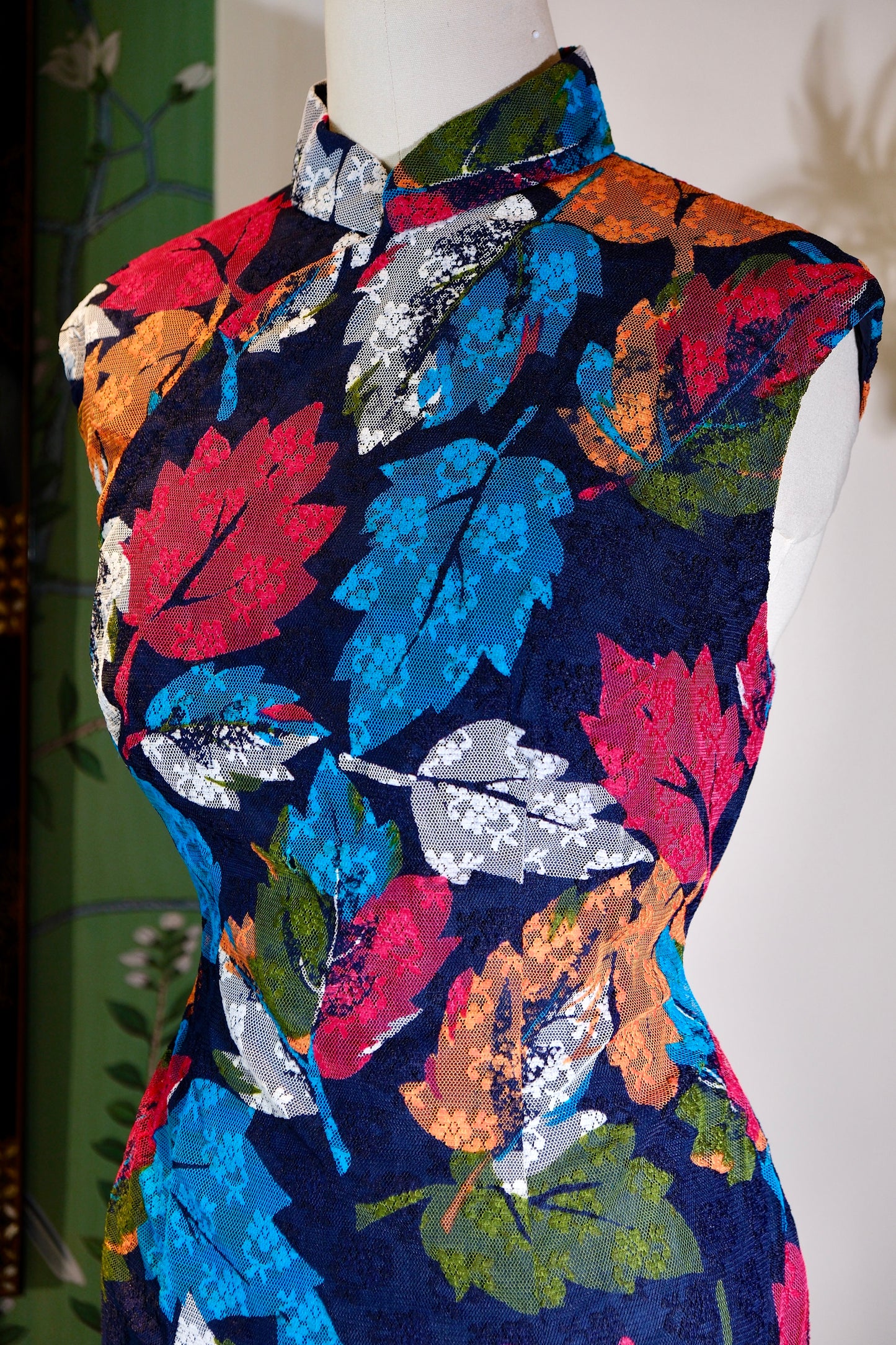
当深蓝底色与斑斓叶影在蕾丝经纬间相遇,这件台湾六十年代古董旗袍,便成了流动的艺术史。其图案以“抽象树叶”为核心意象,摒弃了传统花鸟的具象写实,转而用几何化的叶形轮廓与撞色拼接,勾勒出极具现代感的视觉韵律——绛红如枫、靛蓝似梧、橙黄若银杏,间杂银灰与墨绿的过渡,叶脉以细密蕾丝镂空呈现,既保留了东方“草木有情”的诗意,又暗合六十年代全球艺术界对抽象表现主义的追逐,堪称“东方写意与西方抽象的跨时空对话”。
蕾丝印花的工艺,更藏着时代的巧思。彼时台湾纺织业正处黄金期,匠人将欧洲蕾丝技法与本土印花工艺融合,以“双层透叠”工艺让叶影在深蓝底布上若隐若现,既显肌肤的含蓄之美,又添面料的立体层次。这种“半透非透”的设计,恰如《长物志》所言“韵致在隐显之间”,将东方女性的温婉与六十年代的摩登气质熔于一炉。
这件旗袍的稀缺性,不仅在于“台湾六十年代”的时代标签——彼时旗袍正从日常服饰向“礼仪华服”转型,产量本就有限;更在于其图案的独创性:抽象树叶题材在同期旗袍中极为罕见,既不同于五十年代的传统缠枝纹,也区别于七十年代的几何条纹,是特定历史阶段的艺术孤本。每一片叶形蕾丝的拼接角度、每一处色彩的渐变过渡,皆由匠人手工定位印花,世上难寻两件完全相同的“叶影”,正如《考工记》所云“天有时,地有气,材有美,工有巧,合此四者,然后可以为良”。
穿上它,仿佛听见六十年代台北街头的留声机在转,看见那个东西方文化碰撞年代里,东方女性以旗袍为纸、以蕾丝为墨,写下的关于优雅与革新的诗行。这不仅是件衣服,更是一段可触摸的历史,一份值得珍藏的东方美学遗产。
Measurements / Size Guide:
Bust / Waist / Hips: 98/82/106 cm
Total Length: 110 cm
Detailed Description:
When the deep navy base meets the vibrant shadows of foliage within the warp and weft of lace, this 1960s antique qipao from Taiwan becomes a piece of flowing art history. Its pattern centers on the core imagery of "abstract leaves," discarding traditional figurative floral and bird realism in favor of geometric leaf outlines and color-blocking. This creates a highly modern visual rhythm—crimson like maple, indigo like parasol trees, and orange-yellow like ginkgo, interspersed with transitions of silver-gray and dark green. The leaf veins are rendered through intricate lace openwork, preserving the poetic Oriental sentiment that "plants and trees possess feelings" while aligning with the global art world’s pursuit of Abstract Expressionism in the 1960s. It is truly a "cross-temporal dialogue between Eastern freehand brushwork and Western abstraction."
The craftsmanship of the lace print hides the ingenuity of its era. During the golden age of Taiwan’s textile industry, artisans fused European lace techniques with local printing processes. Using a "double-layer transparency" technique, the leaf shadows appear faintly on the deep navy backing, showcasing both the subtle beauty of the skin and the three-dimensional depth of the fabric. This "semi-transparent" design perfectly captures what the Treatise on Superfluous Things (Zhang Wu Zhi) describes as "charm residing between the hidden and the revealed," melting the gentleness of the Eastern woman and the modern temperament of the 1960s into one.
The scarcity of this qipao lies not only in its "1960s Taiwan" era label—a time when the qipao was transitioning from daily wear to "ceremonial finery" with limited production—but also in the originality of its pattern. Abstract leaf motifs are exceptionally rare among qipaos of that period, standing apart from the traditional interlocking floral patterns of the 1950s and the geometric stripes of the 1970s; it is an artistic "sole copy" of a specific historical stage. Every angle of the lace patchwork and every gradient of color transition was manually positioned by the artisan. It is impossible to find two identical "leaf shadows," echoing the wisdom of the Records of Examination of Craftsman (Kao Gong Ji): "The season has its timing, the earth its vitality, the material its beauty, and the craftsman his skill. When these four combine, a masterpiece is born."
Wearing it feels as if a gramophone on a 1960s Taipei street is spinning, catching a glimpse of an era where Eastern and Western cultures collided. It reveals how the Eastern woman used the qipao as paper and lace as ink to write verses of elegance and innovation. This is more than a garment; it is a touchable fragment of history and a heritage of Oriental aesthetics worthy of cherished collection.