深圳溯源
无法加载取货服务可用情况
衣服尺寸:
胸围/腰围/臀围:94/84/100 厘米
衣长:105 厘米
细节描述:
一、纹样考释:万字不到头的东方哲学
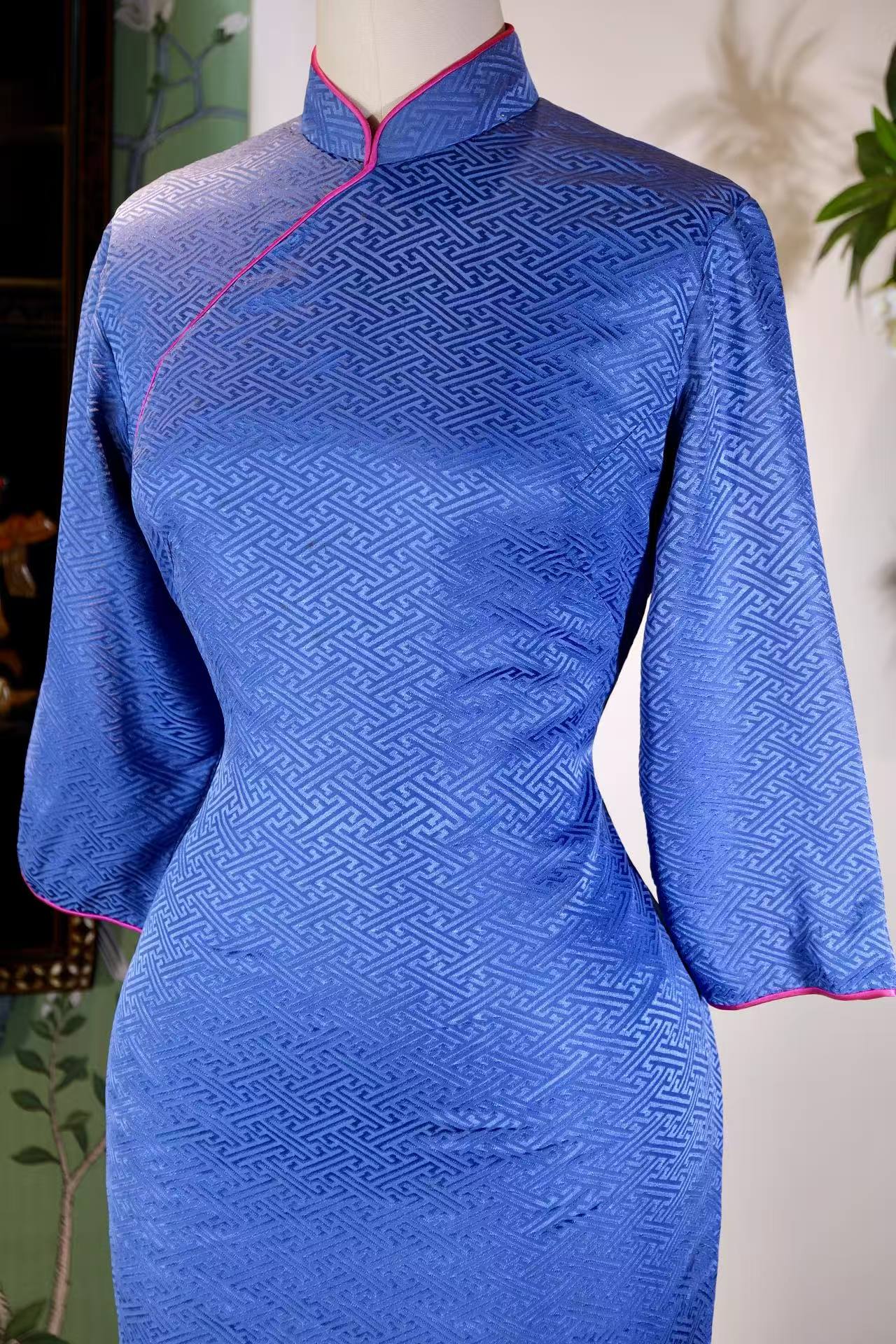
这件宝蓝色旗袍通体织就万字曲水纹,以几何化的“卍”字为基本单元,通过连续回环的构图形成“万字不到头”的视觉效果。此纹样源自佛教“吉祥海云相”,《华严经》载:“如来胸臆有大人相,形如卍字,名吉祥海云”,后演变为民间“福寿绵长”的象征。
在织造工艺上,采用提花织锦技法,经纬交织间形成微妙的浮雕质感。万字纹以45度角斜向排列,既打破传统对称布局的呆板,又暗合“曲水流觞”的古典意趣。衣缘处玫红色滚边如点睛之笔,以撞色手法提亮整体色调,恰似“万绿丛中一点红”的诗意表达。
二、时代叙事:六十年代港岛风华
1960年代的香港,正值中西文化交融的黄金时代。这件旗袍的剪裁暗藏玄机:立领高度较传统款式降低1.5厘米,既保留东方含蓄之美,又适应亚热带气候;腰线位置下移3厘米,贴合当时流行的“自然腰身”审美;七分袖设计则巧妙平衡了传统长袖的庄重与短袖的活泼。
据《香港旗袍史》记载,1965年香港旗袍产量达峰值,但如此完整的万字纹提花面料存世极少。当时此类面料多从内地进口,因政治运动影响,1966年后基本断供,使得这件旗袍成为特殊历史时期的物质见证。其宝蓝色染料采用进口合成靛蓝,色泽历经半个世纪仍鲜亮如初,折射出殖民时期香港作为国际贸易港口的独特地位。
三、艺术价值:海派遗风与港式改良
这件旗袍在细节处彰显海派旗袍的精致基因:暗门襟采用隐形拉链,取代传统盘扣,体现工业化时代的实用主义;侧缝开衩高度控制在膝盖上方10厘米,既方便行走,又符合当时“含蓄性感”的审美尺度。衣身省道处理精准,通过胸省、腰省的立体剪裁,完美勾勒出女性曲线,堪称“东方立体裁剪”的典范。
从艺术风格看,万字纹的几何抽象性与宝蓝色的现代感形成奇妙共振。这种“传统纹样+现代色彩”的组合,与同期巴黎高级时装界的“东方主义”风潮不谋而合,印证了全球时尚语境的同步性。正如艺术史家巫鸿所言:“六十年代香港旗袍是传统与现代、东方与西方的‘第三空间’,承载着文化身份的流动与重构。”
四、稀缺性论证:不可复制的时代标本
从文化价值而言,这件旗袍不仅是服饰,更是“穿在身上的历史”。它见证了香港从转口港到工业城市的转型,承载着无数女性在时代变迁中的身份认同。正如作家西西在《我城》中所写:“旗袍是香港女人的第二层皮肤,每一道褶皱里都藏着故事。”
这件宝蓝万字纹旗袍,以方寸织物浓缩了六十年代港岛的风华,其纹样之精、工艺之巧、历史之重,使其成为研究中国近现代服饰史不可多得的实物标本,堪称“行走的博物馆”。
Measurements / Size Guide:
Bust / Waist / Hips: 94/84/100 cm
Total Length: 105 cm
Detailed Description:
This royal blue qipao is entirely woven with the "Wan" curved water motif, utilizing the geometric "卍" character as its fundamental unit. Through a continuous, looping composition, it creates the visual effect of "Wan-zi-bu-dao-tou" (The Endless Wan). This pattern originates from the Buddhist "Auspicious Sea of Clouds" (Srivatsa). As recorded in the Avatamsaka Sutra: "Upon the Buddha's chest is the mark of a great man, shaped like the character 卍, named the Auspicious Sea of Clouds." It later evolved into a folk symbol for "infinite longevity and fortune."
In terms of weaving craftsmanship, it employs the jacquard brocade technique, where the interlacing of warp and weft creates a subtle relief-like texture. The "Wan" patterns are arranged diagonally at a 45° angle, which breaks the rigidity of traditional symmetrical layouts while subtly echoing the classical poetic interest of "winding streams and floating wine cups." The magenta piping at the garment edges serves as a finishing touch, using a color-blocking technique to brighten the overall tone—a poetic expression akin to "a single red blossom amidst a sea of green."
Hong Kong in the 1960s represented a golden age of cultural fusion between East and West. The tailoring of this qipao hides ingenious details: the standing collar height is reduced by 1.5 cm compared to traditional styles, preserving Oriental subtle beauty while adapting to the subtropical climate. The waistline is lowered by 3 cm, aligning with the "natural waist" aesthetic popular at the time, while the three-quarter sleeve design cleverly balances the solemnity of long sleeves with the liveliness of short sleeves.
According to the History of Hong Kong Qipao, production peaked in 1965, yet surviving examples of such complete "Wan" motif jacquard fabrics are extremely rare. At that time, such fabrics were mostly imported from the mainland; due to the influence of political movements, supply largely ceased after 1966, making this qipao a physical witness to a specific historical period. Its royal blue dye utilizes imported synthetic indigo, with a luster that remains as vibrant as new after half a century, reflecting Hong Kong's unique status as an international trading port during the colonial era.
In its details, this qipao manifests the exquisite genetic markers of the "Haipai" (Shanghai-style) qipao: the hidden placket utilizes an invisible zipper instead of traditional frog buttons (pankou), reflecting the pragmatism of the industrial age. The side slit height is controlled at 10 cm above the knee, which is both functional for walking and consistent with the "subtle sensuality" of the era's aesthetic standards. The precision of the darting—achieved through three-dimensional tailoring of bust and waist darts—perfectly outlines the female silhouette, standing as a masterpiece of "Oriental 3D draping."
From an artistic style perspective, the geometric abstraction of the "Wan" motif resonates marvelously with the modernity of the royal blue. This combination of "traditional pattern + modern color" coincides with the "Orientalism" trend in the Parisian haute couture world of the same period, proving the synchronicity of the global fashion discourse. As art historian Wu Hung remarked: "The 1960s Hong Kong qipao is a 'third space' between tradition and modernity, East and West, carrying the fluidity and reconstruction of cultural identity."
In terms of cultural value, this qipao is not just clothing; it is "history worn on the body." It witnessed Hong Kong's transformation from an entrepôt to an industrial city and carries the identity search of countless women amidst changing times. As the author Xi Xi wrote in My City: "The qipao is the second skin of a Hong Kong woman; every fold hides a story."
This royal blue "Endless Wan" qipao condenses the grace of 1960s Hong Kong within a few square inches of fabric. The refinement of its pattern, the ingenuity of its craft, and the weight of its history make it an indispensable physical specimen for the study of modern Chinese costume history—truly a "walking museum."