深圳溯源
无法加载取货服务可用情况
六十年代香港抽象印花古董旗袍:解码东方美学的时光锦书
在20世纪60年代的香港,旗袍作为东方女性的标志性服饰,
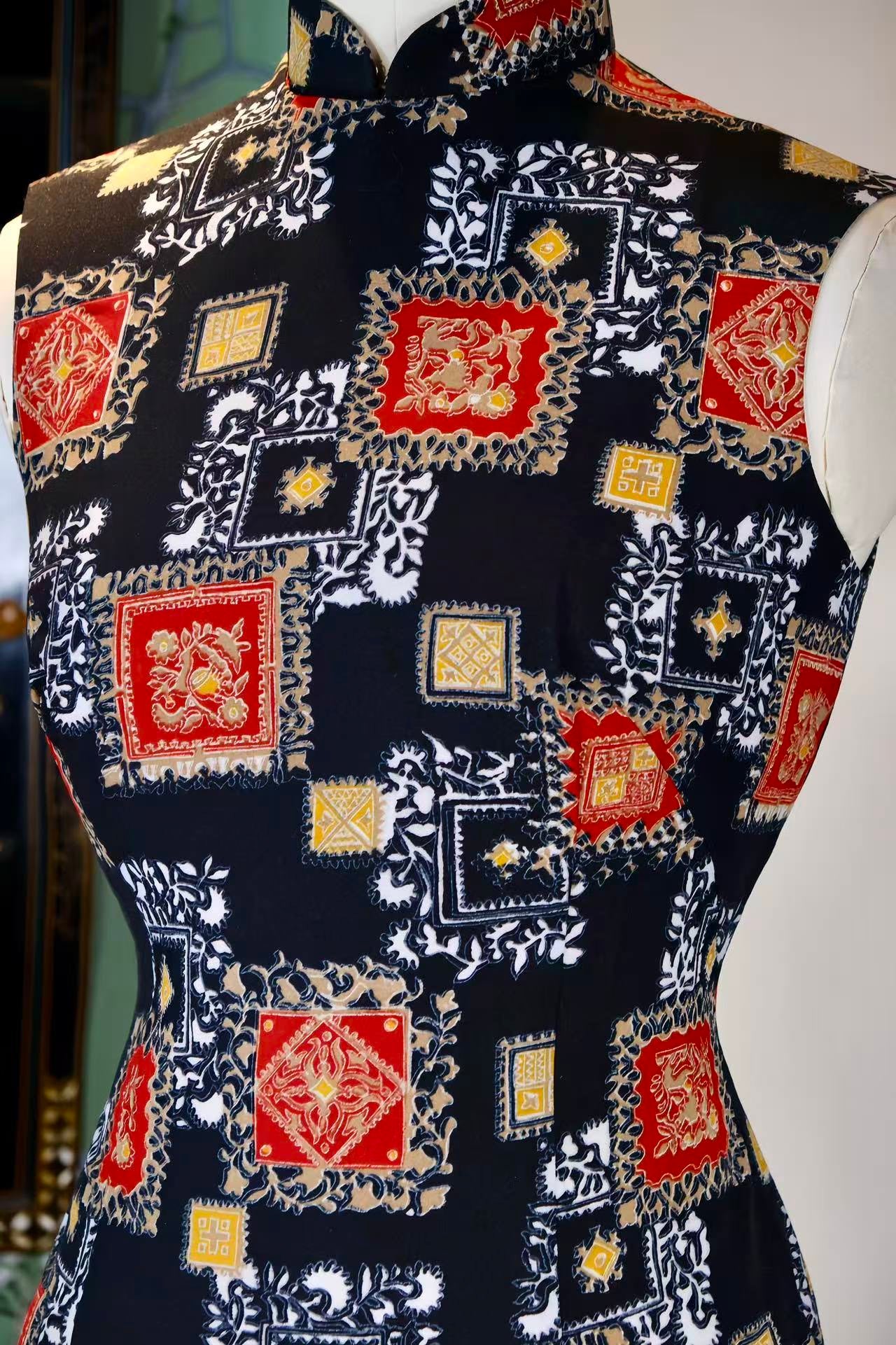
旗袍的图案构成堪称视觉艺术的奇迹。
细察纹样细节,更可见香港作为“东西文化十字路口”的独特基因。
这件旗袍的艺术价值,更在于它超越了服饰的实用属性,
今日,当我们凝视这件旗袍,
In 1960s Hong Kong, the cheongsam stood as the iconic attire of Oriental women, carrying the lineage of millennial weaving crafts while radiating avant-garde energy through colonial cultural fusion. This collector-grade vintage piece features a mysterious black base, manifesting the profound concept in traditional Chinese color philosophy that "Black is the root of all colors," while aligning with the international fashion world’s pursuit of "Oriental Mysticism" at the time. The subtlety of its abstract print makes it a piece of modernist painting worn on the body, with every inch of the pattern serving as a coded translation of the zeitgeist.
The pattern composition is a miracle of visual art. The designer abandoned the concrete flowers, birds, and auspicious motifs of traditional cheongsams, opting instead for geometric abstraction and symbolic deconstruction. Using staggered squares and lozenges as a framework, blocks of red, gold, and white are cut and reorganized, creating an orderliness akin to a Mondrian grid painting. Yet, through feathered edges and irregular color filling, it injects the techniques of "Liubai" (negative space) and "Feibai" (flying white) from Chinese literati painting. The red blocks resemble cinnabar dots, drawing from the color allegories in Kao Gong Ji: "Red and black form Xuan (the mysterious); white and black form Fu (the ritual pattern)," symbolizing festivity and vitality. The golden patterns, appearing like scattered gold dust, echo the luxurious texture of "Jin Xiu" (gold lacquering) from the Song Dynasty’s Yingzao Fashi, but dissolve the weight of traditional gold through abstract lines, showcasing the lightness of modern design.
A closer look at the details reveals the unique genetic markers of Hong Kong as the "Crossroads of East and West." The intersecting lines within the square frames subtly reference variations of the traditional "Wan" (Swastika) pattern, implying continuity. Meanwhile, the ink-splash-style strokes of the white sections find a kindred spirit in the drip techniques of Jackson Pollock and American Abstract Expressionism. This boldness in juxtaposing Oriental symbols with Western modern art reflects the collective wisdom of 1960s Hong Kong designers—they were well-versed in the pattern genealogies of Yingzao Fashi yet keenly captured the avant-garde waves of post-war Western art, ultimately achieving a "creative transformation of tradition" on silk.
The artistic value of this cheongsam lies in its transcendence of utility, becoming a visual text for decoding 20th-century Oriental modernity. It retains the classic form—standing collar, sleeveless, and cinched waist—continuning the ritual tradition from the Book of Rites: Shenyi: "The compass and square are taken from the law; Yin and Yang are prepared in the body." Simultaneously, the abstract print breaks the symbolic shackles of "clothing to manifest etiquette," highlighting the spiritual awakening of modern women striving for individual expression and escaping discipline. As fashion theorist James Laver said: "True avant-garde is carving the scale of the future onto the texture of tradition." This vintage cheongsam, using fabric as paper and thread as a brush, has written a fluid history of art at the intersection of East and West, tradition and modernity.
Today, as we gaze upon this cheongsam, we see more than just a modern silhouette of 1960s Hong Kong; we witness an aesthetic dialogue across time and space. It reminds us that true classics are reborn through deconstruction and reconstruction, and the vitality of Oriental aesthetics lies in its all-encompassing inclusivity and inexhaustible innovation.