深圳溯源
60年代 -《暗夜星河 · 锦绣华章》—— 意式匠心融合东方雅韵:重工烧花丝绒双襟流光古董旗袍 | 1960s - "Starry Night & Grandeur Splendor" — An Antique Double-Placket Devoré Velvet Qipao: A Masterpiece Merging Italian Craftsmanship with Oriental Elegance
60年代 -《暗夜星河 · 锦绣华章》—— 意式匠心融合东方雅韵:重工烧花丝绒双襟流光古董旗袍 | 1960s - "Starry Night & Grandeur Splendor" — An Antique Double-Placket Devoré Velvet Qipao: A Masterpiece Merging Italian Craftsmanship with Oriental Elegance
无法加载取货服务可用情况
暗夜星河 · 锦绣华章》—— 意式匠心融合东方雅韵:重工烧花丝绒双襟流光古董旗袍
衣饰华章:墨金流光,暗夜星河
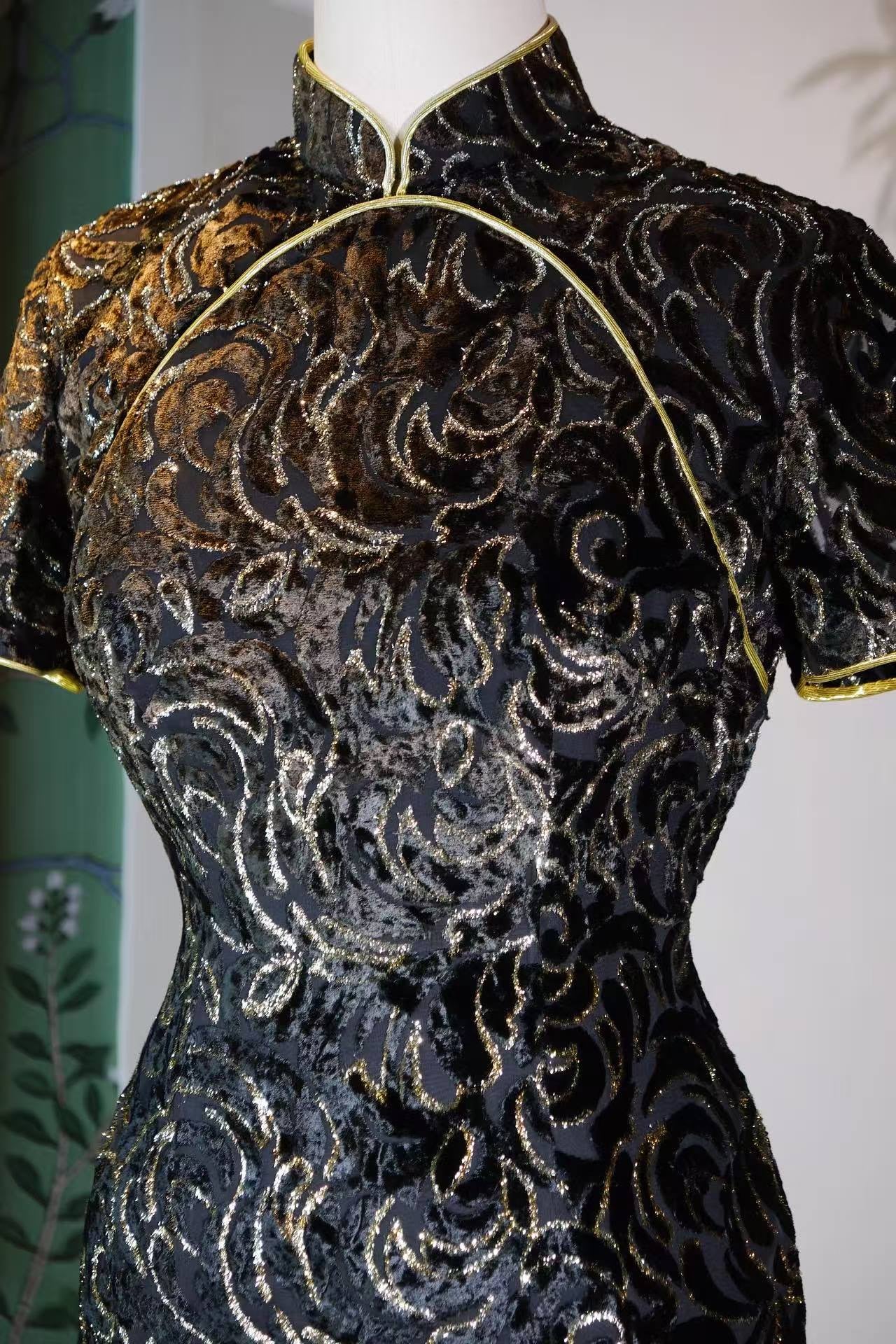
这件旗袍最摄人心魄之处,在于其面料的视觉张力与工艺的复杂性。
面料源自意大利进口,采用了当时极为先进的“织金烧花丝绒”
衣身遍布的并非传统的写实花卉,
双襟设计是六十年代港式旗袍的经典标志。
时代印记:东西方碰撞的“黄金遗珍”
这件旗袍是特定历史时期的产物,它见证了1960年代香港作为“
在那个年代,香港是连接东西方的重要枢纽。
1960年代的香港旗袍,在继承上海“海派”
典籍钩沉:从《更衣记》到《红楼梦》的衣饰密码
若以文学为镜,这件旗袍的风骨可在经典中找到回响。
“对于不会说话的人,衣服是一种语言,随身带着的是袖珍戏剧。” —— 张爱玲《更衣记》
张爱玲作为海派文化的代表,对衣饰有着独到的见解。
再看其墨金配色与繁复纹样,令人联想到《红楼梦》
稀缺性与艺术价值
这件意大利进口织金烧花丝绒双襟旗袍,
它不仅是一件衣物,更是一份“可穿戴的历史档案”。
"Starry Night & Grandeur Splendor" — An Antique Double-Placket Devoré Velvet Qipao: A Masterpiece Merging Italian Craftsmanship with Oriental Elegance
The Splendor of Attire: Ink-Gold Radiance and Midnight Galaxy
The most soul-stirring aspect of this qipao lies in the visual tension of its fabric and the profound complexity of its craftsmanship.
The fabric, sourced from Italy, employs the highly advanced "Gold-Woven Burn-out Velvet" (Devoré) technique of its time. This composite process involves weaving metallic gold threads into a velvet base, then using chemical etching ("burning") to remove specific areas of the pile. This imparts a unique "translucent" texture—under the light, the silhouettes traced by gold threads become vividly clear, while the ink-black velvet ground looms indistinctly, resembling a flowing galaxy against the night sky.
The patterns across the garment are not traditional realistic flora but abstract scrolling grass motifs (or Ruyi cloud patterns) in a distinct Art Deco style. These motifs extend and spiral infinitely in S-shaped curves, brimming with rhythmic vitality. The gold threads shimmer against the deep black velvet, preserving the auspicious connotations of traditional Chinese patterns (symbolizing endless life) while adding a touch of Modernist mystery and opulence through the haziness of the burn-out technique.
The double-placket (Shuangjin) design is a classic hallmark of 1960s Hong Kong-style qipaos. Two golden piped edges diverge from the mandarin collar, converging into an elegant "V" shape at the chest. This not only enhances visual symmetry but also mechanically optimizes the support structure of the neckline. The short sleeves and high side slits are similarly bound with gold thread, echoing the overall motif. With every step, the wearer exudes a swaying grace, epitomizing the Oriental charm of "a whole universe in every stride."
Epochal Mark: A "Golden Legacy" of East-West Collision
This qipao is the product of a specific historical era, witnessing the unique status of 1960s Hong Kong as the "Pearl of the Orient."
In that era, Hong Kong served as a vital hub connecting East and West. Using imported Italian fabrics to craft a Chinese qipao was a symbol of status and taste among Hong Kong’s upper class and Shanghainese-style socialites. Italian velvet is renowned for its delicate pile and superior drape; this model of "imported fabric + exquisite local tailoring" represented the highest level of bespoke couture at the time.
Inheriting the slim-fit tailoring of the "Shanghai School," the 1960s Hong Kong qipao placed greater emphasis on fabric opulence and bold ornamentation. The degree of fit in this piece is exceptionally high, with precise darting that perfectly contours the human form, showcasing the "made-to-measure" mastery of Hong Kong tailors. It is a microcosm of the ultimate pursuit of life aesthetics during the post-war economic recovery.
Literary Echoes: Clothing Codes from "Chronicle of Changing Clothes" to "Dream of the Red Chamber"
Viewed through the lens of literature, the character of this qipao finds resonance in the classics.
"To those who cannot speak, clothes are a language; what one carries with them is a pocket drama." — Eileen Chang, Chronicle of Changing Clothes
As a representative of Shanghai-style culture, Eileen Chang held unique insights into attire. The burn-out velvet of this qipao, with its hazy texture and looming gold threads, perfectly mirrors the "magnificent yet desolate" aesthetic described in her writings. It is more than a garment; it is a "pocket drama"—the ink-black base symbolizes the profound background of the era, while the golden patterns are the protagonist's radiance shining on stage.
Furthermore, its ink-gold palette and intricate motifs evoke the aristocratic atmosphere described in Dream of the Red Chamber. The luxury of the "narrow-waisted jacket of red foreign satin with gold-threaded butterflies among flowers" depicted by Cao Xueqin shares the same spirit as the "gold-woven" craft of this qipao. Though a product of the 1960s, it inherits the essence of traditional Chinese dress: "conveying the Dao through patterns and manifesting nobility through color."
Scarcity and Artistic Value
This Italian-imported gold-woven burn-out velvet double-placket qipao has become a treasure in the world of antique clothing due to the scarcity of its fabric (very little 1960s imported velvet remains), the complexity of the burn-out process (extremely difficult to replicate today), and the classic Hong Kong double-placket cut.
It is not merely an item of clothing, but a "wearable historical archive." It records the prosperity of 1960s Hong Kong, the fusion of Eastern and Western craftsmanship, and the era's women's steadfast pursuit of beauty. To collect it is to preserve a piece of flowing time, shimmering with ink-gold radiance.
分享