深圳溯源
无法加载取货服务可用情况
衣服尺寸:
胸围/腰围/臀围:100/84/106 厘米
衣长:117 厘米
细节描述:
在浩如烟海的服饰史中,总有一些衣物,它们不仅仅是蔽体之物,更是凝固的时代诗篇,是东西方文化在特定历史节点上碰撞出的璀璨火花。眼前这件诞生于上世纪六十年代的香港产古董旗袍,便是这样一件承载着复杂身世与非凡美学的艺术品。
一、图案之美:暗夜繁花,金丝缀锦
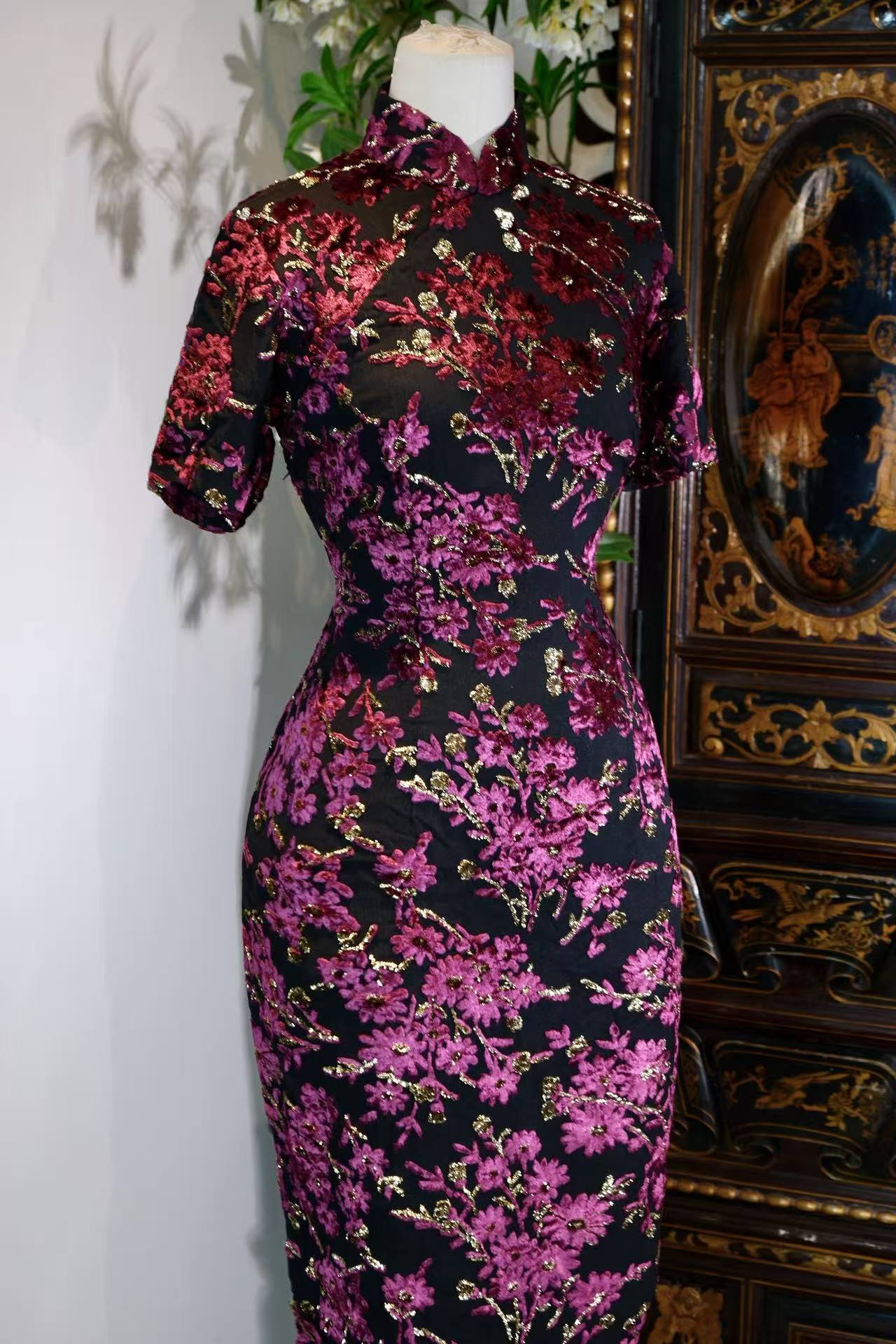
这件旗袍最摄人心魄之处,在于其面料的图案与质感。它并未采用传统旗袍常见的平面印花或刺绣,而是运用了更为复杂、更具奢华感的烧花丝绒织金工艺。
- 底料与色彩:旗袍的底色是深邃的黑色,如同静谧的夜空,为整个图案提供了绝佳的舞台。在这片“暗夜”之上,盛开着大片繁复而热烈的花卉。花朵的色泽并非单一,而是呈现出从酒红到紫红的微妙渐变,仿佛暮色中层层绽放的牡丹或大丽菊,既有雍容之态,又不失神秘之感。
- 工艺与细节:图案的精髓在于“烧花”与“织金”。
- 烧花工艺:这是一种通过化学药剂或物理手段,在丝绒面料上“烧”出通透花纹的技法。这使得花朵的轮廓并非简单印于表面,而是与底料融为一体,形成了丰富的肌理和光影变化。丝绒的短绒与烧花后留下的半透明薄纱部分形成对比,使得花朵仿佛在光影中若隐若现,充满了立体感和呼吸感。
- 织金葱线:更为点睛的是,花枝与叶脉以金葱线织就。这些纤细的金色线条在光线下闪烁着细碎而耀眼的光芒,如同夜空中划过的流星,又似晨露凝结于花叶之上。它们不仅勾勒出花卉的骨架,更赋予了整件旗袍一种流动的、华丽的生命力。这种金线与紫红色花朵的搭配,既有西方巴洛克艺术的繁复与辉煌,又暗合了中国传统“金碧山水”的富丽与雅致。
二、故事之韵:香江遗梦,东西交汇
这件旗袍的故事,要从它的“身世”说起。它诞生于上世纪六十年代的香港,一个东西方文化剧烈碰撞与融合的“东方之珠”。
- 时代背景:六十年代的香港,经济腾飞,社会风尚日新月异。旗袍作为当时女性的主要礼服,其风格也从传统的含蓄内敛,逐渐转向更为大胆、现代的表达。剪裁上更贴合身体曲线,强调女性的S型身段,而这件旗袍修身的廓形正是这一时代审美的最佳注脚。
- 材质溯源:“意大利进口烧花丝绒”这一标签,揭示了其不凡的出身。彼时的意大利,是世界高级时装面料的重镇。将欧洲的奢华面料引入香港,再由本地技艺精湛的裁缝师傅,以传统旗袍的形制进行裁剪制作,这本身就是一场跨越万里的时尚对话。它见证了那个时代香港作为国际贸易港口的开放与包容,也体现了当时上流社会对顶级材质与独特设计的追求。
- 物是人非:我们可以想象,这件旗袍的主人或许是一位穿梭于中环写字楼与高级社交场合的摩登女性。她穿着这件旗袍,在觥筹交错的晚宴上,或在灯光昏黄的舞厅里,裙摆摇曳,流光溢彩。这件旗袍,不仅包裹着她曼妙的身姿,也承载着她那个时代的梦想、野心与风华。如今,斯人已逝,但衣物犹存,它静静地诉说着那段香江遗梦,成为连接过去与现在的珍贵信物。
三、艺术与稀缺:引经据典,孤品天成
从艺术风格上看,这件旗袍是装饰艺术(Art Deco)风格与东方古典主义的完美结合。
- 风格解析:其图案的繁复性、色彩的浓郁度以及金线的使用,都带有装饰艺术风格的典型特征——追求华丽、对称与几何化的自然形态。同时,旗袍本身的立领、侧开衩等元素,又是纯粹的东方符号。这种融合并非生硬的拼凑,而是达到了“和而不同”的境界,正如《文心雕龙》所言:“操千曲而后晓声,观千剑而后识器”,这件旗袍正是在深谙东西方美学精髓之后,创造出的独特范式。
- 稀缺性:烧花丝绒本身就是一种极为娇贵且工艺复杂的面料,保存至今完好无损者凤毛麟角。加之,这种将欧洲顶级面料与香港本地高级定制工艺相结合的旗袍,在当时也属于凤毛麟角的奢侈品。六十年代的动荡与变迁,使得这类衣物大多未能流传下来。因此,这样一件保存状态良好、工艺精湛、设计独特的古董旗袍,其稀缺性不言而喻。它不仅仅是一件衣服,更是一件可供收藏、研究的“软雕塑”,是服装史上一颗遗落的珍珠。
总而言之,这件六十年代的意大利烧花丝绒织金旗袍,以其暗夜繁花般的图案、东西交汇的身世故事以及不可复制的艺术价值,成为了一件真正意义上的“衣以载道”之物。它等待着新的主人,去续写它的传奇,让那段凝固的时光,再次焕发出迷人的光彩。
Measurements / Size Guide:
Bust / Waist / Hips: 100/84/106 cm
Total Length: 117 cm
Detailed Description:
In the vast ocean of fashion history, certain garments transcend their role as mere coverings to become frozen poems of an era—brilliant sparks ignited by the collision of East and West. This 1960s Hong Kong antique qipao is one such masterpiece, carrying a complex lineage and an extraordinary aesthetic.
The most breathtaking aspect of this qipao lies in the texture of its fabric. Eschewing the flat prints or standard embroideries of common qipaos, it employs the luxurious and technically demanding Woven Gold Burn-out (Devoré) Velvet process.
Foundation and Palette: The base color is a deep, ink-like black, acting as a silent night sky that provides a dramatic stage for the motifs. Upon this "dark night," lush clusters of flowers bloom with intensity. The hues are not singular but shift in a subtle gradient from burgundy to plum, resembling peonies or dahlias unfolding in the twilight—possessing both imperial dignity and a sense of mystery.
Craft and Detail: The soul of the pattern lies in the fusion of "Burn-out" and "Woven Gold."
Burn-out (Devoré) Technique: By applying chemical pastes to "eat away" parts of the velvet pile, the artisan creates translucent patterns. This ensures the floral outlines are not merely sitting on the surface but are integrated into the fabric's structure, creating a three-dimensional "breathing" effect between the plush pile and the sheer backing.
Woven Gold (Lurex) Filaments: The branches and leaf veins are woven with fine gold Lurex threads. These glint like shooting stars or morning dew, providing a skeletal structure to the blooms and imbuing the garment with a sense of movement. This combination of gold and violet-red echoes the splendor of Western Baroque art while remaining anchored in the richness of traditional Chinese "Blue and Green" landscapes.
The narrative of this qipao begins with its "pedigree"—born in the 1960s in the "Pearl of the Orient," a city defined by the intense merging of cultures.
The Era: In 1960s Hong Kong, the economy was taking flight and social trends were evolving rapidly. The qipao transitioned from reserved traditionalism to bold, modern expression. Its silhouette became more fitted, emphasizing the "S-curve" of the female form—a shift perfectly captured by this garment's tailored lines.
The Source: The label "Italian Imported Burn-out Velvet" reveals its noble origin. At the time, Italy was the epicenter of high-end textile innovation. Importing luxury European fabrics to Hong Kong to be fashioned into traditional Chinese forms by local master tailors was a profound cross-continental dialogue. It reflects the openness of Hong Kong as an international port and the pursuit of exclusivity by the social elite.
The Persona: One can imagine the original owner—a modern woman navigating the high-rise offices of Central and the tea dances at the Peninsula Hotel. Under the dim lights of a ballroom, the hem of this dress would have flickered with every movement. Though the wearer is gone, the garment remains as a "信物" (token) connecting us to that vanished dream of the Fragrant Harbour.
Artistically, this qipao is a flawless marriage of Art Deco and Oriental Classicism.
Style Analysis: The complexity of the pattern, the saturation of color, and the use of gold are hallmarks of Art Deco—seeking luxury, symmetry, and geometricized natural forms. Meanwhile, the high collar and side slits remain pure Eastern symbols. This is not a forced assembly but a realization of "harmony in diversity." As the Wen Xin Diao Long suggests, true mastery comes after "observing a thousand swords."
Scarcity: Devoré velvet is a delicate material; finding a specimen preserved in pristine condition is like finding a needle in a haystack. Because such pieces—combining top-tier European materials with bespoke Hong Kong craftsmanship—were extreme luxuries even in their day, and considering the historical upheavals of the subsequent decades, very few have survived. It is truly a "Soft Sculpture," a lost pearl of fashion history.
In essence, this 1960s devoré silk velvet qipao with gold-woven accents stands as a profound vessel of culture and artistry. With its patterns reminiscent of night blossoms, its heritage at the crossroads of East and West, and its irreplaceable artistic value, it is more than a garment—it is a piece of history. It now awaits a new custodian to continue its legacy, breathing fresh life into this frozen moment of time and letting its captivating brilliance shine once more.