深圳溯源
无法加载取货服务可用情况
衣服尺寸:
胸围/腰围/臀围:100/86/106 厘米
衣长:105 厘米
细节描述:
一、衣身图案:素色经纬间的肌理诗学
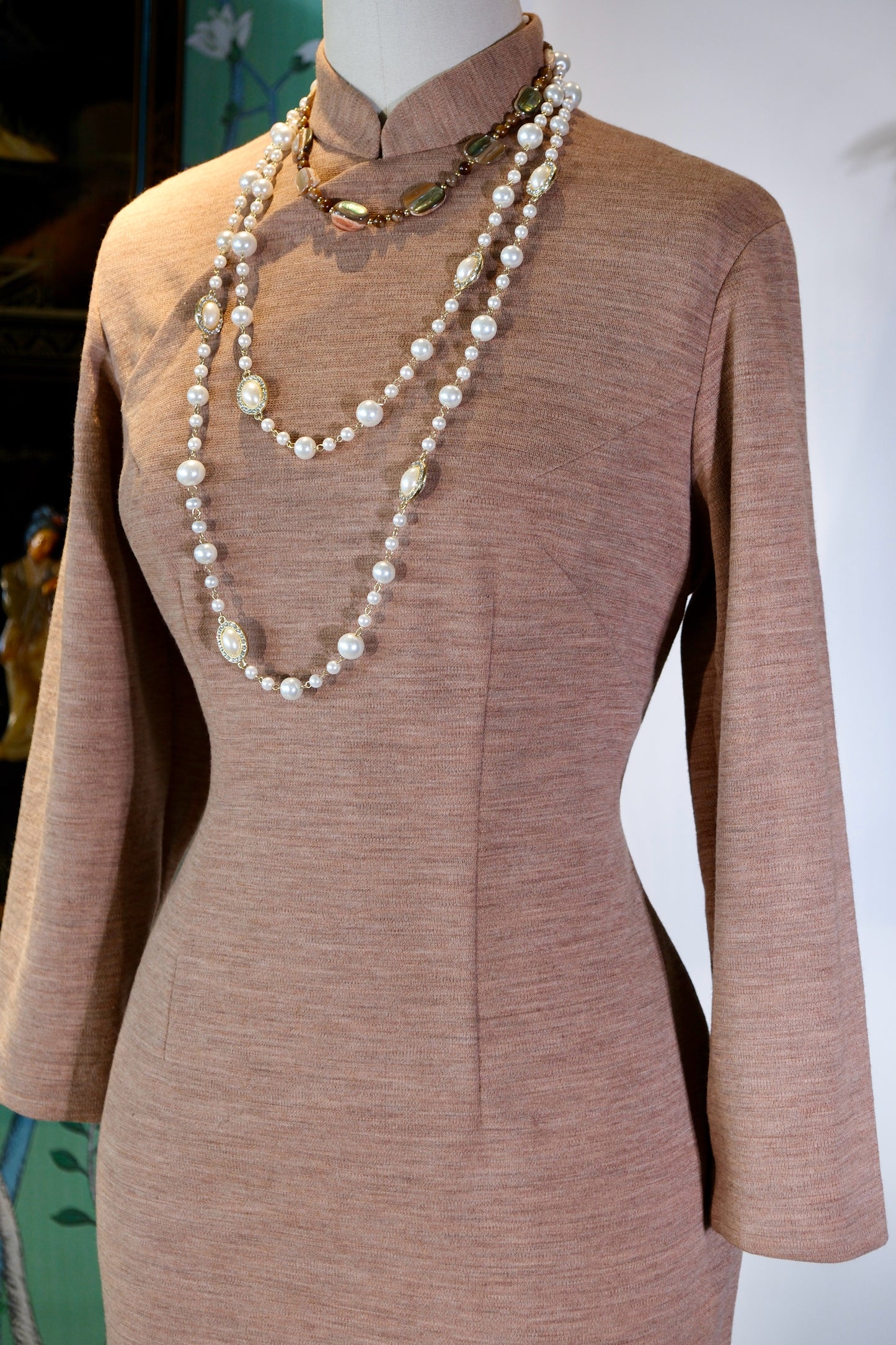
此件旗袍以“无图案”为图案,通体采用暖调藕荷色针织面料,细密的罗纹肌理如宣纸上的皴法,在光线流转间呈现出“远看一色,近观万纹”的视觉效果。领口处保留传统旗袍的立领设计,却在边缘处以同色系丝线暗绣缠枝纹,需近观方见其精微——这种“隐纹”工艺恰如《考工记》所言“材美工巧为良器”,将装饰性藏于实用主义之下,暗合六十年代香港“摩登与传统共生”的审美思潮。
二、古董衣的故事:香江潮汐中的女性觉醒
1960年代的香港,是东西方文化碰撞的熔炉。彼时纺织工业崛起,针织面料因弹性与垂坠感成为旗袍改良的先锋材质。此衣诞生于九龙某小型制衣工坊,其主人或为中环写字楼的“职业女性”——她们摒弃了传统旗袍的繁复刺绣,转而追求“可行动的美”:七分袖设计露出纤细腕骨,裙长及膝下三寸,既符合职场礼仪,又暗藏对身体解放的渴望。衣身侧缝的隐形拉链取代盘扣,是“西风东渐”的物证;而收腰处的省道剪裁,则延续了苏派旗袍“贴合人体曲线”的传统,恰如张爱玲笔下“旗袍是紧的,紧得使人想起自己的身材”的精准描摹。
三、艺术风格:现代主义的东方转译
此衣的艺术价值,在于将西方现代主义的“形式追随功能”与东方美学的“留白意境”熔于一炉。针织面料的弹性赋予旗袍前所未有的流动性,行走时裙摆如涟漪轻漾,呼应了六十年代“摇摆伦敦”的动感美学;而低饱和度的藕荷色,则取自中国传统色卡中的“暮山紫”,在《红楼梦》中曾是黛玉“月洞门”纱帐的配色,暗喻知识女性的内敛与孤高。衣身无任何具象图案,却通过面料肌理与剪裁线条构建出“空故纳万境”的东方哲学,与同时期西方设计师伊夫·圣罗兰的“蒙德里安裙”形成跨文化对话——前者以几何色块解构西方绘画,后者以素色肌理重构东方意境,共同书写了六十年代的时尚史诗。
四、稀缺性:工业浪潮中的手工余温
现存六十年代港产针织旗袍不足百件,此衣的稀缺性更在于其“过渡性”特征:它既非完全手工缝制的传统旗袍,亦非流水线生产的成衣,而是“半工业化”时代的产物——面料由机器织造,但剪裁与缝制仍依赖老师傅的手工经验,衣身内侧可见细密的手工锁边,针脚如“春蚕吐丝”般均匀,这种“机器与手工的共生”在七十年代成衣工业化后便逐渐消失。此外,针织面料易变形、难保存,能完好留存至今者凤毛麟角,其存世量远低于同时期丝绸旗袍,堪称“纺织史的活化石”。
五、结语:时光褶皱里的永恒之美
此衣如一枚被时光打磨的琥珀,封存着六十年代香港女性的独立姿态与文化交融的密码。当指尖抚过罗纹肌理,仿佛触碰到那个“旗袍配高跟鞋、珍珠项链搭西装外套”的摩登年代——它不仅是衣物,更是一部穿在身上的社会史,一首用经纬编织的东方诗。正如本雅明所言“古董是历史的灵光”,这件旗袍的灵光,正在于它以素色之姿,照亮了一个时代的审美觉醒与文化韧性。
Measurements / Size Guide:
Bust / Waist / Hips: 100/86/106 cm
Total Length: 105 cm
Detailed Description:
This cheongsam (qipao) uses "patternlessness" as its pattern. The entire garment is crafted from a warm-toned lotus-purple knitted fabric; its fine ribbed texture acts like the Cun (shading) technique on Xuan paper, presenting a visual effect of "a solid color from afar, yet ten thousand textures up close." The collar retains the traditional standing design but features subtle, tone-on-tone silk embroidery of scrolling vines along the edges, visible only upon close inspection. This "hidden motif" craft embodies the principle of "fine materials and exquisite skill make a superior vessel," hiding decorativeness beneath utilitarianism—aligning with the 1960s Hong Kong aesthetic of "symbiosis between modernity and tradition."
Hong Kong in the 1960s was a crucible of East-West cultural collision. As the textile industry rose, knitted fabrics became the vanguard material for qipao reform due to their elasticity and drape. This garment was born in a small workshop in Kowloon; its owner might have been a "career woman" in a Central office building. These women discarded the complex embroidery of traditional qipaos in pursuit of "active beauty": the three-quarter sleeves reveal slender wrists, and the hem ends three inches below the knee—conforming to workplace etiquette while harboring a desire for bodily liberation. The invisible side zipper replacing frog buttons serves as physical evidence of Western influence, while the waist darts continue the Suzhou-style tradition of "contouring the human curve," perfectly echoing Eileen Chang’s description: "The qipao is tight, so tight it makes one think of their own body."
The artistic value of this piece lies in its fusion of Western Modernism’s "form follows function" with the Eastern aesthetic of "blank space" (Liubai). The elasticity of the knit gives the qipao an unprecedented fluidity; when walking, the hem ripples like water, echoing the dynamic "Swinging London" aesthetics of the sixties. The low-saturation lotus-purple is derived from the traditional Chinese shade "Twilight Mountain Purple" (Mushanzi), famously used for Lin Daiyu’s "Moon-Gate" gauze curtains in Dream of the Red Chamber, symbolizing the restraint and aloofness of intellectual women. With no representational patterns, the garment builds an Eastern philosophy of "emptiness containing all realms" through texture and silhouette, forming a cross-cultural dialogue with Yves Saint Laurent’s "Mondrian Dress" of the same period—the former reconstructing Eastern mood through texture, the latter deconstructing Western painting through geometric blocks.
Fewer than a hundred 1960s Hong Kong-made knitted cheongsams survive today. Its scarcity is heightened by its "transitional" nature: it is neither a fully hand-sewn traditional piece nor a mass-produced ready-to-wear garment, but a product of the "semi-industrial" era. The fabric was machine-knit, yet the cutting and assembly still relied on the manual experience of master tailors. Fine hand-finishing is visible inside the garment, with stitches as even as "silk spun by spring silkworms"—a symbiosis of machine and hand that vanished after the full industrialization of the 1970s. Furthermore, knitted fabrics are prone to deformation and difficult to preserve; finding one in such pristine condition is rarer than finding silk pieces of the same era—a "living fossil of textile history."
This garment is like a piece of amber polished by time, sealing within it the independent stance of 1960s Hong Kong women and the codes of cultural fusion. As fingertips brush against the ribbed texture, one can almost touch that modern era where "qipaos met high heels and pearl necklaces paired with blazers." It is more than clothing; it is a social history worn on the body—an Oriental poem woven from warp and weft. As Walter Benjamin noted, "Antiques are the aura of history," and the aura of this cheongsam lies in its solid-colored grace, illuminating an era’s aesthetic awakening and cultural resilience.