The Raspberry Gold-Brocade Paisley Qipao: A 1960s Dialogue Between East and West
Where the Tree of Life Meets the Auspicious Cloud
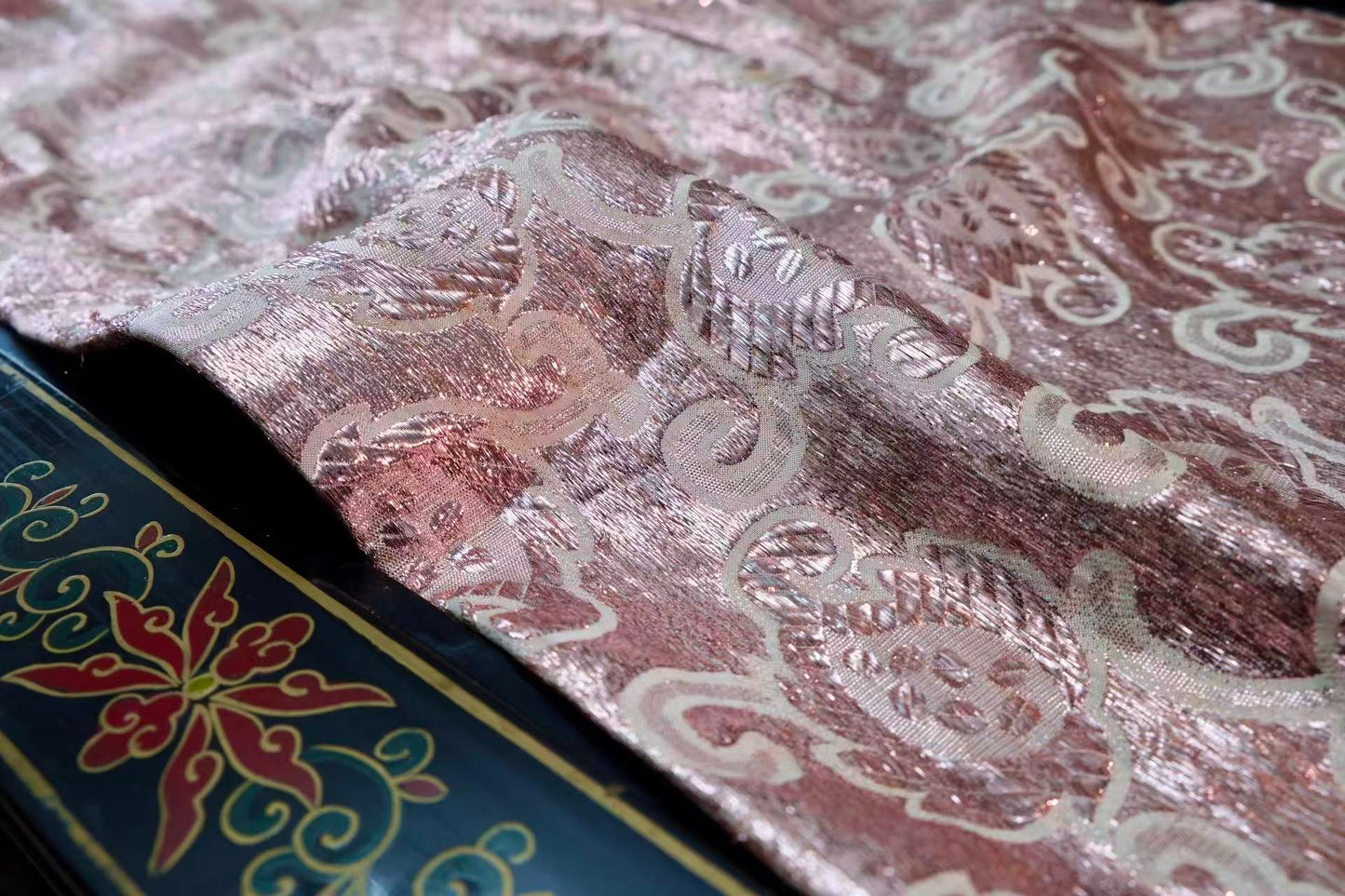
The Paisley motif, known as the "Tree of Life" from India’s Mughal Dynasty in Western tradition, finds its Eastern roots in the "Auspicious Cloud" patterns of China's Tang Dynasty. This Qipao adopts the Western vortex form but breathes into it the soul of the Chinese Ruyi. The raspberry pink base evokes the radiant dawn-colored robes found in Cui Zizhong’s Ming Dynasty painting The Map of Longevity, while the gold-threaded jacquard mirrors the Xianjin (wire-gold) technique recorded in the Song Dynasty’s Sui Jin. It is a furnace where Persian fervor and Huaxia elegance melt into one.
Crafted during the nascent rise of Taiwan’s textile industry in the 1960s, this garment captures the essence of the Republican-era Yi Jing (Classic of Dress): "The value of gold weaving and colorful embroidery lies in the flow of light." Under magnification, the warp and weft reveal a "three-up, one-down" twill weave, embedding gold threads into the mulberry silk. This creates a visual magic of "golden dust hidden in pink mists," inheriting the ancient Suzhou Weaving Bureau’s method of "harmonizing gold and color" while subtly reflecting Taiwan’s historical attempt to "break through via textile diplomacy" during the Cold War.
This 1960s Taiwanese antique Qipao uses the fluid curves of Paisley to trace feminine grace and the eternal luster of gold brocade to recount the passage of time. This is not merely a garment, but a Time Capsule: to touch its texture is to feel the textile history across the Taiwan Strait in the 1960s; to behold its light is to witness the stubborn growth of Oriental aesthetics amidst the waves of globalization.