深圳溯源
无法加载取货服务可用情况
衣服尺寸:
胸围/腰围/臀围:94/78/96 厘米
衣长:110 厘米
细节描述:
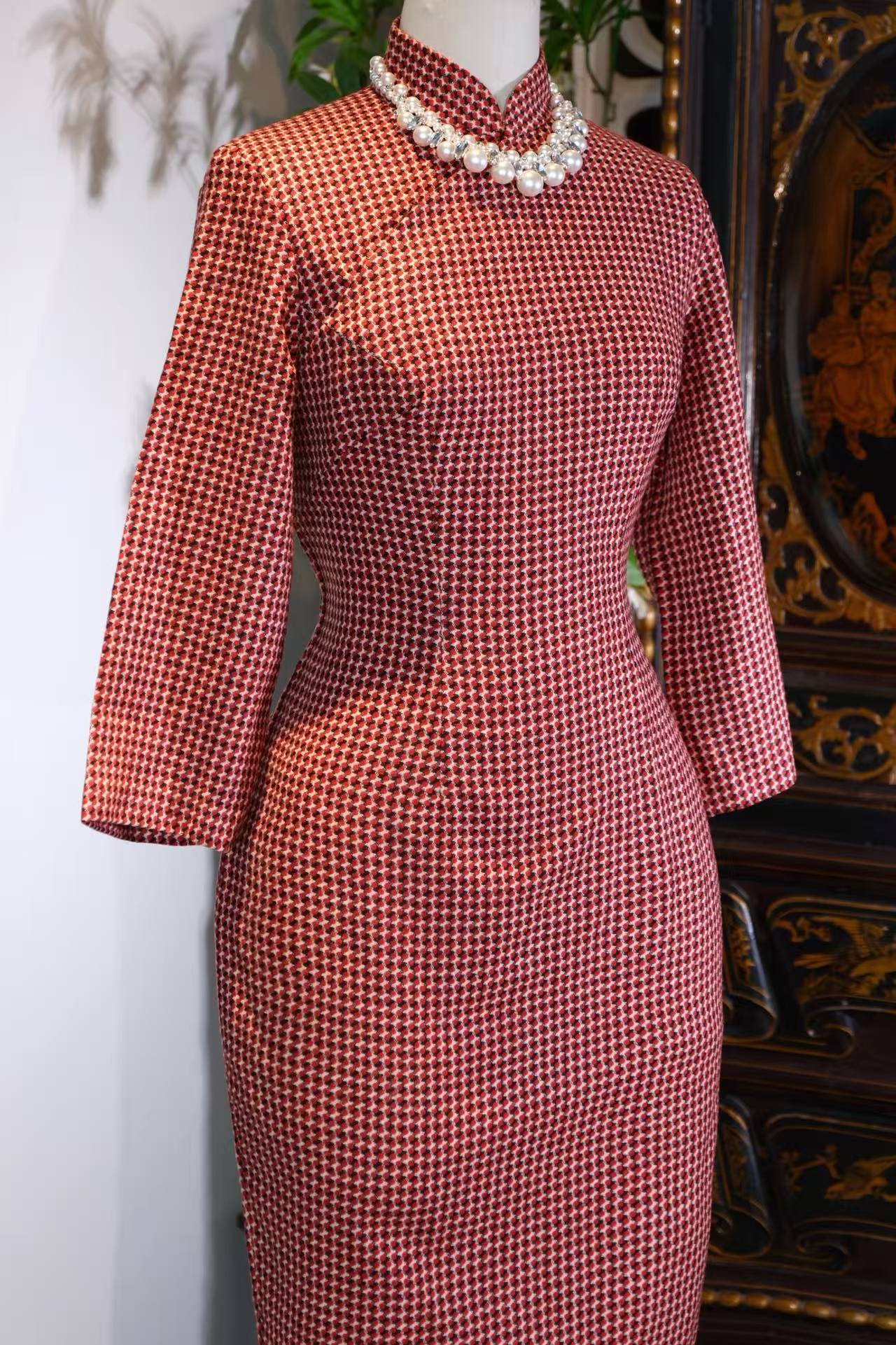
在时尚的万花筒中,很少有时刻能像上世纪六十年代那样,让东方剪裁与西方前卫艺术产生如此剧烈的化学反应。这件诞生于当时香港的高级定制羊毛旗袍,便是这一“摩登时刻”的绝佳证物。它并未沉溺于传统的龙凤呈祥,而是大胆地披上了波普风格的几何铠甲,以一种近乎挑衅的姿态,宣告了东方女性的现代觉醒。
图案解析:视觉的律动与欧普美学
这件旗袍的纹样,绝非传统的织锦或素缎。它由无数细密的红白几何单元重复排列而成,这种高对比度的色彩与规律性的几何结构,正是波普艺术在服装设计上的典型投射。
- 视觉冲击力:这种密集的几何纹样(类似于千鸟格的变体,但更趋向于像素化的几何点阵),在视觉上产生了一种颤动感,与当时风靡欧美的欧普艺术不谋而合。它不再是静止的布料,而是一种流动的视觉盛宴。
- 去中心化:波普艺术强调“重复”与“复制”的美学,这种满身纹样消解了传统旗袍对局部刺绣的依赖,将美感均匀地分布在身体的每一寸曲线之上,极具现代构成的张力。
历史语境:港式摩登的黄金年代
六十年代的香港,是东西方文化最激烈的交汇点。
- 时代的镜像:彼时,伊夫·圣·罗兰刚刚推出震惊世界的“蒙德里安裙”,将抽象几何引入时装;大洋彼岸的波普教父安迪·沃霍尔正用玛丽莲·梦露的头像挑战艺术的定义。而这件旗袍,正是香港裁缝对这股全球浪潮的敏锐回应。
- 材质的革新:选用厚实的羊毛面料来承载这种几何纹样,是极高明的设计。羊毛的挺括感支撑起了波普图案的硬朗线条,使得旗袍不再是软糯的“旧时月色”,而是具有雕塑感的“现代建筑”。
艺术风格与稀缺性:穿在身上的波普宣言
引用罗兰·巴特在《时尚体系》中的观点,服装是一种符号。这件旗袍的符号意义在于它的矛盾与统一——传统的立领、斜襟,代表着东方的含蓄与内敛;而满铺的波普几何纹样,则代表着西方的张扬与解放。
- 稀缺的“中间地带”:在存世的古董旗袍中,丝绸、织锦缎最为常见,而采用这种具有强烈六十年代平面构成风格的羊毛面料,且剪裁如此修身(强调腰臀比的S型曲线)的成衣,实属凤毛麟角。
- 不可复制的工艺:这种细密的几何对格工艺,对裁剪师的要求极高。在那个没有电脑辅助排版的年代,匠人必须手工确保纹样在盘扣、侧缝处的完美衔接,这种“手工时代的工业美学”如今已近乎失传。
结语:
这件旗袍,是张爱玲笔下“人生是一袭华美的袍”的现代注脚。它不属于深闺,而属于那个披头士乐队嘶吼、迷你裙飞扬的六十年代。它是一件穿在身上的波普艺术品,等待着懂得欣赏这段“摩登旧梦”的藏家,续写它的传奇。
Measurements / Size Guide:
Bust / Waist / Hips: 94/78/96 cm
Total Length: 110 cm
Detailed Description:
In the kaleidoscope of fashion, few moments witness such a violent chemical reaction between Eastern tailoring and Western avant-garde art as the 1960s. This bespoke wool qipao (cheongsam), born in Hong Kong during that era, is a perfect witness to this "modern moment." Eschewing traditional motifs of dragons and phoenixes, it boldly dons the "geometric armor" of Pop Art, declaring the modern awakening of the Oriental woman with an almost defiant stance.
The pattern of this qipao is far from traditional brocade or plain satin. It is composed of countless dense, repeating red-and-white geometric units—a high-contrast color palette and rhythmic structure that serves as a quintessential projection of Pop Art in fashion design.
Visual Impact: This dense geometric pattern (reminiscent of a houndstooth variant but leaning towards pixelated dot arrays) creates a sense of visual vibration, aligning with the Op Art (Optical Art) movement then sweeping through Europe and America. It is no longer a static fabric but a flowing visual feast.
Decentralization: Pop Art emphasizes the aesthetics of "repetition" and "reproducibility." This all-over pattern dissolves the traditional qipao's reliance on localized embroidery, distributing beauty evenly across every curve of the body, creating immense tension in its modern composition.
1960s Hong Kong was the most intense intersection of Eastern and Western cultures.
Mirror of an Era: At the time, Yves Saint Laurent had just introduced the world-shaking "Mondrian Dress," bringing abstract geometry into high fashion; across the ocean, Pop Art godfather Andy Warhol was challenging the definition of art with his Marilyn Monroe silkscreens. This qipao is the keen response of Hong Kong tailors to this global wave.
Innovation in Material: Choosing heavy wool to carry these geometric patterns was a masterstroke. The crispness of wool supports the bold lines of the Pop motifs, transforming the qipao from a soft "moonlight of the past" into a sculptural "piece of modern architecture."
Citing Roland Barthes in The Fashion System, clothing is a system of signs. The semiotic significance of this qipao lies in its contradiction and unity—the traditional standing collar and diagonal lapel represent Eastern reserve, while the all-over Pop geometry represents Western extroversion and liberation.
The Rare "Middle Ground": Among surviving vintage qipaos, silk and brocade are common. However, pieces utilizing wool with such strong 1960s graphic composition, coupled with such a form-fitting cut (emphasizing the S-curve), are truly rare.
Irreplicable Craftsmanship: The precise alignment of these dense geometric patterns required immense skill. In an age before computer-aided design, artisans had to manually ensure that patterns matched perfectly at the frog buttons and side seams. This "industrial aesthetics of the manual era" is now a nearly lost art.
This qipao is a modern footnote to Eileen Chang’s famous line: "Life is a gorgeous robe." It does not belong in a secluded courtyard but in the roaring 1960s of the Beatles and flying miniskirts. It is a wearable piece of Pop Art, waiting for a collector who appreciates this "modern old dream" to continue its legend.