深圳溯源
无法加载取货服务可用情况
衣服尺寸:
胸围/腰围/臀围:92/86/94 厘米
衣长:103 厘米
细节描述:
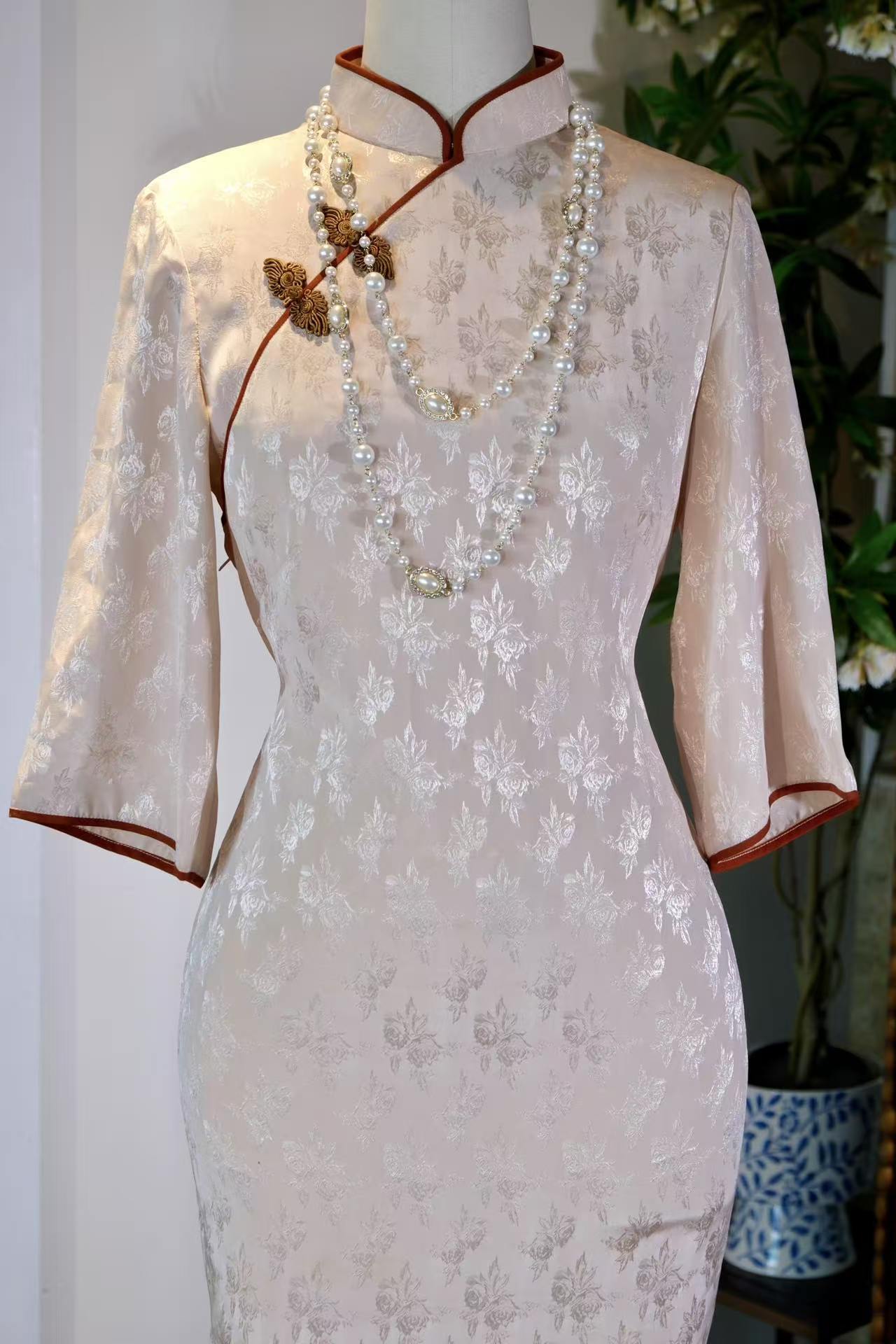
当目光触及这件上世纪六十年代台湾产的玫瑰提花缎旗袍时,仿佛推开了一扇通往旧时光的门。衣身之上,玫瑰纹样以提花工艺织就,花瓣舒展如月下轻舞,枝叶蜿蜒似风中低语,每一朵都带着丝绸特有的光泽,在光影里流转出细腻的肌理。这种提花工艺并非简单的图案复刻,而是将“花中皇后”的雍容气度凝于经纬——玫瑰的盛放姿态被解构为层叠的弧线,花蕊处以更细密的丝线勾勒出星芒般的细节,与缎面的素雅底色形成微妙对比,既有东方纹样的含蓄,又暗合六十年代西方对“浪漫主义”的重新诠释。
六十年代的台湾,正处于传统与现代的交汇点。旗袍作为女性衣橱的经典,既保留着“立领盘扣”的传统形制,又在剪裁上悄然融入西式审美——这件旗袍的收腰设计贴合身体曲线,袖口微喇的弧度则打破了传统旗袍的拘谨,恰如张爱玲笔下“新旧交替时代的女性”:既有旧式闺秀的温婉,又藏着新女性的独立锋芒。提花缎的材质更显珍贵,彼时台湾丝绸产业虽不及江南鼎盛,但匠人以本土桑蚕丝为原料,融合苏杭提花技艺,织就的缎面既轻薄透气,又带着海岛特有的温润光泽,是“南洋风情与江南雅韵”的奇妙共生。
古董衣的价值,从不只在于“旧”,而在于它承载的时光密码。这件旗袍上的玫瑰,或许曾是某位女子赴约时的盛装点缀,或是婚礼上羞涩的见证——六十年代的台湾,旗袍是女性重要的“社交语言”,而提花缎因工艺复杂、产量稀少,多为名门闺秀或艺文界人士所钟爱。如今,当我们抚摸那些历经半世纪仍清晰的纹路,仿佛能听见当年缝纫机“嗒嗒”的声响,看见匠人如何将丝线一寸寸织成诗。正如《考工记》所言:“天有时,地有气,材有美,工有巧,合此四者,然后可以为良。”这件旗袍,正是天时(六十年代的时代风貌)、地气(台湾的本土工艺)、材美(提花缎)、工巧(传统与创新的剪裁)的完美结晶。
在快时尚泛滥的今天,这样的古董旗袍已成稀缺的艺术品。它的玫瑰不会褪色,因为每一片花瓣都浸染着时光的温度;它的缎面依旧柔软,因为匠人的心血早已与丝线融为一体。穿它的人,不仅是在穿一件衣服,更是在穿一段历史,一种被岁月打磨过的优雅。这或许就是古董衣的魅力:它让过去的美,在今天依然能绽放出令人屏息的光芒。
Measurements / Size Guide:
Bust / Waist / Hips: 92/86/94 cm
Total Length: 103 cm
Detailed Description:
The Poetics of Pattern: The Queen of Flowers in Warp and Weft
When one gazes upon this 1960s Taiwan-made rose jacquard satin qipao, it feels like opening a door to a bygone era. The rose motifs, woven through sophisticated jacquard techniques, feature petals unfolding like a moonlit dance and foliage winding like whispers in the wind. Each bloom possesses the unique luster of silk, revealing delicate textures as light and shadow shift. This jacquard process is no simple replication; it condenses the regal poise of the "Queen of Flowers" into the fabric—the blooming posture of the rose is deconstructed into layered arcs, while the stamens are outlined with denser threads to create starlight-like details. This creates a subtle contrast with the elegant satin base, blending Eastern restraint with the 1960s Western reinterpretation of "Romanticism."
The Footnote of History: A Fusion of Island Warmth and Jiangnan Grace
In the 1960s, Taiwan stood at the intersection of tradition and modernity. As a wardrobe staple, the qipao retained traditional elements like the standing collar and frog buttons, while quietly integrating Western aesthetics into its tailoring. The cinched waist fits the body’s curves perfectly, and the subtle flare of the cuffs breaks the rigidity of traditional forms, echoing Eileen Chang’s description of "women in an age of transition": possessing both the gentleness of a traditional lady and the independent edge of a modern woman. The jacquard satin material is particularly precious; though Taiwan's silk industry was not as sprawling as that of Jiangnan, local artisans used indigenous mulberry silk combined with Su-style jacquard techniques. The resulting satin is both light and breathable, carrying an island-specific warmth—a marvelous symbiosis of "Nanyang flair and Jiangnan grace."
Scarcity and Soul: A Wearable Crystalline of the "Four Beauties"
The value of an antique garment lies not in its age, but in the temporal code it carries. These roses might have adorned a lady for a momentous tryst or served as a bashful witness at a wedding. In 1960s Taiwan, the qipao was a vital "social language," and jacquard satin, due to its complex craftsmanship and low yield, was favored by socialites and the literati. Today, touching these patterns that remain clear after half a century, one can almost hear the rhythmic "clack-clack" of the sewing machine and see how the artisan wove silk into poetry. As the Kao Gong Ji states: "The season has its time, the earth has its qi, the material has its beauty, and the craft has its skill. When these four combine, a masterpiece is born." This qipao is the perfect crystallization of its era, its locale, its material, and its craftsmanship.
Conclusion: Elegance Polished by Time
In an age of fast fashion, such an antique qipao has become a rare work of art. Its roses do not fade because every petal is saturated with the temperature of time; its satin remains soft because the artisan's devotion is forever entwined with the threads. The wearer does not just don a garment; they wear a piece of history and an elegance polished by the years. This is the charm of antique clothing: it allows the beauty of the past to radiate a breathtaking brilliance today.