深圳溯源
无法加载取货服务可用情况
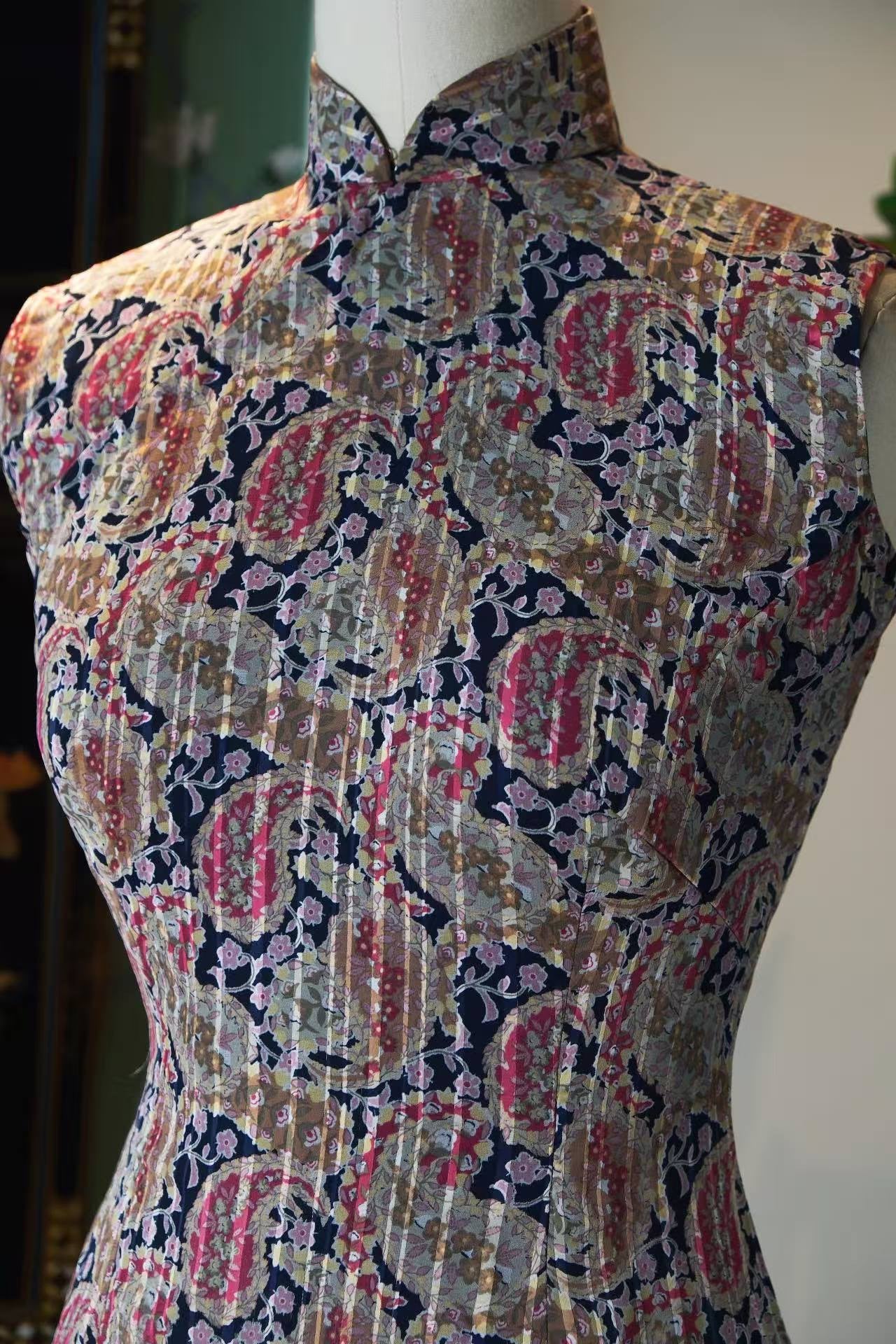
分享一件上世纪六十年代台湾佩斯利花纹薄纱古董旗袍。
深邃的靛蓝底色上,无数佩斯利涡纹如星河般铺陈——
旗袍主体以靛蓝为底,其上佩斯利涡纹(Paisley)以红、
提花雪纺纱的轻盈质地,为佩斯利纹赋予了“纱窗月影”
这种“异域佩斯利”的设计,实为台湾战后纺织业“中西合璧”
佩斯利纹与旗袍的结合,是冷战时期台湾“文化拼贴”的产物——
当佩斯利涡纹在靛蓝薄纱上流转,
Sharing a vintage Taiwanese cheongsam from the 1960s featuring Paisley motifs on thin silk gauze (organza).
Upon a deep indigo blue base, countless Paisley swirls are spread like a river of stars—this is no ordinary print, but the pinnacle of Taiwanese textile craftsmanship from the sixties. The light gauze acts as paper, the Paisley pattern as poetry, fusing the ancient charm of Persia with Oriental elegance within its interwoven threads, becoming "moving art" filtered by time.
The cheongsam's body is set on indigo blue, with the Paisley swirls (涡纹) interwoven in three colors: red, cream, and gold. Each swirl, shaped like a cashew or a flame, shows the lingering brushstrokes of Persian miniature painting in its layered petals. The Paisley pattern originated from the ancient Persian "Tree of Life" totem; after its introduction to East Asia via the Mughal Empire, Taiwanese artisans creatively integrated it into the cheongsam fabric. The "S" curve of the vortex pattern subtly aligns with the I Ching's* philosophy of "the winding path perfects all things" (曲成万物), while the dense arrangement of the motifs inherits the auspicious symbolism of Southern Fujian's "brocade patterns" (锦纹), such as "continuous abundance" (连绵不断) and "double blessings of fortune and longevity" (福寿双全).
The light texture of the jacquard chiffon (提花雪纺纱) lends the Paisley pattern an ethereal quality, evoking the artistic concept of "moonlight through a gauze window" (纱窗月影). Cheongsams in 1960s Taiwan were at a crucial juncture of "traditional deconstruction and modern reconstruction": the tailoring continued the slimming language of the Shanghai school's "nine-panel cut" (九片裁剪), yet it discarded complicated piping and trimming. Instead, it used a sleeveless, high-slit design to align with the minimalist trends of Western modern fashion. The fabric daringly adopted a "sheer gauze" (透纱) technique, creating a sharp contrast between the complexity of the Paisley pattern and the transparency of the organza. This mirrors the sense of temporal dislocation found in Bai Xianyong's Wandering in the Garden, Waking from a Dream: "The brilliant purples and reds bloomed everywhere, as if they were all consigned to broken wells and crumbling walls"—the heavy tradition of the pattern and the lightness of the modern cut achieve a subtle balance in this sheer fabric.
This "exotic Paisley" design was a pioneering experiment of "East-meets-West" in Taiwan's post-war textile industry: on one hand, Taiwan, as an "Asian textile transshipment hub," imported a large number of European Paisley design drafts. On the other hand, local artisans translated the folk "gauze embroidery" (纱绣) techniques of the Minnan and Taiwanese regions into a printing and dyeing process, ensuring the vortex patterns maintained both a three-dimensional effect and sheerness on the organza. This makes it a classic specimen for studying the "globalization and localization" of East Asian fashion in the 1960s.
The combination of the Paisley pattern and the cheongsam is a product of "cultural collage" in Cold War-era Taiwan—using Western motifs to project modernity while safeguarding tradition through Eastern tailoring. The surviving quantity of this kind of "cross-cultural aesthetic" is extremely rare, making it all the more precious.
As the Paisley swirls flow on the indigo organza, and the modern spirit of the sixties emerges through the sheer fabric, this Taiwan-made vintage cheongsam is more than just a piece of clothing; it is a "touchable cross-cultural history": using the vortex pattern as a brush and the organza as paper, it writes an eternal dialogue between East and West, tradition and modernity, across the river of time.