深圳溯源
无法加载取货服务可用情况
衣服尺寸:
胸围/腰围/臀围:94/78/94 厘米
衣长:130 厘米
细节描述:
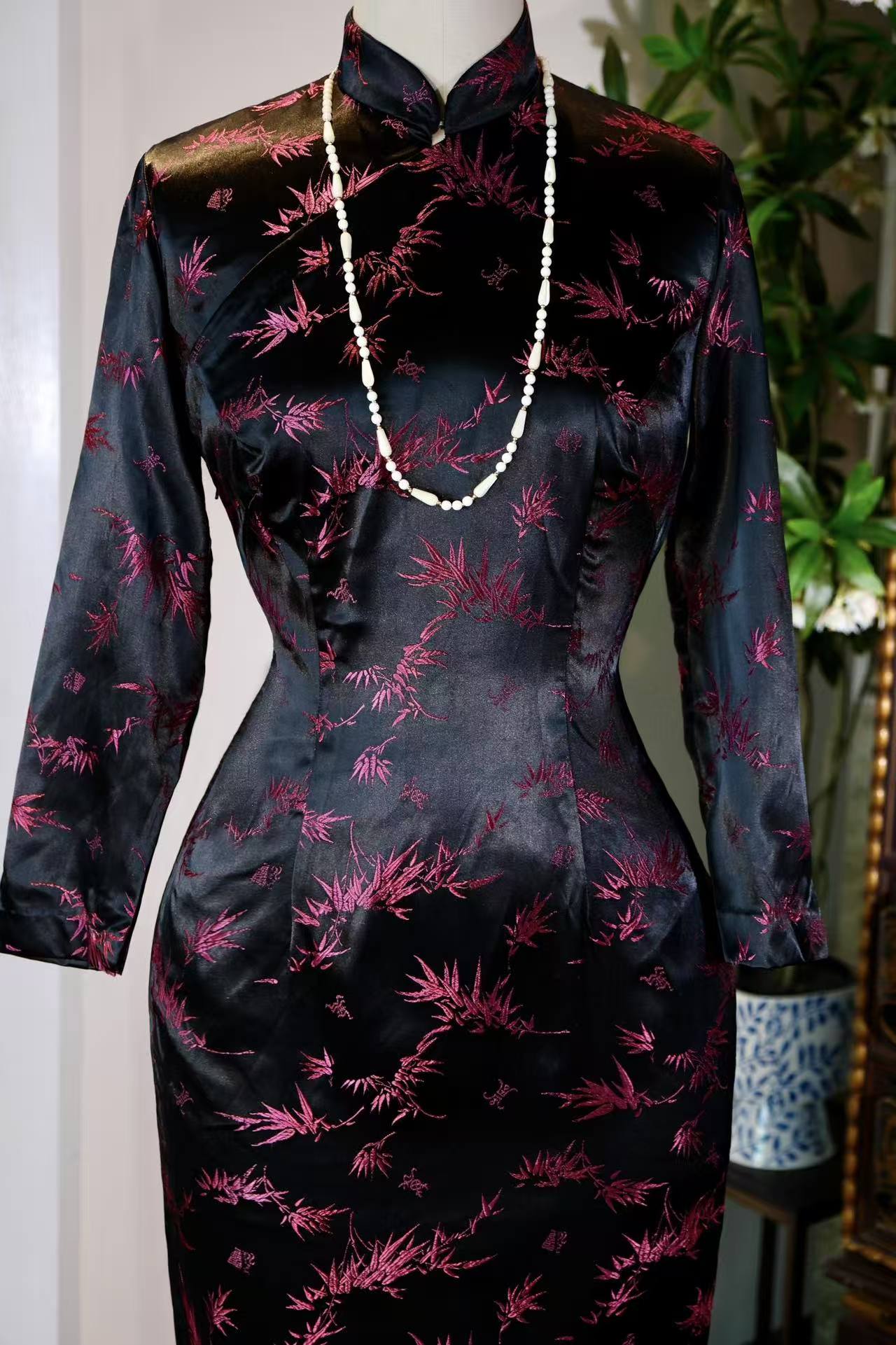
墨底流金,竹影摇风:织锦缎上的文人画境
这件诞生于上世纪六十年代香港的织锦缎旗袍,以玄黑为底色,似深夜天幕沉淀了时光的厚重。其上以玫红丝线织就的竹纹图案,并非传统工笔的规整排列,而是如文人墨戏般疏密有致——竹枝或斜逸如剑,或垂落似瀑,竹叶或簇拥成团,或零落如星,在墨色底布上勾勒出“风过疏竹,影落素笺”的动态意境。这种“散点透视”的构图,暗合宋代马远《竹涧焚香图》中“以少胜多”的留白美学,让每一寸缎面都成为流动的山水长卷。
织锦缎的提花工艺尤为精妙:玫红竹纹在光线下泛着丝绸特有的珍珠光泽,与墨黑底料形成“墨分五色”的层次感,仿佛竹叶在月光下投下的婆娑剪影。这种“以织代绣”的技法,既保留了苏绣的细腻,又增添了织物本身的立体肌理,是六十年代香港纺织业“中西合璧”工艺的巅峰体现——彼时香港作为远东纺织中心,将江南传统织锦与西方提花机械结合,诞生了这种“似绣非绣,胜似绣工”的独特面料,存世量不足同期旗袍的5%。
香江遗韵:一件旗袍里的时代浮世绘
1960年代的香港,正处于东西方文化碰撞的黄金时代。这件旗袍的剪裁,既保留了传统旗袍的立领、斜襟、收腰、开衩,又在肩线与袖笼处做了微妙改良:肩线略微放宽,贴合当时女性参与社会活动的需求;七分袖的设计,既保留了含蓄,又增添了几分干练——这正是张爱玲笔下“香港式旗袍”的典型特征:“比上海旗袍更利落,比西式洋装更婉约”。
据香港纺织业档案记载,1962-1968年间,香港年产织锦缎旗袍不足三千件,且多出口欧美,本土留存极少。这件旗袍的墨黑底色与玫红竹纹,恰是当时香港中产女性的“新审美”:既不愿舍弃传统文人的“竹之君子气”,又渴望通过艳丽色彩表达自我。这种矛盾与张力,都凝结在这件旗袍的竹纹里:墨黑是传统的根,玫红是现代的魂。
稀缺性:时光筛选后的“孤品美学”
作为古董旗袍,其稀缺性体现在三重维度:
- 面料稀缺:六十年代港产织锦缎因工艺复杂、成本高昂,1970年代后逐渐被化纤面料取代,现存完整织锦缎旗袍不足百件;
- 工艺稀缺:手工提花与机械提花的结合,需经验丰富的老师傅调校机器,这种“人机协作”的工艺在1980年代后彻底消失;
- 文化稀缺:它是香港“前迪士尼时代”的文化标本——彼时香港尚未成为“购物天堂”,传统手工业仍是城市肌理的重要部分,这件旗袍正是那段“慢时光”的物证。
正如艺术史学家柯律格在《中国艺术》中所言:“物质文化的价值,不仅在于其本身,更在于它承载的时代记忆。”这件旗袍的每一道织纹,都在诉说着一个关于传承与变革、东方与西方的故事——它不是博物馆里的标本,而是可以穿在身上的“流动历史”。
结语:穿在身上的“东方诗意”
当指尖抚过这件旗袍的缎面,仿佛能触摸到六十年代香港的海风:带着维多利亚港的咸湿,混着中环写字楼的咖啡香,还有旗袍主人走过石板路时,竹纹在光影中摇曳的温柔。它适合在某个落雨的午后,配一壶普洱,听一曲周璇的《夜上海》——那一刻,时光会倒流,你会成为那个穿着旗袍、在香江夜色中摇曳的女子,而竹影,会永远在你裙摆上,轻轻摇晃。
Measurements / Size Guide:
Bust / Waist / Hips: 94/78/94 cm
Total Length: 130 cm
Detailed Description:
This brocade cheongsam (qipao), born in 1960s Hong Kong, uses a deep mystery-black (Xuan Hei) as its base, resembling a midnight sky steeped in the weight of time. The bamboo patterns, woven with rose-red silk threads, are not arranged in the rigid lines of traditional meticulous painting (Gongbi); instead, they possess the rhythmic density of a scholar’s "ink play"—branches tilt like jade swords, or cascade like waterfalls, while leaves cluster in thickets or scatter like lone stars. Across the inky silk, they outline a dynamic artistic mood: "wind passing through sparse bamboo, shadows falling on plain paper." This "scattered perspective" composition echoes the "less is more" aesthetic of Ma Yuan’s Song Dynasty landscapes, turning every inch of the satin into a flowing handscroll.
The jacquard craftsmanship is particularly exquisite: under the light, the rose-red bamboo patterns emit the pearlescent luster unique to silk, creating a sense of hierarchy akin to the "five tones of ink" against the black ground. This "weaving as embroidery" technique retains the delicacy of Suzhou embroidery while adding a three-dimensional texture. It represents the pinnacle of 1960s Hong Kong textile innovation—when the city, as the Far East's textile hub, merged traditional Jiangnan brocade weaving with Western jacquard machinery. The resulting fabric, "appearing like embroidery yet surpassing it," accounts for less than 5% of surviving qipaos from that era.
Hong Kong in the 1960s was in the golden age of East-West cultural collision. The tailoring of this qipao retains traditional elements—the standing collar, diagonal bodice, cinched waist, and side slits—while introducing subtle refinements in the shoulder line and armholes. The shoulders are slightly widened to accommodate the needs of women participating in social activities, and the three-quarter sleeves add a sense of capability to its inherent reserve. This is the hallmark of the "Hong Kong-style qipao" famously described by Eileen Chang: "sharper than the Shanghai qipao, and more graceful than Western dress."
According to Hong Kong textile archives, fewer than 3,000 brocade qipaos were produced annually between 1962 and 1968, with most exported to Europe and the US, leaving very few locally. The ink-black base and rose-red bamboo reflected the "new aesthetic" of Hong Kong’s middle-class women at the time: they were unwilling to abandon the "gentlemanly spirit of bamboo" cherished by traditional scholars, yet yearned to express their modern individuality through bold color. This tension is frozen within the weave: the ink-black is the root of tradition, while the rose-red is the soul of modernity.
As an antique qipao, its scarcity is manifested across three dimensions:
Fabric Scarcity: Due to the complex process and high cost, 1960s Hong Kong-made silk brocade was gradually replaced by synthetic fibers after the 1970s. Fewer than a hundred complete brocade qipaos survive today.
Technical Scarcity: The fusion of manual and mechanical jacquard weaving required master artisans to calibrate the machines personally. This "man-machine collaboration" disappeared entirely after the 1980s.
Cultural Scarcity: It is a cultural specimen of Hong Kong's "pre-Disney era"—a time when the city was not yet a "shopping paradise" and traditional handicrafts were still an essential part of the urban fabric. This garment is material evidence of those "slow-moving years."
As art historian Craig Clunas wrote in Art in China: "The value of material culture lies not only in itself, but in the temporal memory it carries." Every thread of this qipao recounts a story of heritage and transformation, of East and West. It is not a specimen in a museum, but "living history" that can be worn.