深圳溯源
无法加载取货服务可用情况
衣服尺寸:
胸围/腰围/臀围:82/62/90 厘米
衣长:100 厘米
细节描述:
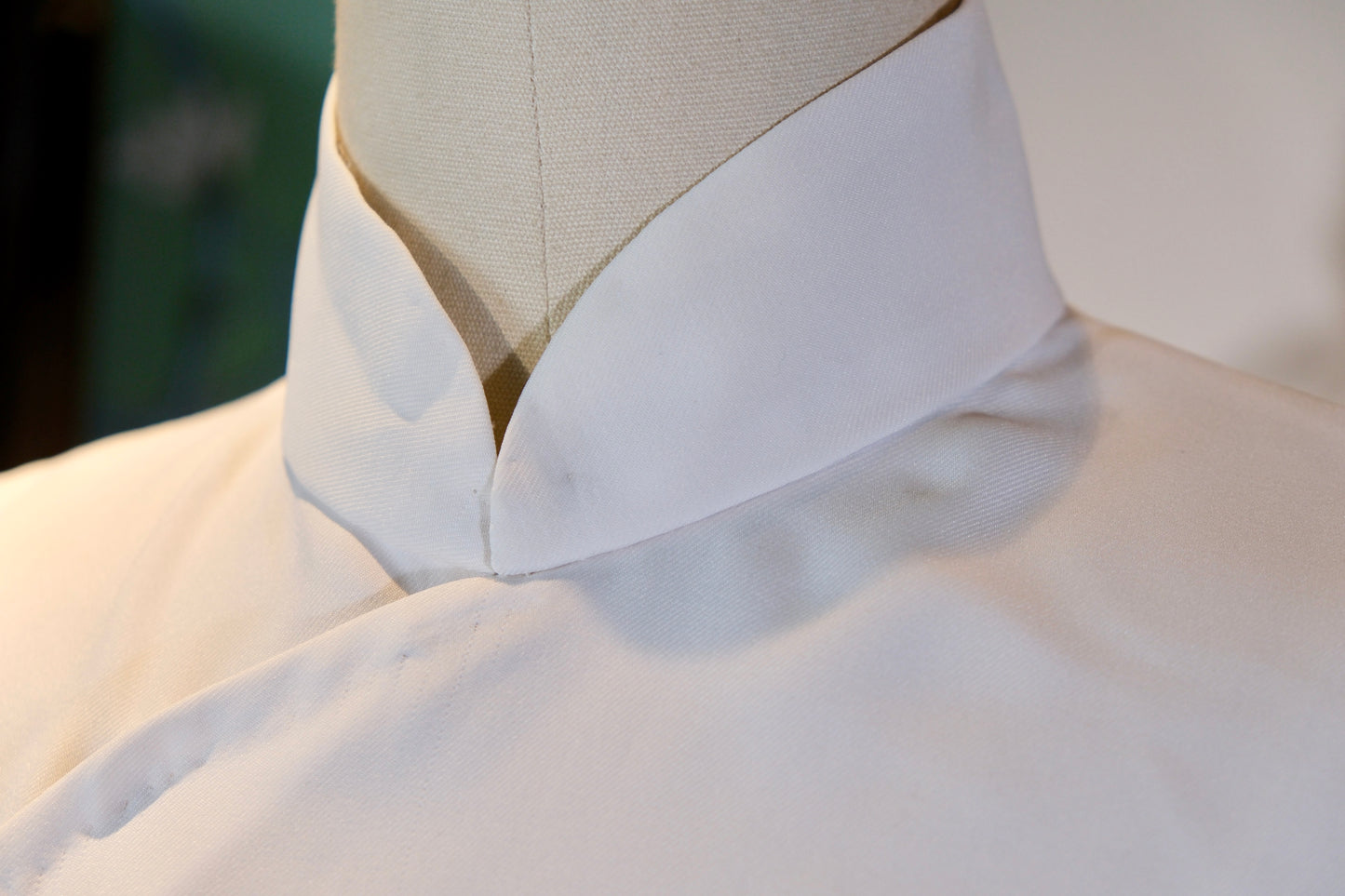
在时光的褶皱里,有些衣裳是会呼吸的。这件上世纪六十年代香港产的素白古董旗袍,便如一卷未拆封的宣纸,以最纯粹的留白,承载着那个时代的风骨与诗意。它没有繁复的图案,却在无纹处见天地——正如《考工记》所言:“天有时,地有气,材有美,工有巧,合此四者,然后可以为良。”这件旗袍的“美”,正在于它以极简的形制,凝练了东方美学的精髓与香港文化的独特气质。
一、无纹之纹:素白中的艺术哲思
旗袍通体素白,无一丝花纹,却并非“无物”。这种“空”,恰是中国传统美学的至高境界。《道德经》云:“大音希声,大象无形。”素白的底色,如同文人画中的“计白当黑”,将想象的空间留给穿着者与观者。它不似苏绣旗袍以针线绘花鸟,也不似粤绣旗袍以金线绣龙凤,却以“无饰”为饰,暗合了六十年代香港知识分子阶层追求的“新文人风”——在东西方文化碰撞中,以简约对抗浮华,以素净彰显格调。
二、时光的故事:香港裁缝的黄金时代
六十年代的香港,是旗袍制作的“黄金时代”。彼时上海裁缝南迁,将海派旗袍的精致工艺与香港本地的实用主义结合,形成了独特的“港派旗袍”风格。这件旗袍的制作者,或许正是湾仔或中环某家老裁缝铺的师傅——他们用一把剪刀、一根粉笔,在素白的丝绸上勾勒出女性的曲线,每一针都藏着“量体裁衣”的匠心。
三、稀缺性:时光淘洗后的孤品
在快时尚泛滥的今天,一件六十年代的古董旗袍,早已超越了“衣物”的范畴,成为可触摸的历史标本。它的稀缺性,不仅在于年代久远,更在于其承载的文化记忆:
- 时代的印记:无袖、高腰、中长款的设计,精准对应了六十年代香港女性的审美——她们既穿旗袍赴宴,也穿牛仔裤逛街,在传统与现代间自如切换。
- 素白的隐喻:在色彩斑斓的旗袍史中,素白旗袍尤为罕见。它不似婚嫁旗袍的喜庆,也不似日常旗袍的活泼,更像一件“仪式性”的衣裳——或许是某位知识女性的书房常服,或许是某位名媛的下午茶战袍,在低调中彰显着“腹有诗书气自华”的底蕴。
四、结语:让衣裳说话
这件素白旗袍,如今静立于人台之上,却仿佛在诉说一个关于时光、匠心与女性力量的故事。它没有图案,却比任何图案都更丰富;它没有色彩,却比任何色彩都更动人。正如木心所言:“从前的日色变得慢,车,马,邮件都慢,一生只够爱一个人。”从前的衣裳也慢,一针一线,都是对美的虔诚。
若你有幸拥有它,不妨想象:六十年代的某个黄昏,一位身着此衣的女子,走过香港的石板路,旗袍下摆轻拂过路边的茉莉,素白的身影与维多利亚港的灯火相映,成为那个时代最优雅的注脚。而如今,这件旗袍等待着新的主人,续写属于它的下一个六十年。
Bust / Waist / Hips: 82/62/90 cm
Total Length: 100 cm
Within the folds of time, some garments breathe. This plain white antique qipao, crafted in 1960s Hong Kong, is like an unopened scroll of Xuan paper—using the purest "white space" to carry the character and poetics of its era. It bears no complex patterns, yet finds a universe in its void. As the Artificers' Record (Kao Gong Ji) states: "Heaven has its seasons, Earth its qi, materials their beauty, and craftsmen their skill. When these four combine, a masterpiece is born." The beauty of this qipao lies in its minimalist form, condensing the essence of Oriental aesthetics and the unique spirit of Hong Kong culture.
The qipao is entirely plain white, without a single motif, yet it is far from "empty." This void represents the highest realm of traditional Chinese aesthetics. The Tao Te Ching says: "Great music has the faintest notes; the Great Image has no form." The plain white base acts like the "calculating white as black" (ji bai dang hei) technique in literati painting, leaving space for the imagination of both wearer and observer. Unlike Suzhou-embroidered qipaos with their silken birds or Cantonese styles with golden phoenixes, this piece uses "non-decoration" as its primary ornament. It aligns with the "Neo-Literati Style" pursued by Hong Kong’s intellectual class in the 1960s—using simplicity to resist flashiness and purity to manifest high style amidst the collision of East and West.
The 1960s was the "Golden Age" of qipao tailoring in Hong Kong. During this period, Shanghainese tailors migrated south, merging the exquisite craftsmanship of the Haipai (Shanghai-style) qipao with Hong Kong's local pragmatism to create the unique "Hong Kong-style" qipao. The maker of this piece likely resided in an old tailor shop in Wan Chai or Central—using only shears and chalk to outline the feminine curve on white silk, with every stitch hiding the ingenuity of "bespoke tailoring."
In today’s world of fast fashion, a 1960s antique qipao has transcended the category of "clothing" to become a tactile historical specimen. Its scarcity lies not just in its age, but in the cultural memory it carries:
Imprint of an Era: The sleeveless, high-waisted, mid-length design precisely matches the aesthetics of 1960s Hong Kong women—who wore qipaos to banquets and jeans to the market, switching effortlessly between tradition and modernity.
The Metaphor of White: In the colorful history of the qipao, the plain white variant is exceptionally rare. It lacks the festivity of bridal red or the liveliness of daily prints; instead, it feels "ritualistic"—perhaps the study-wear of an intellectual woman or the afternoon tea "armor" of a socialite, manifesting the depth of "poetry and books in the heart" through low-key elegance.
This plain white qipao stands silently now, yet it seems to narrate a story of time, craftsmanship, and feminine power. It has no pattern, yet it is richer than any motif; it has no color, yet it is more moving than any hue. As the poet Mu Xin said: "In the past, the sun moved slowly... one's whole life was only enough to love one person." Garments in the past were slow too—every stitch and thread was an act of devotion to beauty.